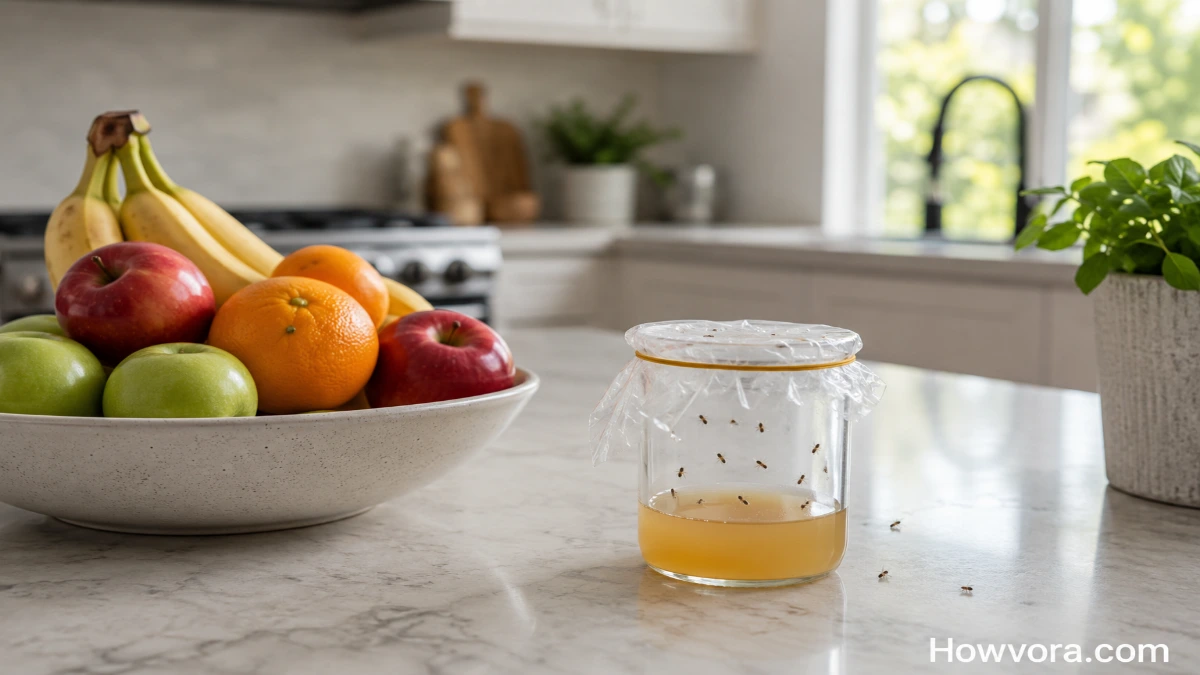
Fruit flies multiply fast because they breed in anything sweet, fermenting, or moist, not just fruit bowls. A female can lay up to 500 eggs, and those eggs become adults in about a week, which is why a “small” problem can look like an infestation within days.
This guide is for anyone dealing with fruit flies in their kitchen right now, whether it’s a handful of flies near the trash can or a full swarm around the sink. The goal isn’t just to kill the flies you see; it’s to find and remove every breeding site so new ones stop appearing. Follow the steps in order, and you should see a fly-free kitchen within one to two weeks.
Featured Snippet
To get rid of fruit flies, remove all ripe or rotting produce, empty the trash and recycling, and clean drains where residue collects. Set out an apple cider vinegar trap covered with plastic wrap poked with small holes. Repeat trapping and cleaning daily until no new flies appear, usually 7–10 days.
Before You Begin
Difficulty: Easy, but it requires daily follow-through for a week or more. Time: 30–45 minutes for the initial deep clean; 5 minutes a day afterward. Cost: $0–$15 (most households already have vinegar, dish soap, and plastic wrap). DIY vs. Pro: This is a DIY task in nearly all cases. Professional pest control is rarely needed for fruit flies (see “When to Call a Professional” below). Prerequisites: Access to your kitchen drains, trash, recycling, and any produce storage areas. No special tools required.
The most common reason fruit fly treatments fail isn’t a bad trap; it’s an undiscovered breeding site. Traps only catch adult flies; they don’t stop new ones from hatching. That’s why this guide treats trapping and source removal as equally important, not one or the other.
Choosing the Right Approach
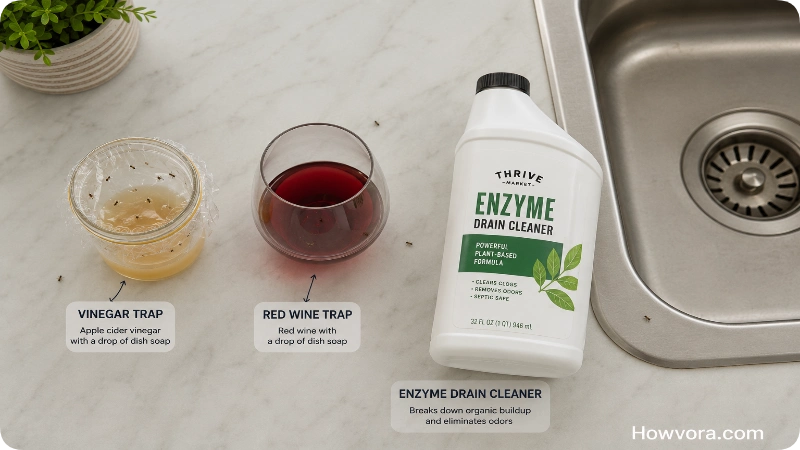
There are two effective home remedy traps, plus drain treatment for source elimination. None of these requires pesticides.
| Method | Best For | Effort | Effectiveness |
| Apple cider vinegar + dish soap trap | General infestations, kitchen counters | Low | High, most reliable DIY trap |
| Red wine or beer trap | Homes without apple cider vinegar on hand | Low | Moderate attracts fewer flies than vinegar |
| Drain gel/enzyme cleaner | Flies breed in sink or garbage disposal drains | Low | High for drain-based infestations specifically |
| Store-bought sticky traps | Passive, long-term monitoring | Very low | Moderate good for prevention, weak on active infestations |
Most kitchens need a combination: a vinegar trap to catch existing adults, plus a drain treatment if flies are hovering around the sink specifically. Skipping the drain check is the single most common reason people say “I tried the vinegar trick and it didn’t work.”
At a Glance
| Category | Details |
| Difficulty | Easy |
| Time to resolve | 7–10 days |
| Cost | $0–$15 |
| Skill level | Beginner |
| Best for | Kitchens, pantries, compost areas, bar carts |
Things You’ll Need
| Item | Purpose |
| Apple cider vinegar | Bait that attracts fruit flies into the trap |
| Dish soap | Breaks the surface tension so flies sink instead of escaping |
| Small jar or bowl | Trap container |
| Plastic wrap and toothpick, or paper funnel | Creates a one-way entrance into the trap |
| Trash bags | Removing rotting produce and breeding material immediately |
| Drain brush or bottle brush | Physically scrubbing gunk from drain walls |
| Enzyme-based drain cleaner | Breaking down organic buildup where larvae live |
| Disinfecting spray or diluted bleach solution | Wiping down counters, drains, and trash can interiors |
Step-by-Step Guide
1. Find and remove every breeding site
Check fruit bowls, under-sink cabinets, the trash can, recycling bins (especially ones with juice, beer, or soda residue), compost bins, and any produce that’s overripe. Throw out anything visibly rotting; don’t just move it, since eggs and larvae can already be inside. Common mistake: people remove the fruit but leave the empty container unwashed, so residue keeps attracting flies.
2. Check your drains
Fruit flies breed in the slimy organic film that builds up inside sink and garbage disposal drains, not just in food. Shine a flashlight down the drain at night. If you see flies resting there, that’s your source. Scrub the drain walls with a bottle brush, then treat with an enzyme-based drain cleaner and let it sit overnight per the label instructions. Repeat every few days until no flies appear in the drain.
3. Deep clean surfaces
Wipe down counters, the inside of the trash can, and any sticky spots on the floor or under appliances with a disinfecting spray or diluted bleach solution. Fruit flies can feed on microscopic residue you can’t easily see.
4. Build an apple cider vinegar trap
Pour about half an inch of apple cider vinegar into a small jar or bowl. Add a few drops of dish soap and stir gently; don’t create foam. Cover the top with plastic wrap, secure it with a rubber band, and poke 5–6 small holes with a toothpick. Flies enter through the holes, chasing the scent, but can’t easily fly back out, and the dish soap breaks the surface tension so they sink.
5. Place traps strategically
Set traps near the fruit bowl, sink, and trash can, anywhere you’ve seen flies congregate. Use two or three traps at once in a moderate infestation rather than relying on one.
6. Empty and refresh traps daily
Dump caught flies down the drain or in the trash, rinse the container, and remake the trap with fresh vinegar each day. A trap that’s been sitting for several days becomes less effective as the scent balances out with the room.
7. Repeat cleaning and trapping until the population drops to zero
Most infestations clear within 7–10 days if you’re consistent. If you’re still seeing new adult flies after 10–14 days of daily trapping and cleaning, there’s likely an undiscovered breeding site; go back to Step 1 and check less obvious spots like inside a garbage disposal, a recycling bin liner, or a forgotten potato or onion in a pantry.
How to Know You Did It Correctly
You’re done when you go a full 2–3 days without catching a single new fly in your traps, and you don’t see any flies resting on drains, walls, or counters. If you catch zero flies for three consecutive days, remove the traps. Leaving old vinegar out longer than necessary can attract new flies once the food source is gone.
Expected Timeline and Results
- Days 1–2: Visible drop in adult flies as traps catch the existing population.
- Days 3–5: New flies should be noticeably fewer if breeding sites were fully removed. If numbers stay flat, recheck drains and hidden produce.
- Days 7–10: Most households are fly-free. Any flies at this point are usually from a missed source rather than a failed trap.
- Beyond 10–14 days: Persistent flies point to an ongoing breeding site, most often a drain, a disposal, or a piece of produce tucked away out of sight.
Common Mistakes to Avoid
- Treating symptoms, not the source. Trapping adults without removing rotting food or cleaning drains just delays the problem.
- Letting a trap sit too long. A vinegar trap loses effectiveness after 2–3 days and should be refreshed, not left indefinitely.
- Making the holes too large. If the holes in the plastic wrap are too big, flies fly in and back out just as easily.
- Ignoring the garbage disposal. People often clean the visible sink but skip the disposal itself, which can be a major breeding site.
- Bringing in produce that already has eggs. Fruit purchased at peak ripeness, especially bananas and tomatoes, can carry eggs from the store or delivery truck. Rinsing produce when you bring it home reduces this risk.
Troubleshooting & Common Problems
| Problem | Cause | Solution |
| Traps catch flies, but the population isn’t shrinking | An active breeding site is still supplying new flies | Recheck drains, disposal, and any stored produce; remove and clean thoroughly |
| Flies keep appearing near the sink, specifically | Organic buildup inside the drain or disposal | Scrub with a bottle brush and treat with an enzyme cleaner; repeat every 2–3 days |
| Trap isn’t catching any flies | Holes too large, vinegar too old, or trap placed too far from the source | Remake the trap with smaller holes and fresh vinegar; move it closer to where flies are seen |
| Flies return a few weeks after clearing up | New produce or trash buildup restarted the cycle | Keep produce refrigerated or in sealed containers, and take out trash more frequently |
| Small flies persist even after fixing fruit flies | Could be drain flies or fungus gnats, which look similar but have different causes | Compare wing shape and behavior (see FAQs) to confirm the species before continuing treatment. |
Expert Tips
- Refrigerate ripe produce like berries, peaches, and tomatoes once they’ve reached peak ripeness; cold temperatures slow both ripening and fly activity, even though it changes texture slightly.
- Rinse recycling containers (cans, bottles) before putting them in the bin. Sugary residue is one of the most overlooked attractants.
- If you have a compost bin in the kitchen, keep it sealed with a tight lid and empty it every 2–3 days rather than letting it accumulate.
- A second, smaller trap placed directly on top of the garbage disposal opening overnight can confirm whether the disposal is a breeding site.
When to Call a Professional
Fruit flies rarely require professional pest control. Consider calling an exterminator only if flies persist for more than 3 – 4 weeks despite thorough cleaning and consistent trapping, or if the population is large enough that you suspect a hidden breeding site you can’t access, such as inside wall cavities or under large appliances. A pest professional can also help confirm whether you’re actually dealing with drain flies or fungus gnats, which need different treatment approaches.
What to Do Next
Once your kitchen is clear, prevent a repeat infestation by storing ripe produce in the refrigerator, taking out the trash and recycling every 1–2 days, and giving your drains a monthly scrub with an enzyme cleaner even when you don’t have an active problem. A few minutes of prevention each week is far less work than another full week of trapping.
FAQs
How long does it take to get rid of fruit flies?
Most infestations clear within 7–10 days of consistent trapping and cleaning. Persistent problems usually mean a breeding site was missed.
What attracts fruit flies in the first place?
Anything sweet, fermenting, or decaying: overripe fruit, empty soda cans, wine bottles, drains with organic buildup, and compost.
Does apple cider vinegar really work better than other liquids?
Yes, generally. Its fermented scent closely mimics the rotting fruit that fruit flies are drawn to, which is why it consistently outperforms plain vinegar or sugar water in traps.
Can I use a paper towel instead of plastic wrap for the trap?
A paper funnel works as well as plastic wrap and can sometimes be easier to shape with small enough holes.
Are fruit flies harmful to health?
They aren’t known to bite or sting, but they can carry bacteria on their legs from surfaces they land on, so keeping food covered while dealing with an infestation is a good precaution.
How can I tell fruit flies apart from drain flies or fungus gnats?
Fruit flies are tan or brown with red eyes and fly quickly in short bursts. Drain flies are fuzzy, moth-shaped, and cling to walls near drains. Fungus gnats are darker, slower, and usually linked to overwatered houseplants rather than kitchen produce.
Will bleach in the drain get rid of fruit fly larvae?
Bleach can kill flies on contact but doesn’t dissolve the organic film larvae feed on as effectively as an enzyme-based cleaner, so it’s better used for surface disinfecting than as a primary drain treatment.
Why do fruit flies keep coming back even after I clean?
This almost always means a breeding site wasn’t fully addressed, most often a drain, a disposal, or a piece of produce stored out of sight.
Final Thoughts
Fruit flies are persistent because they need so little to breed: a few drops of juice or a forgotten piece of fruit is enough. The fix isn’t complicated, but it does require treating the problem from both directions at once: trapping the adults you can see and removing the breeding sites you often can’t. Stay consistent for a week to ten days, and the vast majority of kitchens clear up completely without any need for pesticides or professional help.







1 thought on “How to Get Rid of Fruit Flies in Kitchens: A Permanent Fix”