
The sound of thousands of cicadas can reach 90 decibels louder than a lawnmower, making it nearly impossible to enjoy your yard or hear yourself think. Beyond the noise, cicadas can weaken trees by laying eggs in branches, causing damage that affects your landscape’s health for years.
The challenge with cicadas is that you can’t truly “eliminate” them; they’re a temporary phenomenon tied to their lifecycle. What you can do is protect your property, minimize damage, reduce the noise they produce, and prepare for their eventual departure.
This guide shows you practical strategies to protect trees, manage cicada presence during their active season, and make your home more tolerable during peak emergence periods.
Featured Snippet
You cannot eliminate cicadas during emergence, but you can minimize their impact by wrapping vulnerable trees with protective netting, applying targeted insecticides to tree trunks, and using noise barriers. For long-term protection, prune weak branches before cicada season, maintain tree health, and accept temporary disruption knowing cicadas will naturally leave within 4-6 weeks of peak emergence.
Before You Begin
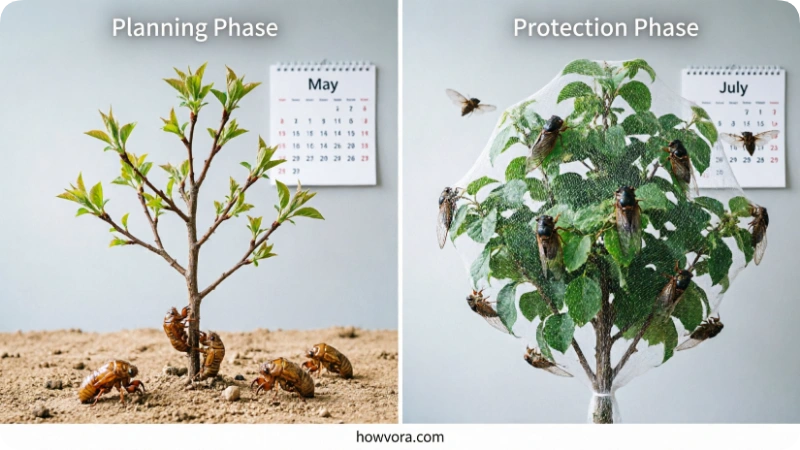
Difficulty Level: Beginner to Intermediate (depends on tree size and property extent)
Time Required: 2-4 hours for initial tree protection setup; ongoing monitoring takes 15-20 minutes daily during peak season
Estimated Cost: $30–$200 (DIY protection) vs. $300–$1,000+ (professional tree treatment and management)
DIY vs. Professional: Most cicada management is DIY-friendly, wrapping trees and basic deterrence are straightforward. Call a professional arborist if you have large, valuable trees or if cicada damage from previous years requires assessment and repair.
Prerequisites: Identify which cicada type you’re dealing with (annual vs. periodical; 13-year vs. 17-year cycle if periodical), determine your tree types and their value/vulnerability, understand that cicada control is management, not elimination, and accept that the process is temporary (4-6 weeks during peak season).
Understanding Cicadas vs. Other Insects
Before attempting management, confirm you’re actually dealing with cicadas and not similar-sounding insects. Cicadas emerge in specific seasons and patterns; other insects cause year-round noise.
Identifying Cicada Activity: The distinctive buzzing/droning sound is unmistakable. Cicadas are typically 1-2 inches long, have large eyes, and leave shell casings on tree bark and ground after emergence. They appear predictably in summer (annual cicadas: May–August; periodical cicadas: specific years on 13 or 17-year cycles). If you’re uncertain about timing, check your state’s cicada emergence forecasts or university extension office records.
Choosing the Right Approach

Cicada management depends on your goals: protecting trees, reducing noise, or both. Here’s how the main strategies compare:
| Method | Pros | Cons | Best For |
| Tree Netting | Physically blocks cicadas from laying eggs, protects the most vulnerable trees; reusable. | Labor-intensive to install; requires removal before cold weather; covers only the netting area | Valuable or weak trees; complete egg-laying prevention |
| Systemic Insecticide | Absorbed by the tree, protects the entire tree; lasts weeks; single application | Affects non-target insects (bees if flowers bloom); cost; requires professional application for large trees; may not stop all damage.e | Large infestations; valuable trees; when netting is impractical |
| Noise Barriers | Reduces ambient noise; improves quality of life during peak season; low cost | Doesn’t protect trees; only reduces noise for the immediate area; requires consistent placement | Patios, decks, seating areas; homes in heavily infested zones |
| Pruning Weak Branches | Removes preferred egg-laying sites; improves tree health; prevents damage before it happens | Only prevents future cicada damage, not current-season damage; requires yearly maintenance | Long-term prevention; valuable trees; preparing for next emergence |
| Professional Arborist Treatment | Comprehensive approach; expert assessment; handles large/valuable trees safely | High cost; less control over methods; scheduling required | Mature/valuable trees; extensive damage history; structural concerns |
| Acceptance + Temporary Tolerance | No cost; no environmental impact; acknowledges cicadas are temporary (4-6 weeks) | Requires tolerating noise and accepting minor tree damage; no tree protection | Limited infestation; damage-tolerant properties; budget-conscious homeowners |
Why Tree Netting Is Recommended (For Valuable Trees): Netting physically prevents cicadas from reaching branches and laying eggs, eliminating the primary risk of damage. It’s labor-intensive but affordable, effective, and allows you to protect specific high-value trees while letting cicadas naturally cycle through other areas.
At a Glance
| Aspect | Details |
| Difficulty | Beginner–Intermediate |
| Time to Start | 1–3 hours (tree wrapping) or 30 minutes (noise barriers) |
| Duration of Cicada Season | 4–6 weeks peak emergence |
| Estimated Cost | $30–$200 (DIY) or $300–$1,000+ (professional) |
| Safety Gear Needed | Work gloves, ladder safety equipment |
| Permanent Solution? | No cicadas return seasonally; management is temporary. |
Things You’ll Need
| Item | Purpose | Notes |
| Bird Netting (Fine Mesh, 1/4 inch) | Wrapping around the tree canopy to block cicada access | Reusable; comes in rolls; must be removed in the fall |
| Rope or Ties | Securing netting to the tree trunk and branches | Soft rope prevents branch damage |
| Ladder (6–12 feet) | Accessing the upper tree canopy | Essential for netting installation; safety critical |
| Work Gloves | Hand protection while handling netting and branches | Heavy-duty gloves work better than light ones |
| Systemic Insecticide (Optional) | Tree soil injection or drench treatment | Products containing imidacloprid, applied pre-season |
| Shade Cloth or Tarps (Optional) | Creating noise barriers around seating areas | 50-70% shade cloth reduces noise perception |
| Pruning Saw or Shears | Removing dead or weak branches before the season | Prepares the tree for cicada season |
| Drop Cloth (Optional) | Catching shell casings and debris during netting | Makes cleanup easier |
| Earplugs or Noise Dampening (Optional) | Personal noise reduction during peak season | An inexpensive way to improve comfort |
Safety Precautions
Real Hazards and When Extra Caution Matters:
Ladder Safety: Tree netting installation requires climbing ladders, especially for tall trees. Ensure ladders are on stable, level ground. Use a three-point contact (two hands and one foot, or two feet and one hand on the ladder at all times). Never overreach; move the ladder instead. For trees over 15 feet tall, consider professional installation.
Netting Entanglement: Fine mesh can catch on clothing, hair, or skin if not handled carefully. Wear fitted clothing and tie back long hair. Work with a partner to hold the netting steady and prevent accidental entanglement.
Branch Stress: Wrapping heavy netting on weak branches can break them under the weight of accumulated rain or debris. Use rope support systems to distribute weight and relieve stress on branches. Thinner branches may not support netting; prioritize thicker, stronger branches.
Systemic Insecticide Safety: If using insecticides, follow product labels completely. Wear gloves and avoid skin contact. Keep products away from children and pets. Don’t apply near water sources or flowering plants if pollinators (bees) are active. Some insecticides can harm non-target insects, including beneficial species.
Tree Damage Risk: Improper netting or rough handling can girdle branches (cutting off nutrient flow) or create entry points for disease. Use soft ropes and inspect regularly to ensure netting isn’t cutting into bark.
Step-by-Step Guide
Step 1: Assess Your Trees and Identify Priorities
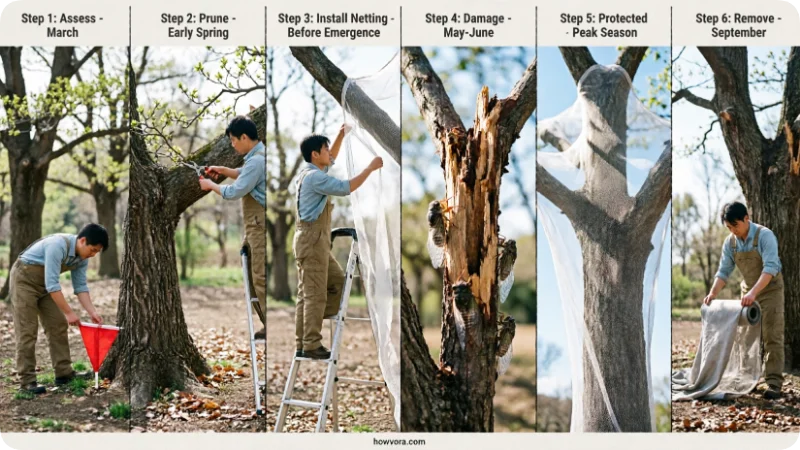
What to Do: Walk your property and identify which trees are most valuable, vulnerable, or problematic. Look for trees that have shown previous cicada damage (branch tips cut cleanly off, areas where egg-laying is visible). Note young trees, recently planted trees, and specimen trees you want to protect. Mark these priority trees for protection.
Why It Matters: Not all trees need protection. Young trees and weak varieties sustain more damage and are worth protecting. Mature, healthy hardwoods tolerate cicada damage better. Focusing protection effort on high-priority trees maximizes impact while reducing labor.
What Success Looks Like: You’ve identified 3-5 priority trees that are either young, weak, or valuable. You understand which trees can tolerate cicada damage and which cannot.
Common Beginner Mistakes:
- Trying to protect every tree on the property (impossible and unnecessary).
- Protecting large shade trees while ignoring young ornamental trees that are most vulnerable.
- Not considering tree health or age when deciding what to protect (healthy mature trees need less protection).
- Forgetting that cicadas prefer certain tree types (hickory, ash, dogwood) and avoiding other species entirely.
Step 2: Prune Weak Branches Before Season Peaks
What to Do: Before or during early cicada season, prune dead, diseased, weak, or crossing branches from priority trees. Remove branches thinner than a pencil (cicadas prefer thin branches for egg-laying). Make cuts at branch collars (the swollen area where the branch meets the trunk) using sharp pruning tools. Dispose of pruned material away from the house.
Why It Matters: Cicadas lay eggs in thin branches; weak branches are preferred sites. Removing these branches eliminates the most attractive egg-laying habitat and reduces damage potential significantly. Pruning also improves overall tree health.
What Success Looks Like: Dead branches are removed. The tree canopy is slightly opened up. Thin, weak branches that would have been targeted by cicadas are gone. The tree looks healthier and is less attractive to egg-laying cicadas.
Common Beginner Mistakes:
- Over-pruning stresses the tree and creates more vulnerability to other problems.
- Pruning major structural branches (not just weak growth).
- Waiting to prune until mid-season, when cicadas are actively laying eggs (pruning wounds attracts more cicadas).
- Not making proper cuts at branch collars, leaving branch stubs that don’t heal properly.
Step 3: Install Tree Netting on Priority Trees
What to Do: Using a ladder, wrap fine-mesh netting (1/4 inch openings) around the canopy of priority trees. Start at the bottom of the canopy and work upward, securing netting loosely with soft rope or ties at multiple points. Leave the trunk exposed, but ensure netting covers all branches. The goal is to create a barrier that cicadas cannot penetrate.
Why It Matters: Physical netting prevents cicadas from accessing branches and laying eggs. A well-installed net protects the entire canopy from damage.
What Success Looks Like: Netting covers the tree canopy completely. No gaps exist where cicadas could access branches. The netting is loosely applied (not suffocating the tree) and won’t cut into branches.
Common Beginner Mistakes:
- Installing netting too tightly, which can girdle branches and damage the tree.
- Leaving gaps where cicadas can squeeze through.
- Waiting until cicadas are already laying eggs (too late; they’ve already accessed branches).
- Not securing netting properly, allowing wind to dislodge it mid-season.
- Forgetting to remove netting in the fall (it can girdle branches as the tree grows).
Step 4: Apply Systemic Insecticide (If Needed)
What to Do: For large trees where netting is impractical, or as a supplemental method, apply systemic insecticide to the soil around the tree or directly to the trunk per product instructions. Products containing imidacloprid are most effective. Apply in early season (May, before peak cicada emergence). Water in thoroughly and allow the tree to absorb the product for 1-2 weeks before peak cicada activity.
Why It Matters: Systemic insecticide is absorbed by the tree’s vascular system. Cicadas feeding on treated tree tissues are poisoned. This protects the entire tree without physical netting.
What Success Looks Like: Insecticide is applied according to label instructions. The tree is watered thoroughly. No new egg-laying occurs on the treated tree (or is significantly reduced).
Common Beginner Mistakes:
- Applying insecticide too late (after peak emergence, when cicadas have already laid eggs).
- Underdosing or applying incorrectly reduces effectiveness.
- Applying to trees with flowering nearby (can harm pollinators).
- Not reading the label thoroughly (different products have different application methods).
Step 5: Monitor and Maintain Protection Throughout Season
What to Do: Check installed netting daily for tears, gaps, or wind damage. Repair any openings immediately by patching with additional netting or rope. Monitor the tree for cicada activity. You should see few or no cicadas on netting-covered trees. If cicadas are accessing protected trees, repair netting or consider supplemental insecticide.
Why It Matters: Netting protection is only effective if maintained. A small tear can allow cicadas to access branches. Consistent monitoring ensures the protection works as intended.
What Success Looks Like: Netting remains intact throughout the season. Minimal cicada damage is visible on protected trees. Compared to unprotected trees, protected trees show less egg-laying damage dramatically.
Common Beginner Mistakes:
- Installing netting, then ignoring it, not checking for damage or wind displacement.
- Assuming netting protects automatically without maintenance.
- Leaving netting on too long into fall/winter (girdles branches as the tree grows).
Step 6: Remove Netting After Peak Season Ends
What to Do: Once cicadas have naturally declined (4-6 weeks after peak emergence), carefully remove all netting from trees. Store netting for reuse next season. Inspect branches for any damage from the netting itself. Remove any dead branches or areas showing disease from the netting contact.
Why It Matters: Leaving netting on for too long girdles branches and prevents the tree from growing naturally. Removing it allows the tree to recover and prepares it for dormancy.
What Success Looks Like: Netting is removed before fall growth resumes. Branches are exposed to air and light again. The tree shows no signs of girdling or stress from extended netting use.
Common Beginner Mistakes:
- Leaving netting on into fall and winter, permanently damaging branches.
- Roughly removing netting and tearing branches.
- Not inspecting branches for girdling or damage when removing netting.
How to Know You Did It Correctly
Success Signs:
- Protected trees show minimal cicada egg-laying damage (no cut branch tips).
- Unprotected trees in the same yard show obvious damage (cut branch ends, slit bark) in comparison.
- No cicadas are visible on netting-covered trees; few or none on treated areas.
- Tree health improves after the season (new growth, no stress symptoms).
Verification Methods:
Compare protected and unprotected trees side-by-side. Protected trees should show 80-90% less damage. Count visible cicadas on protected vs. unprotected trees—protected trees should have significantly fewer. After the season ends, inspect branches for egg-laying damage (small slits in the bark along thin branches).
Expected Results:
Well-protected trees (via netting or insecticide) sustain minimal damage. Trees left unprotected lose some branches to cicada egg-laying but usually recover within a season. The majority of tree damage from cicadas is cosmetic, not structural, so even unprotected trees typically survive in good health.
Expected Timeline and Results
When Cicadas Appear:
- Early May (Annual Cicadas): First emergence in southern regions.
- Late May–Early June (Annual Cicadas): Peak emergence expands northward.
- June–July (Annual Cicadas & Periodical): Peak activity; maximum noise and egg-laying.
- August–September: Activity declines; cicadas naturally exit.
Periodical Cicadas (13 or 17-year cycles): Timing is predictable based on historical records. Check your state’s extension office or USDA for forecast maps showing emergence years and locations.
Normal Progress During Season:
- Weeks 1–2: Cicadas appear and begin mating; buzzing intensifies.
- Weeks 2–4: Peak egg-laying; visible damage on unprotected trees increases.
- Weeks 4–6: Activity begins to decline; new generations emerge from the soil.
- Week 6+: Cicadas naturally exit; season ends.
When Protection Shows Results:
Compare tree damage to the same species in unprotected areas. By mid-season (week 4), protected trees should show minimal damage compared to unprotected trees nearby.
When to Reassess:
If protected trees show unexpected damage by week 4, inspect netting for tears or gaps. If systemic insecticide shows no effect by week 3, the product may not have been absorbed properly, or timing was off.
Alternative Methods
Noise Barriers and Acoustic Management
How It Works: Temporary barriers (shade cloth, tarps, or sound-dampening panels) reduce ambient noise perception in specific areas like patios or decks without affecting cicadas themselves.
Advantages:
- Improves personal comfort without tree impacts.
- Low cost; temporary and reusable.
- No chemicals or environmental concerns.
- Effective for specific outdoor spaces.
Disadvantages:
- Doesn’t protect trees from damage.
- Only reduces noise in the immediate area.
- Requires consistent placement and maintenance.
- Visual impact (may look unattractive during the season).
Best Use Case: When tree damage isn’t a concern, homeowners focus on reducing noise in specific outdoor spaces; renter situations where tree protection isn’t your responsibility.
Pesticide Spray Applications
How It Works: Contact insecticide sprays (pyrethrin, permethrin, or neem oil) applied directly to tree foliage kill cicadas on contact.
Advantages:
- Quick results: cicadas die within hours.
- Inexpensive.
- Applied as needed during peak season.
Disadvantages:
- Doesn’t prevent egg-laying (cicadas lay eggs quickly).
- Must be reapplied frequently (every 7-10 days).
- Kills non-target insects, including beneficial species.
- Less effective on large trees where spray coverage is incomplete.
- Environmentally questionable with repeated applications.
Best Use Case: Supplemental method on small trees; when cicadas are actively present and causing disturbance (not primarily for tree protection).
Trapping and Manual Removal
How It Works: Sticky traps or bagging branches with fine mesh capture cicadas for manual removal and disposal.
Advantages:
- No chemicals; physical method.
- Provides immediate gratification (removing visible cicadas).
- Safe for all non-target organisms.
Disadvantages:
- Extremely labor-intensive for large populations.
- Doesn’t prevent egg-laying.
- Doesn’t protect trees long-term.
- Impractical for heavy infestations.
Best Use Case: Light infestations; small properties; manual removal enthusiasts; supplemental method alongside other strategies.
Common Mistakes to Avoid
Mistake 1: Trying to Eliminate Cicadas Entirely
What It Is: Assuming you can completely get rid of cicadas through pest control methods.
Why It Happens: People underestimate cicada populations (thousands of billions emerge) and overestimate control method effectiveness.
Consequences: Wasted time and money on ineffective strategies; frustration when cicadas persist despite efforts.
How to Prevent: Accept that cicada management is about minimizing impact, not elimination. Focus on protecting high-value trees and accepting temporary disruption.
Mistake 2: Applying Netting Too Late
What It Is: Waiting until cicadas are actively laying eggs before installing netting.
Why It Happens: Underestimating how quickly cicadas infest trees; procrastination.
Consequences: Cicadas have already laid eggs in most of the canopy; netting provides minimal protection.
How to Prevent: Install netting in May, before peak emergence. Plan, don’t wait until cicada activity peaks.
Mistake 3: Leaving Netting on Too Long
What It Is: Keeping netting on trees into fall and winter.
Why It Happens: Forgetfulness; not realizing netting damages trees if left on too long.
Consequences: Netting girdles branches, cutting off nutrient flow, and killing them. The tree can be permanently scarred.
How to Prevent: Set a reminder to remove netting by early September. Remove netting as soon as cicada activity declines (4-6 weeks after peak).
Mistake 4: Installing Netting Too Tightly
What It Is: Wrapping netting so tightly that it cuts into branches or restricts air flow.
Why It Happens: Wanting to ensure no cicadas get through, not understanding that loose netting is just as effective.
Consequences: Branches suffocate or girdle under the weight of tight netting and accumulated rain. The tree suffers permanent damage.
How to Prevent: Install netting loosely. It should cover branches but allow air circulation. Distribute weight with rope supports, not by tightening netting.
Mistake 5: Over-Relying on a Single Protection Method
What It Is: Using only netting (and never removing it properly) or only insecticide (and not pruning weak branches).
Why It Happens: Simplicity; wanting one solution to solve everything.
Consequences: Protection is incomplete and possibly ineffective. Combined methods (pruning + netting or pruning + insecticide) work far better.
How to Prevent: Use multiple complementary strategies: prune weak branches, apply netting to high-priority trees, and consider insecticide for large or valuable trees.
Why Many Attempts Fail
Reason 1: Unrealistic Expectations
Many people expect complete elimination. Cicadas cannot be eliminated; they can only be managed. Setting realistic expectations (protecting specific trees, accepting noise, managing damage) leads to success.
Solution: Frame your goal as “minimizing damage to priority trees,” not “eliminating all cicadas.” This shifts the perspective from failure to success.
Reason 2: Poor Timing
Installing protection after cicadas have already arrived or leaving protection on too long damages trees. Timing is critical for both installation and removal.
Solution: Plan protection in April (before May emergence). Mark removal dates in August before fall growth.
Reason 3: Incomplete Netting Installation
Gaps in netting render it ineffective. Cicadas find the smallest openings and access branches.
Solution: Double-check netting coverage. Walk around the tree and visually confirm no gaps. Repair any tears immediately.
Reason 4: Focusing on Wrong Trees
Protecting mature, healthy hardwoods while ignoring young ornamental trees wastes effort.
Solution: Prioritize young, weak, or valuable trees. Accept that robust, mature trees tolerate damage well.
Reason 5: Ignoring Prevention (Pruning)
Pruning weak branches ahead of season prevents the most attractive egg-laying sites.
Solution: Make pruning part of your pre-season plan every year. Remove thin branches and deadwood before cicadas emerge.
Troubleshooting & Common Problems
| Problem | Cause | Solution |
| Significant tree damage despite netting | Netting has tears/gaps; cicadas entered through openings | Inspect netting daily; patch all tears immediately; consider supplemental insecticide |
| Branches killed under netting | Netting too tight; girdling branches; left on too long | Remove netting immediately; remove dead branches after the season; install more loosely next year |
| Cicadas still visible on the protected tree | Netting installed after egg-laying began; cicadas already inside | Accept existing damage; continue protection to prevent further access; supplement with insecticide |
| Insecticide didn’t prevent egg-laying | Applied too late; incorrect dosage; product ineffective on the species | Reapply insecticide if the season allows; supplement with netting next year; consider a professional arborist assessment |
| Netting blew off during the wind/rain | Netting not secured properly; insufficient rope ties | Reinstall with additional tie points; use a stronger rope; consider removing temporarily during high wind forecasts |
| Small trees can’t tolerate the netting weight | Netting too heavy; support ropes inadequate | Use lighter-weight netting for small trees; add additional support branches; consider insecticide instead |
| Protective measures harmed non-target plants nearby | Insecticide drift; netting blocked sunlight on adjacent plants | Use barriers when spraying; position netting to minimize shade on neighbors; consider the location of protection |
Expert Tips
Tip 1: Prune Weak Branches Year-Round
Don’t wait for cicada season to prune. Remove weak growth throughout the year. This builds a tree structure that naturally resists cicada damage and improves overall health for all stressors.
Tip 2: Know Your Cicada Type
Annual cicadas return every year. Periodical cicadas emerge on 13 or 17-year cycles. Knowing which you have determines if this is a recurring annual problem or a temporary 4-6 week emergence. Check historical records or your state’s extension office.
Tip 3: Protect Young Trees Aggressively
Young and newly planted trees are most vulnerable. During their first 3-5 years, aggressive protection (netting + insecticide) prevents damage that can permanently weaken the structure. Once mature, they tolerate cicada damage better.
Tip 4: Use Insecticide as Supplement, Not Replacement
Insecticide works best when combined with netting or pruning. Using insecticide alone requires perfect timing and multiple applications. Combine methods for better results.
Tip 5: Check Netting During Rain
Heavy rain can collect in netting and create weight stress on branches. After heavy rain, check netting and adjust ties to distribute weight. Drain accumulated water by gently lifting the netting.
Tip 6: Plan Protection in April
Successful protection requires planning. Order netting in April, prune in April, and apply insecticide in early May. Waiting until cicadas arrive is too late for most methods.
When to Call a Professional
Call a Professional If:
- Trees are very large (40+ feet), and climbing is dangerous. Professional arborists have equipment and training for safe high-work.
- Tree damage from previous years is severe, and you need an expert assessment of long-term viability. Professionals can diagnose whether the tree can recover.
- You have valuable specimen trees (rare species, estate trees, heritage trees) worth expensive protection. Professionals can devise custom protection strategies.
- You’re uncertain about tree species or vulnerability. An arborist can assess which trees need protection and recommend strategies.
- Previous DIY protection failed. Professional treatment may use stronger insecticides or better techniques.
Cost Expectation: Professional cicada protection (netting installation, insecticide treatment) typically costs $300–$1,000+, depending on tree size and method, with possible follow-up visits at $75–$250 each.
What to Do Next
Immediate Follow-Up (Before Next Emergence):
Record which trees were most damaged this season. Note which protection methods worked best. Take photos of the damage for reference. Order netting and supplies for next year while they’re fresh in your mind.
Short-Term (After Season Ends):
Remove all netting from trees by early September. Prune any dead branches or areas damaged by netting. Dispose of pruned material. Clean up shell casings and debris under trees.
Long-Term Prevention (Year-Round):
- Maintain Tree Health: Healthy trees tolerate cicada damage better. Water during drought, mulch appropriately, and avoid unnecessary stress.
- Prune Regularly: Remove weak, dead, and thin branches year-round. This builds a structure that resists cicada damage.
- Plan Ahead: In April of next year, order supplies, assess priorities, and schedule protection installation.
- Monitor Tree Condition: Watch for signs of stress or disease. Cicada damage is usually superficial, but combined with other stressors, it can weaken trees.
- Know Your Timeline: Learn your region’s cicada schedule. Annual cicadas return yearly; periodical cicadas follow predictable cycles. Knowing when they’ll emerge lets you plan accordingly.
Signs You Need Professional Help:
Large-scale tree damage affecting multiple valuable trees, structural damage (major branches broken), disease or pest issues compounded by cicada damage, or uncertainty about tree health after a heavy infestation.
FAQs
Q1: Can I completely get rid of cicadas?
No. Cicadas cannot be eliminated; they’re a temporary seasonal phenomenon managed through protection and acceptance. The best approach is to minimize damage to priority trees while accepting that cicadas will naturally pass through after 4-6 weeks.
Q2: Do cicadas bite or sting humans?
No. Cicadas do not bite or sting. They have no interest in humans. Their only goal is to lay eggs in tree branches and complete their lifecycle. They’re a noise and tree damage issue, not a human threat.
Q3: Are periodical cicadas worse than annual cicadas?
Periodical cicadas emerge in enormous numbers (millions per acre) and cause visible tree damage more severe than that of annual cicadas. The sheer volume makes them more dramatic, but individual trees usually recover. The 13 or 17-year gap between emergences makes preparation possible.
Q4: How long do cicadas stay?
Peak emergence lasts 4-6 weeks. Cicadas naturally emerge as the soil cools and conditions become unfavorable. You don’t need to kill them; they’ll leave on their own. Early arrivals may appear in late May; stragglers may linger into September, but peak activity is 4-6 weeks.
Q5: What trees are most damaged by cicadas?
Cicadas prefer thin-barked trees, including ash, hickory, dogwood, fruit trees, and ornamentals. Hardwoods like oak and maple tolerate damage better. Young trees of any species are more vulnerable than mature trees.
Q6: Can I use pesticide spray to protect my whole yard?
Sprays are minimally effective on large areas and require frequent reapplication (every 7-10 days). Spraying entire yards kills non-target insects and is environmentally questionable. Better to focus spray on small, valuable trees or use netting for larger areas.
Q7: Is tree damage from cicadas permanent?
Most cicada damage is superficial (branch tips cut off, bark slits where eggs are laid). Trees recover within 1-2 seasons by growing new branches. However, repeated infestations on weak trees or multiple stressors can weaken or kill the tree.
Q8: Can I save a tree that’s been heavily damaged by cicadas?
Yes. Remove dead branches (pruning encourages new growth), improve tree health through watering and care, and avoid additional stressors. Most trees recover even from heavy cicada damage, though recovery takes 1-2 seasons.
Q9: What’s the best time to protect trees?
Install netting in May before peak emergence. For annual cicadas, this is yearly. For periodical cicadas, preparation happens only during emergence years (on the 13 or 17-year cycle specific to your area).
Q10: Do younger cicada-infested trees need more protection?
Yes. Young trees are more vulnerable than mature trees. They don’t have the structural strength or stored resources to recover quickly from significant egg-laying damage. Protect young trees aggressively; mature trees can often tolerate unprotected exposure.
Final Thoughts
Getting rid of cicadas is impossible, but managing their impact is straightforward. The key is shifting perspective from “elimination” to “damage management.” Accept that cicadas are temporary; they’ll be gone naturally within 4-6 weeks, and focus your effort on protecting the trees you care about most.
A combination of smart pruning (removing weak branches), strategic netting (protecting high-value trees), and possibly systemic insecticide (for large trees) will dramatically reduce tree damage. Young, valuable, or weak trees deserve protection. Mature, healthy hardwoods usually tolerate unprotected exposure without significant long-term harm.
Plan in April, implement protection in May, maintain through the summer, and remove protection by September. This annual rhythm becomes routine and ensures your trees survive cicada season in good health. You’ll have peace of mind knowing you’ve done what you can, and you’ll have the perspective to accept what you can’t control.
