
Moles announce themselves with raised ridges of dirt snaking across your lawn and volcano-shaped mounds popping up overnight. The tunneling isn’t just cosmetic; it tears roots from soil, creates uneven footing, and can kill grass by drying out the root zone underneath.
This guide is for any homeowner who wants those tunnels gone for good, not just temporarily flattened. By the end, you’ll know how to identify active tunnels, choose a method that actually works, set it up correctly, and confirm the moles are gone rather than just relocated a few feet over.
Featured Snippet
The most reliable way to get rid of moles is trapping: locate an active surface tunnel, set a scissor, harpoon, or scissor-jaw trap directly on it, and check every 24 hours. Repellents and grub control rarely work because moles eat earthworms, not grubs, and simply root around scents and vibrations.
Before You Begin
Difficulty: Moderate requires locating active tunnels correctly Time investment: 15–30 minutes to set up; 3–14 days to fully clear a yard Cost: $15–$40 for a trap (DIY) or $150–$400 for professional trapping service DIY vs. Pro: DIY works well for one or two moles on a standard residential lot; call a pro for persistent activity across a large property or if you’re uncomfortable handling a live-caught animal Prerequisites: Access to the affected area, a garden trowel or narrow probe, and at least one dry-ish day to walk the lawn and mark tunnels
Choosing the Right Approach
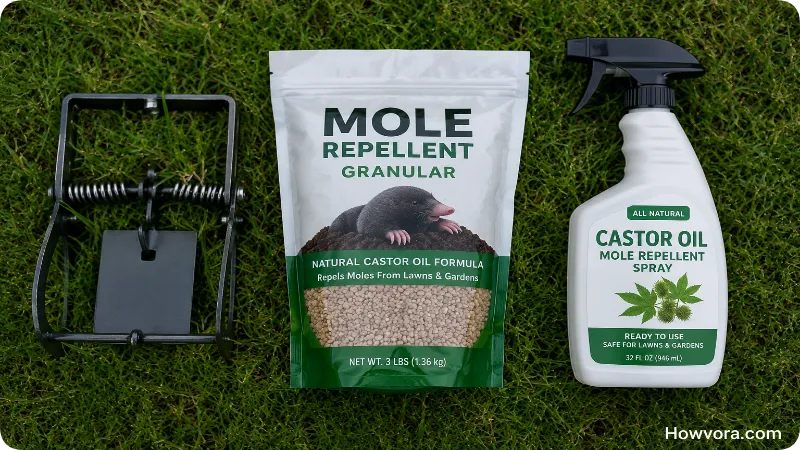
Most articles list five or six “methods” side by side as if they’re equally effective. They aren’t. Here’s how the common options actually compare, based on turf-extension research and pest-control field data.
| Method | Effectiveness | Speed | Cost | Notes |
| Trapping | High removes the mole itself | 1–14 days | Low ($15–$40) | The only method with a consistent, verified track record |
| Poison bait (worm-shaped, bromethalin-based) | Moderate | 3–10 days | Low–Moderate | Works because it mimics an earthworm; less reliable than trapping and riskier around pets |
| Castor-oil repellents | Low, temporary | Days to weeks | Low, recurring | Moles usually just shift tunnels a few feet away, especially in moist soil |
| Ultrasonic stakes | Very low | N/A | Moderate | Moles are nearly blind and navigate by smell/vibration; they habituate quickly |
| Grub control products | Ineffective for moles | N/A | Low | Targets the wrong food source earthworms, not grubs, make up most of a mole’s diet |
| Professional trapping service | High | 1–14 days | Higher ($150–$400) | Best for large properties or repeated failed DIY attempts |
The takeaway most guides skip: grub control is one of the most commonly recommended “fixes” for moles, and it’s largely a myth. Moles primarily eat earthworms, so a grub-free lawn does little to make your yard less attractive to them.
At a Glance
| Difficulty | Time to Results | Cost | Skill Level | Best For |
| Moderate | 3–14 days (trapping) | $15–$40 (DIY) | Beginner–Intermediate | Homeowners with 1–3 active tunnels |
Things You’ll Need
| Item | Purpose |
| Mole trap (scissor, harpoon, or scissor-jaw style) | Physically removes the mole from an active tunnel |
| Garden trowel or narrow probe | Locates and opens tunnels for trap placement |
| Work gloves | Protects hands and reduces human scent transfer to the trap |
| Flags or stakes | Marks tunnel locations you’re monitoring |
| Bucket or tarp | Holds excavated soil while you work |
| Bromethalin worm bait (optional, secondary method) | Alternative if trapping is not viable on your property |
Safety Precautions
- Keep poison bait away from pets and children. Bromethalin-based baits are toxic to dogs and cats if dug up and eaten. If you have pets that dig, trapping is the safer option.
- Wash hands after handling traps or bait. Both can carry soil-borne bacteria.
- Call 811 before digging deeply if you plan to probe tunnels near buried utility lines.
- Dispose of a trapped mole according to local regulations. Some areas have specific wildlife disposal rules; check with your local extension office if unsure.
Step-by-Step Guide
Step 1: Find the Active Tunnels
Ignore the volcano-shaped mounds that cap deep nesting tunnels moles rarely reuse. Instead, look for slightly raised, winding ridges just under the surface; these are shallow feeding tunnels. Flatten a short section with your foot or hand. Check it again in 24 hours.
Why it matters: If the ridge pops back up within a day, that tunnel is active and worth targeting. If it stays flat, the mole isn’t currently using it, and a trap there will just sit empty.
Step 2: Choose Your Trap Type
Scissor-jaw and harpoon traps are the most widely available and easiest to learn. Scissor-jaw traps are generally considered more humane and easier to set without drawing blood, which some homeowners prefer.
Step 3: Set the Trap on an Active Tunnel
Use your trowel to gently open a small section of the confirmed active tunnel, then press the soil beneath it down slightly. This forces the mole to push upward through the trap’s trigger mechanism when it repairs the tunnel. Position the trap directly over the opening, following the manufacturer’s setting instructions exactly.
Common mistake: Setting the trap on a tunnel that “looks” active but hasn’t been confirmed with the flatten-and-recheck test. This is the single biggest reason DIY trapping fails.
Step 4: Check the Trap Every 24 Hours
Moles are solitary and cover ground quickly, so a sprung, empty trap usually means the mole passed through but wasn’t caught, or a different mole is now using the tunnel. Reset it in the same spot for one more day.
Step 5: Relocate If Nothing Happens Within 48–72 Hours
If the trap hasn’t been triggered after two to three days, you’re likely in the wrong tunnel. Move to a different confirmed-active section and repeat Steps 1–4.
Step 6: Repeat Across All Active Tunnels
A single yard often has more than one mole. Continue trapping until you go 5–7 consecutive days with no new tunnel activity anywhere on the property.
How to Know You Did It Correctly
- No new raised ridges or mounds appear for at least a full week
- Previously flattened test sections stay flat
- Grass over old tunnels begins to recover and re-root within 2–3 weeks
- You’ve caught and removed at least one mole per confirmed active tunnel
Expected Timeline and Results
Most single-mole infestations resolve within 3–7 days of correct trap placement. Yards with multiple moles, or heavy clay/moist soil that holds earthworm populations near the surface, can take up to two weeks of active trapping. Full lawn recovery, grass filling back in over collapsed tunnels, typically takes 3–6 weeks after the last mole is removed, depending on grass type and season.
Alternative Methods
Poison bait (bromethalin worm bait): A reasonable second option where trapping isn’t practical,l for example, in a yard with many young children where you’d rather not handle a live-caught animal. It’s less consistently effective than trapping and carries pet-safety risks, so it should be treated as a backup rather than a first choice.
Professional trapping service: Worth the cost if you’ve made two or three genuine trapping attempts on confirmed active tunnels without success, or if the property is large enough that manually mapping tunnels is impractical.
Common Mistakes to Avoid
- Targeting mounds instead of surface-feeding tunnels
- Setting a trap without confirming activity with the flatten test
- Applying grub control, expecting it to solve a mole problem
- Giving up after one failed 24-hour check instead of relocating the trap
- Using poison bait around pets that dig
Troubleshooting & Common Problems
| Problem | Cause | Solution |
| Trap never triggers | Placed on an inactive or wrong tunnel | Relocate to a freshly confirmed active tunnel |
| Trap triggers but no mole | Trap set too loosely or soil not packed properly beneath it | Reset following the manufacturer’s instructions; pack soil firmly under the trigger plate |
| Tunnels reappear a few feet away | Mole was repelled, not removed (common with scent products) | Switch to trapping on the new tunnel location |
| New activity after a mole-free period | A different mole has moved into the vacated territory | Repeat the trapping process; this is normal, especially in spring and fall |
| Bait untouched after several days | Bait placed in an inactive tunnel or gone stale | Move to a confirmed active tunnel and use fresh bait |
Expert Tips
- Trap in spring and early fall, when moles are most active near the surface, searching for earthworms pushed up by moist soil.
- Wear gloves when handling traps; reducing human scent on the trap and surrounding soil improves your odds.
- If your lawn stays consistently moist (heavy clay soil, frequent irrigation), expect mole pressure to return seasonally, since that soil type keeps earthworm populations near the surface year-round.
- Don’t judge a method’s success within 24 hours; rs give trapping efforts a full 48–72-hour window per tunnel before concluding it isn’t working.
When to Call a Professional
Call a pest control professional if you’ve correctly trapped 2–3 confirmed active tunnels with no results after a week, if the infestation covers a large property, or if you’re not comfortable handling live-caught wildlife. A professional can also advise on local wildlife disposal regulations, which vary by municipality.
What to Do Next
Once tunnels stop reappearing, focus on lawn recovery: gently tamp down collapsed tunnel sections, overseed bare patches, and keep an eye out each spring and fall for new ridges, the seasons when moles are most likely to move back in.
FAQs
Do moles actually eat grass roots?
No. Moles are carnivores that eat earthworms, grubs, and other soil insects. Grass damage happens indirectly, from tunneling disturbing roots, not from moles feeding on the plant.
Will grub control get rid of moles?
Rarely. Earthworms, not grubs, make up the bulk of a mole’s diet, so eliminating grubs does little to reduce mole activity.
Do ultrasonic or vibrating stakes work?
Not reliably. Moles are nearly blind and rely on smell and vibration to navigate; most studies and field reports show they simply reroute around these devices within days.
How many moles are usually in a yard?
Often just one to three. Moles are territorial and solitary, so a single active tunnel system is frequently the work of one animal.
Is it legal to trap and relocate moles?
Regulations vary by state and municipality. Check with your local extension office or wildlife agency before relocating a live-trapped mole, as some areas require different handling methods.
Can I use mothballs, human hair, or chewing gum to repel moles?
No, these are widely repeated home remedies with no real effectiveness. They’re a waste of time compared to a properly placed trap.
How soon will my lawn look normal again after the moles are gone?
Grass over collapsed tunnels typically fills back in within 3–6 weeks, faster with light raking, tamping, and overseeding of bare patches.
Final Thoughts
Mole control comes down to one core principle: target the animal, not the symptoms. Repellents, grub treatments, and ultrasonic devices address surface signs or the wrong food source, which is why they tend to disappoint. Confirming active tunnels and trapping correctly,y checked every 24 hours and relocated when needed, ed remains the method with the most consistent results, and it’s well within reach for most homeowners in a single weekend.
