
Dog pee smell lingers because urine doesn’t just sit on a surface; it soaks into carpet fibers, padding, grout, and even subflooring, where bacteria keep breaking down uric acid crystals and releasing odor for months or years if it’s never fully treated.
This happens to nearly every dog owner at some point, whether from a puppy who isn’t housetrained yet, an older dog with incontinence, or a one-time accident that got missed.
This guide walks you through exactly how to find every affected spot, break down the odor at the chemical level (not just mask it), and stop the smell from coming back on carpet, hardwood, tile, mattresses, and outdoor spots like patios and lawns.
Featured Snippet
To get rid of the dog pee smell, blot up fresh urine, then saturate the area with an enzymatic cleaner made for pet urine, and let it air-dry completely. Enzymes need time to break down the uric acid crystals that cause the odor. For old or dried stains, use a UV blacklight to find hidden spots first, then treat each one the same way.
Before You Begin
Difficulty: Easy to moderate, depending on how old the stain is and what surface it’s on. Time: 15–30 minutes of active work per spot, plus 24–48 hours of drying/dwell time. Cost: $10–$40 for a bottle of enzymatic cleaner and basic supplies; $100–$300+ if you need professional carpet cleaning or subfloor treatment. DIY vs. Professional: Fresh stains and most surface-level odors are easy DIY. Deep-set stains that have soaked through carpet padding into subflooring, or odors covering a large area, usually need professional extraction or padding replacement. Prerequisites: Locate every affected spot before you start (see Step 1), treating only the spots you can smell or see leaves hidden sources that keep the odor alive.
Choosing the Right Approach
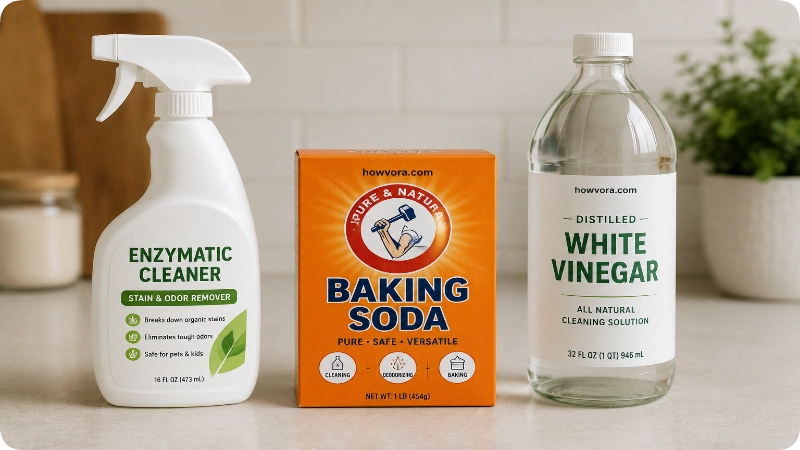
Different situations call for different products. Here’s how the main options compare.
| Method | Pros | Cons | Best Use Case |
| Enzymatic cleaner | Breaks down uric acid at the source; safest for pets; works on old and new stains | Needs long dwell/dry time; won’t work if diluted or rinsed too soon | Most carpet, upholstery, and fabric stains |
| Baking soda + vinegar | Cheap, non-toxic, good for fresh light odors | Doesn’t break down uric acid crystals; only masks/neutralizes surface odor | Fresh, minor accidents on hard floors |
| Hydrogen peroxide + dish soap | Strong on set-in stains and discoloration | Can bleach colored carpet or fabric; needs spot-testing | Stains with visible discoloration on light-colored carpet |
| Steam cleaning | Deep-cleans large areas, good for whole-room refresh | Heat can permanently set uric acid odor if used before enzyme treatment | Final step after enzymes have already broken down the odor |
| Professional extraction | Handles subfloor and padding contamination; commercial-grade tools | Expensive; not needed for minor accidents | Old, widespread, or repeated soiling in the same spot |
Recommended approach: Enzymatic cleaner is the foundation for almost every situation because it’s the only method that actually breaks down the compounds causing the smell rather than covering them up. Baking soda, vinegar, and steam cleaning are useful as follow-up or maintenance steps, not replacements.
At a Glance
| Detail | Estimate |
| Difficulty | Easy–Moderate |
| Time required | 15–30 min active + 24–48 hr dry time |
| Estimated cost | $10–$40 (DIY) / $100–$300+ (professional) |
| Tools needed | UV blacklight, enzymatic cleaner, clean cloths |
Things You’ll Need
| Item | Purpose |
| UV blacklight flashlight | Reveals dried or hidden urine spots invisible in normal light |
| Enzymatic pet urine cleaner | Breaks down uric acid crystals that cause odor |
| White vinegar | Neutralizes fresh odor and helps loosen residue before enzyme treatment |
| Baking soda | Absorbs residual moisture and odor after enzyme treatment dries |
| Clean white cloths or paper towels | Blotting without spreading or rubbing in the stain |
| Rubber gloves | Skin protection when handling cleaning solutions |
| Wet/dry vacuum (optional) | Extracts moisture from carpet or padding faster |
| Plastic sheeting or foil | Covers treated spots to slow evaporation and extend enzyme dwell time |
Safety Precautions
Never mix ammonia-based cleaners with bleach; this combination produces toxic chloramine gas. Also avoid using ammonia-based products on pet urine stains at all: ammonia is a component of urine, so ammonia-scented cleaners can actually encourage dogs to re-mark the same spot. Keep enzymatic cleaners and vinegar solutions out of reach while wet, since curious dogs may try to lick treated areas. If you have asthma or sensitivities, ventilate the room and wear gloves when working with concentrated cleaning solutions.
Step-by-Step Guide
Step 1: Find every affected spot with a UV blacklight
Turn off the lights, close curtains, and run a UV blacklight over floors, baseboards, and furniture legs. Dried dog urine glows yellow-green under UV light, revealing spots you can’t see or smell during the day. Circle each spot lightly with chalk or painter’s tape so you don’t lose track of them once the lights come back on.
Why it matters: Odor-causing uric acid crystals are often invisible once urine dries, and treating only the stains you happen to notice leaves hidden sources that keep producing smell, especially as humidity rises.
What success looks like: Every glowing spot in the room is marked and ready for treatment, not just the one or two stains you already knew about.
Common beginner mistake: Skipping this step and only treating the smell you can currently detect, which often means missing 3–5 older spots in an average room.
Step 2: Blot fresh urine (don’t rub) or vacuum dried residue
For fresh accidents, press clean paper towels or cloths straight down onto the wet spot, replacing them until no more moisture transfers. For dried stains, vacuum loose debris first if it’s on carpet.
Why it matters: Rubbing pushes urine deeper into carpet fibers and padding, spreading the contaminated area and making it harder to fully remove later.
What success looks like: No more liquid transfers to a fresh cloth when you press down on the spot.
Common beginner mistake: Scrubbing the stain, which drives urine further into the padding and subfloor.
Step 3: Pre-treat with water and vinegar (optional but helpful)
Mix equal parts white vinegar and cool water, then lightly saturate the stained area. Blot again after a few minutes.
Why it matters: Vinegar’s mild acidity helps neutralize the alkaline salts in dried urine and loosens residue, giving the enzymatic cleaner better access to the uric acid underneath.
What success looks like: The vinegar smell is present, but the underlying urine odor is noticeably reduced, not eliminated. Enzymes will finish the job.
Common beginner mistake: Using hot water, which can permanently set the stain and odor by bonding proteins in the urine to the fibers.
Step 4: Saturate the spot with enzymatic cleaner
Pour or spray the enzymatic cleaner generously so it reaches the same depth the urine soaked to for carpet, which usually means saturating through to the padding, not just the surface. Follow the product’s label instructions for exact application.
Why it matters: Enzymes need direct contact with every bit of uric acid to break it down chemically; under-application leaves crystals untouched, and the odor returns as soon as humidity rises again.
What success looks like: The area is visibly damp throughout, matching roughly the size and depth of the original stain.
Common beginner mistake: Using too little product on old or deep stains, which only treats the surface and leaves the odor source intact underneath.
Step 5: Let it dwell and air-dry completely (don’t rush this)
Cover the spot loosely with plastic wrap or foil to slow evaporation, and let it sit for the time listed on the product label, typically several hours to overnight. Then remove the cover and allow the area to fully air-dry, which can take 24–48 hours.
Why it matters: Enzymes are living organisms that need time and moisture to fully digest the uric acid; drying too fast or too soon stops the process before the odor source is gone.
What success looks like: The spot is completely dry and, once dry, has no detectable urine smell.
Common beginner mistake: Using a fan or heater to speed up drying, which can cut the dwell time short and leave odor-causing crystals behind.
Step 6: Vacuum and deodorize once fully dry
Once the area is completely dry, sprinkle baking soda over it, let it sit for 15–20 minutes, then vacuum thoroughly.
Why it matters: Baking soda absorbs any remaining trace moisture and odor molecules that the enzyme treatment didn’t fully neutralize.
What success looks like: No powder residue remains, and the treated area smells the same as the rest of the room.
Common beginner mistake: Skipping this step on porous surfaces like carpet, where trace odor can linger even after enzyme treatment.
How to Know You Did It Correctly
The clearest test is your nose and a UV light, both used after the area is completely dry. A wet enzymatic cleaner can smell different from the final result. Sniff the treated spot up close; there should be no ammonia or musty odor. Run the black light over it again; while some enzymatic cleaners leave a faint glow from the cleaner itself, there should be no strong yellow-green fluorescence pattern matching the original stain shape. Dogs also stop returning to a spot once the underlying scent marker is fully gone, so watch whether your dog continues sniffing or re-marking the same area over the following days.
Expected Timeline and Results
Fresh accidents treated promptly with an enzymatic cleaner typically show full odor elimination within 24–48 hours, once the area dries completely. Older, set-in stains may need two or three treatment cycles over several days, especially if urine has soaked into carpet padding or wood subflooring. If a treated spot still smells after full drying and one repeat treatment, that’s a sign the contamination has gone deeper than the enzyme could reach on the first pass. Repeat with a heavier saturation, or move to the padding/subfloor steps under Alternative Methods.
Alternative Methods
Baking soda paste: Mix baking soda with a small amount of water into a paste, apply to the stain, let dry completely, then vacuum. Advantage: cheap and safe around pets. Disadvantage: only absorbs surface odor, doesn’t break down uric acid. Best for: light, fresh odors on hard flooring.
Hydrogen peroxide and dish soap solution: Mix 1 part 3% hydrogen peroxide with a few drops of dish soap, apply to the stain, let sit 10 minutes, then blot and rinse. Advantage: effective on tough, visible discoloration. Disadvantage: can lighten or bleach colored carpet and fabric, so always spot-test first. Best for: stained (not just smelly) spots on light-colored carpet.
Steam cleaning: Use a carpet steam cleaner after enzymatic treatment has already broken down the odor. Advantage: deep-cleans large areas and refreshes overall carpet condition. Disadvantage: heat applied before enzyme treatment can permanently bond uric acid to fibers, making the odor much harder to remove. Best for: a final refresh step, never a first-line odor treatment.
Replacing carpet padding or sealing subfloor: For urine that has soaked through carpet and padding into the wood subfloor, the padding may need replacing and the subfloor sealed with an odor-blocking primer. Advantage: permanently removes deeply embedded odor sources. Disadvantage: costly and labor-intensive. Best for: long-term or repeated accidents in the same spot that enzymatic cleaners haven’t resolved.
Common Mistakes to Avoid
Using ammonia-based cleaners: Ammonia is chemically similar to a component of urine, so it can actually encourage dogs to remark the same spot. This happens because dogs associate the ammonia scent with a “toilet” location. Prevent it by choosing enzymatic or vinegar-based cleaners instead.
Renting a steam cleaner too early: Applying heat before the uric acid is broken down sets the stain and odor permanently. This happens when owners try to speed-clean instead of finishing enzyme treatment first. Prevent it by treating with enzymes and letting the area fully dry before any heat-based cleaning.
Under-saturating the stain: Using a light spray instead of soaking to the same depth the urine reached leaves crystals untouched below the surface. This happens because people assume a quick spray is equivalent to a deep clean. Prevent it by matching the cleaner’s depth and volume to the size of the original stain.
Skipping the UV light check: Relying only on smell or visible staining misses older or drier spots. This happens because dried urine is often invisible under normal lighting. Prevent it by always doing a full blacklight sweep before starting.
Why Many Attempts Fail
Most failed DIY treatments come down to three root causes: rushing the enzyme dwell time before the reaction finishes, treating only the visible stains or smell rather than sweeping the whole area with a blacklight first, and using surface-level products (like air fresheners or standard carpet shampoo) that mask odor instead of breaking down the uric acid causing it. Avoiding these three mistakes resolves the vast majority of “the smell keeps coming back” situations.
Troubleshooting & Common Problems
| Problem | Possible Cause | Solution |
| Smell returns after a few days | Enzyme dwell time was cut short, or contamination reached the padding/subfloor | Re-treat with a longer dwell time; if it persists, check and treat the padding underneath |
| Stain still visible after cleaning | Discoloration wasn’t addressed, only odor | Use a hydrogen peroxide and dish soap solution after spot-testing for colorfastness |
| Dog keeps re-marking the same spot | Residual scent marker not fully neutralized, or an ammonia-based cleaner was used | Re-treat with enzymatic cleaner; avoid ammonia products entirely |
| Odor worse in humid weather | Uric acid crystals were never fully broken down, only masked | Re-treat with enzymatic cleaner at full saturation and allow proper dwell/dry time |
| Smell present but no visible stain | Urine soaked into the padding or subfloor beneath the carpet | Pull back the carpet at the spot, treat and seal the subfloor, or replace the padding section |
Expert Tips
Choose an enzymatic cleaner labeled specifically for pet urine rather than a general “stain and odor” product, since the enzyme strains are formulated to target uric acid specifically. Apply cleaner generously enough to match the depth of the original stain. A light surface spray rarely reaches urine that has soaked into padding. Let treated areas air-dry naturally instead of using fans or heaters, since rushing the process cuts enzyme activity short. For recurring problem spots, treat the same area twice: once immediately and once again a few days later to catch any crystals the first pass missed.
When to Call a Professional
DIY treatment is usually enough for isolated accidents caught within a few days. Call a professional carpet cleaning service if the odor persists after two full enzymatic treatment cycles, if urine has soaked through padding into a wood subfloor across a large area, or if you’re dealing with an older home with unknown prior soiling. A professional can also help if you’re moving into a home with pre-existing pet odor issues that weren’t addressed by the previous owner, since extraction equipment reaches contamination that household tools can’t.
What to Do Next
Once the area is fully treated, focus on prevention: keep puppies on a consistent bathroom schedule, use belly bands or diapers for dogs with incontinence issues, and place washable mats in high-risk spots like entryways. Periodically run a UV blacklight check every few months, especially in homes with multiple dogs, to catch new spots before they set in. If accidents keep happening in the same location despite training, consult your veterinarian, since repeated marking or incontinence can sometimes signal a urinary tract infection or other medical issue.
FAQs
Does vinegar alone get rid of dog urine smell?
Vinegar helps neutralize fresh, mild odors and can loosen residue, but it doesn’t break down the uric acid crystals responsible for long-term odor. For anything beyond a very fresh, minor accident, follow vinegar with an enzymatic cleaner for a complete result.
Why does my house still smell like dog pee after cleaning the carpet?
The most common cause is urine that has soaked past the carpet into the padding or subfloor, which a surface cleaning won’t reach. A UV blacklight check can confirm whether hidden spots remain, and deeper treatment or padding replacement may be needed.
Can I use baking soda and vinegar together on dog urine?
Baking soda and vinegar can be used in sequence: vinegar to help loosen and neutralize, baking soda afterward to absorb remaining moisture and odor, but neither breaks down uric acid the way an enzymatic cleaner does.
How long does it take for an enzymatic cleaner to work on dog urine?
Most enzymatic cleaners need several hours to overnight of dwell time, plus full air-drying afterward, which can take 24–48 hours total. Cutting this time short is the most common reason treatments fail.
Is the smell of dog urine dangerous to breathe?
Fresh dog urine odor isn’t typically hazardous in small amounts, but prolonged exposure to ammonia fumes from heavily soiled areas can irritate the eyes and respiratory tract, particularly in poorly ventilated spaces. Ventilate the area and consider professional cleaning for large or long-neglected contamination.
Will a black light show old urine stains through the carpet?
Yes, dried urine fluoresces under UV light even when it’s soaked through carpet into the padding below, which is why a blacklight sweep is one of the most reliable ways to locate hidden accident spots.
What kills a dog’s urine smell permanently?
Enzymatic cleaners are the most reliable permanent solution because they chemically break down uric acid rather than masking it. Products that only cover odor, like air fresheners or standard carpet shampoo, allow the smell to return as humidity changes.
Can I get the smell of dog urine out of hardwood floors?
Yes, if treated before urine seeps into the wood grain or between boards, blot immediately, clean with an enzymatic cleaner formulated for hard surfaces, and dry thoroughly. Deeply soaked or stained hardwood may need sanding and refinishing.
Final Thoughts
Getting rid of dog pee smell permanently comes down to finding every affected spot (not just the obvious ones), using an enzymatic cleaner that actually breaks down uric acid instead of just masking it, and giving the treatment enough time to fully work before drying or applying heat. Skip any of those three steps, and the smell tends to come back. Follow the full process here, be patient with dwell and dry times, and address the root cause, whether that’s incomplete housetraining, an aging dog’s incontinence, or a medical issue worth a vet visit, and the odor should stay gone for good.
