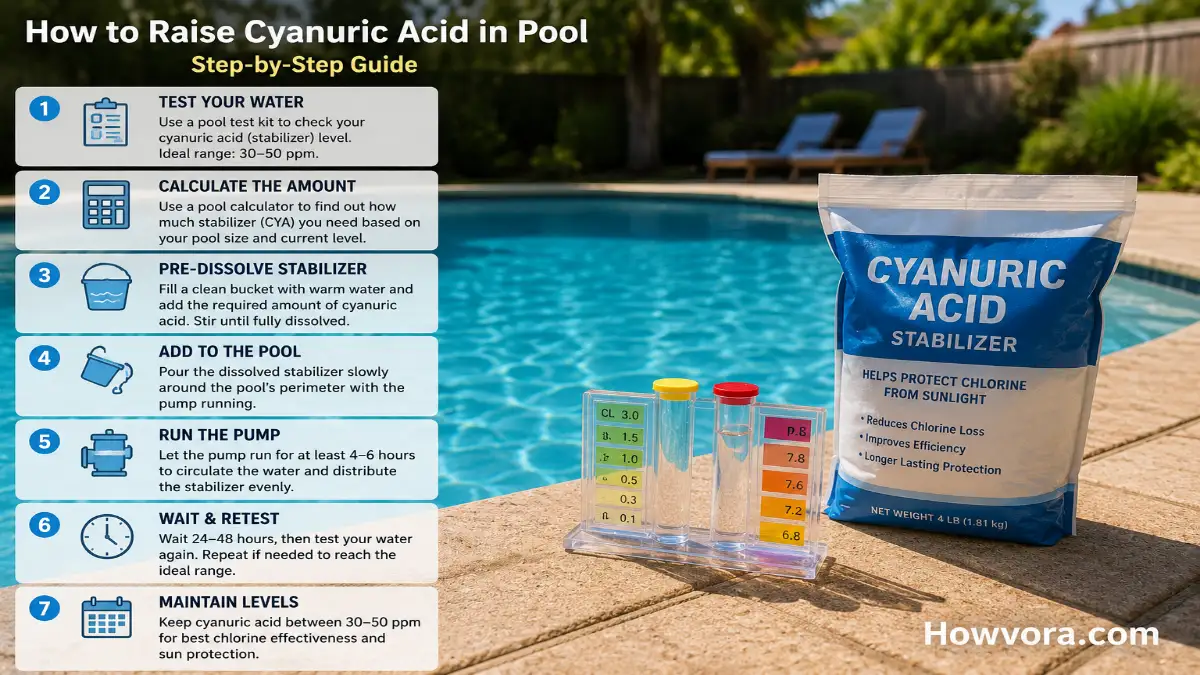
If your pool keeps burning through chlorine no matter how much you add, low cyanuric acid (CYA) is a likely culprit. CYA, also called pool stabilizer or conditioner, shields chlorine from being broken down by UV rays. Without enough of it, sunlight can destroy a large share of your chlorine within hours, leaving the water under-sanitized and prone to algae and cloudiness.
This guide is for outdoor pool owners whose test kit shows CYA below the 30-50 ppm target range. By the end, you’ll know exactly how much stabilizer to add, how to add it safely, and how long to wait before it takes effect. Indoor pools with no sun exposure don’t need CYA and can skip this guide entirely.
Featured Snippet
To raise cyanuric acid, add granular or liquid pool stabilizer directly to your pool water, or switch to a stabilized chlorine like dichlor or trichlor. Use about 13 ounces of granular CYA per 10,000 gallons to raise levels by 10 ppm, dissolve it fully, run the pump, and retest after 48-72 hours.
Before You Begin
Raising CYA is one of the easier pool chemistry adjustments, but it’s not instant. Cyanuric acid dissolves slowly and needs time to circulate fully through the water, so patience matters more than speed here.
- Test first. Confirm your current CYA reading with a fresh test rather than relying on an old number. CYA test strips are notoriously imprecise; a liquid drop kit or a professional water test gives a more reliable starting point.
- Know your target. Traditional chlorine pools should sit at 30-50 ppm. Saltwater pools run higher, typically 60-80 ppm, because salt cells generate chlorine continuously and need more protection.
- Check your pool volume. Dosing is calculated per 10,000 gallons, so an accurate gallon count (from your builder’s specs or an online pool volume calculator) prevents over- or under-dosing.
- DIY vs. Pro: This is a straightforward DIY task for most pool owners. Professional help is really only worth considering for large commercial pools or if you’re unsure how to calculate your pool’s volume accurately.
Choosing the Right Approach
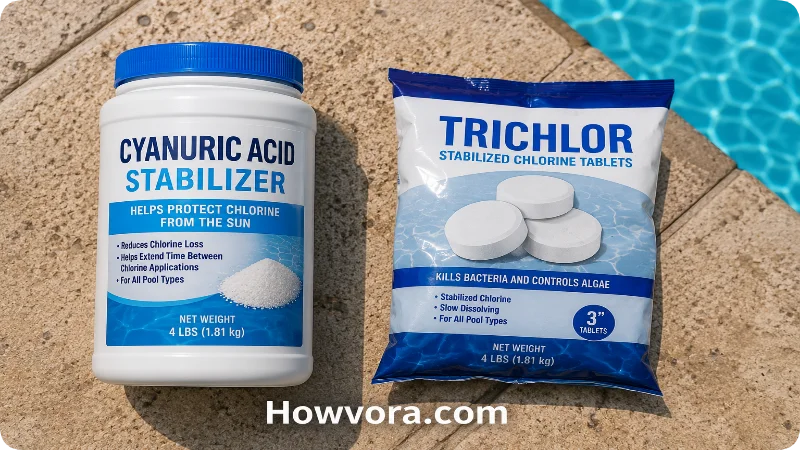
There are two legitimate ways to raise CYA, and picking the right one depends on whether you also need more chlorine in the water.
| Method | Best For | Pros | Cons |
| Add pure cyanuric acid (stabilizer/conditioner) | Pools where chlorine levels are already fine but CYA is low | Precise control over CYA without adding chlorine | Slow to dissolve; requires a pre-dissolve step |
| Switch to stabilized chlorine (dichlor or trichlor) | Pools that need more chlorine anyway | Raises chlorine and CYA at the same time, with low effort | Less precise CYA control; can overshoot if overused |
Most pool owners default to trichlor tablets for routine sanitizing, which is exactly why CYA creeps up over time without anyone adding stabilizer on purpose. If your CYA is low but your chlorine routine is working fine, adding pure CYA directly is the more controlled choice.
At a Glance
| Difficulty | Time Required | Cost | Skill Level | Best For |
| Easy | 10 minutes to add, 48-72 hours to fully register | $15-$40 for stabilizer (residential pool) | Beginner | Outdoor pools with a confirmed low CYA reading |
Things You’ll Need
| Item | Purpose |
| CYA test kit (liquid drop kit preferred) | Confirms current and post-treatment CYA levels |
| Granular or liquid cyanuric acid (stabilizer/conditioner) | The product that raises CYA |
| 5-gallon bucket | Pre-dissolving granular CYA before adding to the pool |
| Rubber gloves and eye protection | Protects skin and eyes from the acidic granules |
| Pool volume figure (in gallons) | Calculates the correct dose |
| Skimmer sock or old clean sock (optional) | Alternative method for slow-release dosing |
Safety Precautions
Cyanuric acid is a mild acid and an eye and skin irritant in concentrated form, so basic precautions matter even though it’s not classified as highly hazardous.
- Wear gloves and eye protection when handling granular or liquid CYA, and avoid breathing in dust from the granules.
- Never mix CYA directly with other pool chemicals in a dry state; add it to water, not the other way around.
- Keep children and pets away from the area while you’re handling and dissolving the product.
- Store leftover stabilizer in a cool, dry place away from chlorine products, since combining concentrated pool chemicals improperly can trigger dangerous reactions.
Step-by-Step Guide
- Test your current CYA level. Use a liquid drop kit for the most accurate baseline reading before you add anything.
- Calculate your dose. As a general rule, 13 ounces of granular cyanuric acid raises CYA by 10 ppm in a 10,000-gallon pool. Scale this up or down based on your actual pool volume and how many ppm you need to add.
- Predissolve granular CYA. Fill a 5-gallon bucket with warm pool water and stir in the measured dose until it’s fully dissolved. Granular CYA dissolves slowly and can sit undissolved on the pool floor for days if added dry, so this step matters. Why it matters: undissolved granules can bleach or damage vinyl liners and plaster if they settle and sit in one spot.
- Add the slurry to the pool. With the pump running, pour the dissolved mixture slowly around the perimeter of the pool, away from skimmers and returns.
- Alternative: use a sock method. If you prefer not to pre-dissolve, place the measured granular dose in a clean sock or skimmer sock, tie it closed, and hang it in front of a return jet or inside the skimmer basket so water flows through it continuously.
- Run the pump continuously. Keep circulation running for at least 6-8 hours, and ideally overnight, to help the stabilizer distribute evenly.
- Wait before retesting. Cyanuric acid takes 48-72 hours to fully dissolve and register accurately on a test kit, even though it starts protecting chlorine sooner than that.
- Retest and adjust. After the waiting period, retest CYA. If you’re still below target, repeat the dosing calculation for the remaining ppm needed rather than guessing.
How to Know You Did It Correctly
A successful CYA increase shows up as a stable reading of 30-50 ppm (or 60-80 ppm for saltwater pools) on a retest taken at least 48 hours after treatment. You should also notice that your chlorine level holds steadier day to day instead of dropping sharply by afternoon, since that faster daytime chlorine loss is the main symptom low CYA causes in the first place.
Expected Timeline and Results
Granular CYA typically takes 2-4 days to fully dissolve and give an accurate test reading, though it begins offering some UV protection within the first day. Liquid CYA products dissolve faster, often registering an accurate reading within 24-48 hours. Because CYA doesn’t break down or evaporate, once you hit your target range, you generally won’t need to add more for months, sometimes up to a year, unless you drain part of your pool or your CYA source (like stabilized chlorine) stops being used.
Alternative Methods
- Liquid cyanuric acid: Pre-mixed liquid stabilizer can be poured directly into the pool with the pump running, skipping the dissolving step entirely. It costs more per ppm than granular CYA but is more convenient and less prone to settling.
- Switching chlorine type: If your pool also needs more chlorine, switching your primary sanitizer to dichlor (for shock) or trichlor (for tablets) raises CYA gradually with each dose, since both products are roughly 50-57% cyanuric acid by weight. This works well for pools with chronically low CYA and chlorine demand, but it’s a slower, less precise way to hit a specific ppm target.
Common Mistakes to Avoid
- Adding granules directly without pre-dissolving. This risks bleaching or staining the pool surface where undissolved granules settle.
- Retesting too soon. Testing within a few hours of adding CYA gives an inaccurate low reading, leading owners to overdose.
- Guessing the dose instead of calculating it. Overshooting is common because CYA never leaves the water on its own, so an overdose can only be fixed by draining and diluting.
- Ignoring pool volume accuracy. Dosing based on a rough guess of gallons, rather than a real volume figure, is one of the most common reasons owners end up over- or under-treating.
Troubleshooting & Common Problems
| Problem | Cause | Solution |
| CYA reading hasn’t moved after 3+ days | Granular CYA undissolved or settled on pool floor | Brush the pool floor to redistribute, keep the pump running, and retest after another 24 hours |
| CYA reading is inconsistent between tests | Test strips being used instead of a liquid drop kit | Switch to a liquid drop test or the “black dot” comparator test for more accurate readings |
| Chlorine still burns off fast after raising CYA | CYA still below the 30 ppm minimum, or free chlorine not adjusted to match new CYA level | Retest CYA to confirm it’s in range, then raise free chlorine proportionally (roughly 7.5-10% of your CYA level) |
| CYA overshot above 50-80 ppm target | Dose miscalculated or pool volume estimate was off | Partially drain and refill with fresh water; there’s no chemical way to lower CYA quickly |
| White granules visible on pool floor | CYA added without pre-dissolving | Vacuum or brush the area promptly to prevent surface staining, and pre-dissolve future doses |
Expert Tips
- Match your free chlorine to your CYA level instead of chasing a single fixed chlorine number. A common field rule is to keep minimum free chlorine at roughly 7.5% of your CYA reading, so a pool at 40 ppm CYA needs a higher chlorine floor than one at 20 ppm.
- Don’t backwash your filter for 3-5 days after adding CYA. Backwashing too soon flushes stabilizer out before it’s had time to fully dissolve and circulate.
- If you use trichlor tablets regularly, you’re likely adding CYA passively with every dose. Before buying a separate stabilizer, check whether your existing chlorine routine is already pushing CYA toward your target.
When to Call a Professional
Most residential pool owners can raise CYA themselves with a test kit and basic math. Consider calling a pool professional if you manage a commercial or public pool (which typically has stricter regulatory testing requirements), if your pool volume is uncertain due to an irregular shape, or if repeated attempts to raise CYA aren’t producing a stable reading, which can indicate a filtration or circulation issue beyond the stabilizer itself.
What to Do Next
Once your CYA is in range, retest it monthly alongside your regular chlorine and pH checks. Because CYA accumulates and doesn’t break down, your next adjustment is far more likely to involve lowering it (via dilution) than raising it again, especially if you regularly use stabilized chlorine tablets.
FAQs
How long does it take for cyanuric acid to raise chlorine effectiveness?
Granular CYA needs 48-72 hours to fully dissolve and provide an accurate test reading, though partial UV protection begins within the first day.
Can I add cyanuric acid and chlorine at the same time?
Yes, but add them separately rather than mixing them dry, and give the pump time to circulate each product before dosing further.
Will cyanuric acid raise my pH?
Cyanuric acid can cause a slight, temporary dip in pH when added in large amounts, so check pH after your CYA has fully dissolved and adjust if needed.
Why does my CYA keep reading low even after I add stabilizer?
The most common cause is undissolved granules settled on the pool floor or testing too soon before the product has fully circulated.
Do saltwater pools need more cyanuric acid than chlorine pools?
Yes. Saltwater pools typically target 60-80 ppm because salt cells generate chlorine continuously and need more protection from UV breakdown.
Is it possible to add too little cyanuric acid to see any effect?
Yes. Doses below what’s needed to reach at least 30 ppm often won’t produce a noticeable improvement in chlorine retention, since the protective effect is minimal at very low CYA levels.
Can I use dichlor or trichlor instead of buying pure stabilizer?
Yes, since both are stabilized chlorine products that raise CYA alongside chlorine. This works well if you also need more chlorine, but it’s less precise for hitting an exact CYA target.
Final Thoughts
Low cyanuric acid is one of the more fixable causes of a pool that won’t hold its chlorine. Test accurately, calculate your dose based on real pool volume, pre-dissolve granular stabilizer before adding it, and give the product 48-72 hours to fully register. Because CYA builds up and doesn’t break down on its own, dosing carefully now saves you the more involved process of draining and diluting an overshoot later.