
Gnats in your kitchen are more than a nuisance; they’re a sign of moisture, food debris, or drains that need attention. These tiny flying insects reproduce rapidly, turning a minor problem into an infestation within days.
Whether you’re dealing with fruit flies swarming over produce or fungus gnats breeding in soil, the solution involves identifying their sources, eliminating breeding grounds, and using targeted removal methods.
This guide covers everything you need to reclaim your kitchen, from quick fixes to long-term prevention. By the end, you’ll know exactly what’s attracting them, how to eliminate the current population, and how to stop them from returning.
Featured Snippet
To get rid of gnats in your kitchen, eliminate their breeding sources by cleaning drains, removing ripe fruit, and taking out trash daily. Use drain gel or boiling water to target drain-dwelling gnats, deploy vinegar traps to catch flying insects, and ensure all surfaces are dry. Most infestations clear within 3–7 days once sources are removed.
Before You Begin
Difficulty Level: Beginner
Time Required: 30 minutes for initial treatment; ongoing maintenance 5 minutes daily
Cost Estimate: $5–15 (vinegar, dish soap, and traps; most people have these at home)
DIY vs. Professional: This is a DIY job. Professional pest control is rarely necessary unless the infestation is severe or recurring despite your efforts.
What You Should Know: Gnats thrive in moist environments with decaying organic matter. Killing flying gnats without removing breeding sources will fail. The key is a two-pronged attack: destroy eggs and larvae in drains, garbage disposals, and rotting food, then trap adult gnats.
Choosing the Right Approach
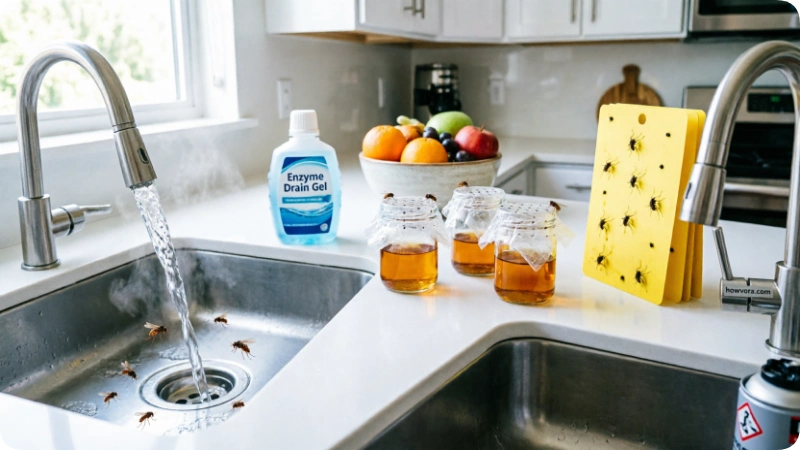
Gnat infestations vary. Here’s how to pick the best strategy:
| Method | Best For | Pros | Cons | Time to Results |
| Drain Cleaning + Vinegar Traps | General infestations, drain-based gnats | Safe, inexpensive, and addresses the root cause | Requires patience, multiple traps needed | 3–7 days |
| Drain Gel/Enzyme Treatment | Drain-dwelling gnats (fungus gnats) | Targets larvae directly, chemical-free option | Slower than boiling water, may need repetition | 5–10 days |
| Boiling Water Flush | Quick drain elimination | Fast, free, kills larvae instantly | Only works for drains, won’t catch flying gnats | 1–2 days for drain source |
| Commercial Drain Cleaner | Stubborn drain clogs with gnats | Very effective, fast results | Harsh chemicals, safety concerns, overkill for gnats | 1–2 days |
| Sticky Traps | Monitoring and catching flying gnats | Effective for catching adults, reusable | Doesn’t eliminate the breeding source; it’s a temporary solution | Same day for trapping |
Recommended Approach: Start with drain cleaning (boiling water or gel) combined with vinegar traps. This combination is safe and affordable, and it addresses both the source and the visible problem. Add sticky traps if gnats persist after 3 days.
At a Glance
| Aspect | Details |
| Difficulty | Easy to moderate |
| Time | 30 minutes initial setup; 5 minutes daily |
| Cost | $5–15 total |
| Results Timeline | 3–7 days for most cases |
Things You’ll Need
| Item | Purpose |
| White vinegar | Attracts gnats into the trap |
| Dish soap (any brand) | Breaks surface tension, traps gnats |
| Small container or jar | Holds a vinegar trap |
| Plastic wrap or bowl | Covers the trap, creates a cone |
| Rubber band | Secures covering |
| Boiling water | Flushes drain to kill larvae |
| Cleaning brush or pipe cleaner | Scrubs drain pipes |
| Garbage bags | Removes rotting food waste |
| Paper towels | Dries surfaces |
| Drain gel or enzyme-based cleaner (optional) | Alternative to boiling water for ongoing maintenance |
Safety Precautions
Burns from boiling water: When pouring boiling water down drains, keep your face and hands away from the drain opening. Steam can cause burns. Use a funnel or pour slowly to prevent splashing.
Drain cleaners (chemical): If using commercial drain cleaners, wear gloves, avoid breathing fumes, and never mix with bleach or other chemicals; toxic gas can form. Ensure good ventilation.
Mold and contamination: Fruit and vegetable scraps that breed gnats may harbor mold. When disposing of infested food, double-bag it and take it outside immediately.
Pesticide sprays: Avoid broad-spectrum insecticides in kitchens where food is prepared. They’re unnecessary and pose health risks. Stick to vinegar traps and drain treatments instead.
Step-by-Step Guide
Step 1: Identify the Gnat Source
What to do: Look for moisture and organic decay in these locations:
- Kitchen drain (most common), especially the sink strainer
- Garbage disposal
- Dishwasher drain
- Under the refrigerator (condensation and spilled food)
- Compost bin or trash can
- Fruit or vegetable bowls (overripe or rotting produce)
- Potted plants (moist soil)
- Beer, wine, or juice bottles and glasses left out
Why it matters: Gnats breed in decaying organic matter and stagnant water. A single drain can harbor hundreds of larvae. Removing the breeding source stops reproduction immediately.
What success looks like: You’ve pinpointed at least one location where gnats congregate or where moisture and debris are present. Often, it’s the kitchen drain.
Common beginner mistake: Assuming gnats come from outside or random airborne sources. Nearly all indoor kitchen gnats originate from something inside a drain, trash, or produce.
Step 2: Clean and Flush All Drains
What to do:
- Remove the sink strainer and dispose of any food debris inside.
- Use a brush or pipe cleaner to scrub the inside of the drain opening and exposed drain pipe.
- Boil a kettle of water (2–3 quarts minimum).
- Carefully pour boiling water down the drain in slow streams, allowing it to reach deeper into the pipe.
- Repeat for all kitchen drains (sink, dishwasher, garbage disposal).
- If you have a garbage disposal, run hot water for 30 seconds while running the disposal.
Why it matters: Boiling water kills gnat eggs and larvae living in the biofilm lining your drain pipes. This removes the primary breeding ground and stops the infestation at its source.
What success looks like: Drain pipes are clear, and you’ve removed visible debris. You may see dead gnats or residue in the drain opening for a day or two. This is normal and means the treatment is working.
Common beginner mistake: Pouring boiling water once and assuming the problem is solved. Gnats can rebreed quickly if even a few eggs survive in deeper parts of the pipe. Repeat daily for 3 days to ensure complete elimination.
Step 3: Set Up Vinegar Traps to Catch Flying Gnats
What to do:
- Fill a small jar or container halfway with white vinegar (apple cider vinegar works even better).
- Add one squirt of dish soap to the vinegar and stir gently; don’t create too many bubbles.
- Cover the container tightly with plastic wrap.
- Use a rubber band to hold the wrap in place.
- Poke 3–4 small holes in the plastic wrap with a fork or toothpick.
- Place the trap near where you see gnats congregating (typically the sink, fruit bowl, or trash area).
- Set up additional traps in different areas of the kitchen;n one is rarely enough.
Why it matters: Gnats are attracted to fermented smells (vinegar). They enter through the holes, land on the liquid, and the dish soap breaks the surface tension, causing them to drown. This captures adult gnats while you’re eliminating breeding grounds.
What success looks like: After a few hours, you’ll see gnats stuck in the liquid at the bottom of the trap. The number decreases each day as the breeding source depletes.
Common beginner mistake: Using only one trap. Gnats spread throughout the kitchen, so multiple traps catch more insects faster and give you confidence that the infestation is declining.
Step 4: Remove Ripe and Rotting Food
What to do:
- Inspect all fruit and vegetable bowls. Remove any overripe, bruised, or rotting produce.
- Dispose of it in an outdoor trash bin or a tightly sealed garbage bag.
- Wash the bowl with hot soapy water.
- Store fruit in the refrigerator instead of on the counter, or cover bowls tightly with plastic wrap.
- Check under and behind the refrigerator for fallen fruit or sticky spills. Wipe clean with a damp cloth.
- Empty trash cans daily, especially if they contain food waste.
Why it matters: Rotting fruit and produce are gnat-breeding hotspots. By removing them, you eliminate one of their primary food sources and breeding environments.
What success looks like: Your kitchen counter is free of overripe fruit, and bowls are either empty or refrigerated.
Common beginner mistake: Leaving fruit visible because “it’s still good.” Even slightly soft fruit attracts gnats. When in doubt, refrigerate or discard.
Step 5: Dry Up Moisture Sources
What to do:
- Wipe down all kitchen surfaces, especially around the sink.
- Ensure the sink is completely dry before bed. If water drips from under the sink cabinet, investigate and repair the leak.
- Check under and around the dishwasher for water pooling.
- Dry mops or cleaning cloths immediately after use; don’t leave them damp in the sink.
- If you have a compost bin indoors, ensure it has a tight-fitting lid.
Why it matters: Gnats need moisture to breed. Even small puddles or damp areas create breeding grounds. Drying surfaces removes the environment they thrive in.
What success looks like: Your kitchen sink and surrounding areas are dry by evening, with no standing water or damp cloths left out.
Common beginner mistake: Assuming drains are dry because water drains quickly. The inside of pipes stays moist, which is why drain cleaning is so important.
How to Know You Did It Correctly
Immediate signs (Day 1–2):
- Vinegar traps contain trapped gnats.
- You see fewer flying gnats during daylight hours.
- The drain area is clean and free of debris.
Short-term verification (Day 3–5):
- The number of trapped gnats in your vinegar traps decreases daily.
- No new gnats appear near the sink or in your fruit bowls.
- You’re not seeing gnat swarms when you move fruit or open the trash.
Success (Day 7+):
- Vinegar traps contain no new gnats for 2 consecutive days.
- Zero visible gnats in the kitchen.
- No small black specks (gnat droppings) on surfaces or in sinks.
If gnats persist after 7 days, the breeding source wasn’t fully eliminated. Re-examine the drain, garbage disposal, and under-appliance areas. Sometimes secondary drains (like a dishwasher) are the culprit.
Expected Timeline and Results
Days 1–2: Gnats may still be visible because it takes time to kill all larvae in the drain. You’ll see gnats in your vinegar traps. Don’t be discouraged by continued activity.
Days 3–5: Gnat population drops noticeably. Fewer insects flying around, fewer trapped in vinegar. This signals that the breeding source is under control.
Days 6–7: Most infestations are eliminated. You may see one or two stragglers if the infestation was large. Continue vinegar traps and drain maintenance.
Days 8+: If no gnats appear for 2 consecutive days, the infestation is resolved. Begin preventive maintenance.
When to repeat: If gnats reappear, repeat the drain-flushing and vinegar-trap process. This typically indicates a new breeding source or incomplete initial cleaning.
Alternative Methods
Drain Gel or Enzyme-Based Drain Cleaner
Advantages: Chemical-free, gentler on pipes than boiling water, effective over time, good for ongoing maintenance.
Disadvantages: Slower than boiling water (results in 5–10 days instead of 1–2), may require multiple applications, costlier than free boiling water.
Best use case: Use this if you have delicate pipes, prefer a gentler approach, or want to incorporate maintenance into your routine. Apply once weekly to prevent gnat breeding in drains.
Commercial Sticky Traps
Advantages: Highly effective at trapping flying gnats, reusable (some models), provides visual proof of infestation declining, no liquid or mess.
Disadvantages: Doesn’t address the breeding source (only catches adults), doesn’t eliminate the problem alone, can be expensive if buying multiple traps.
Best use case: Use as a supplement to drain cleaning and vinegar traps, especially if you have a large visible gnat population. Sticky traps are excellent for monitoring progress.
Bleach Down the Drain
Advantages: Strong antimicrobial action kills bacteria and mold that gnats feed on.
Disadvantages: Harsh on pipes, creates noxious fumes, unnecessary overkill for gnats (boiling water is equally effective), unsafe if mixed with other cleaners.
Best use case: Not recommended. Boiling water and drain gel are safer and equally effective.
Fruit Fly Traps with Wine or Beer
Advantages: Uses household items, very effective at attracting and trapping gnats.
Disadvantages: Attracts gnats to your kitchen (counterintuitive), is messy, requires frequent emptying.
Best use case: Only if your infestation is already visible and widespread. Vinegar is a safer choice for prevention.
Common Mistakes to Avoid
Mistake 1: Killing flying gnats without eliminating the source
What it is: Using only traps or sprays while ignoring drains and rotting food.
Why it happens: It feels like progress when you catch gnats, so people focus on that instead of the harder work of cleaning drains.
Consequence: Gnats return within days because new larvae are still hatching from the breeding source.
How to prevent it: Always start with drain cleaning and food removal. Traps are the second step, not the first.
Mistake 2: Using pesticide sprays indoors
What it is: Spraying insecticide to kill flying gnats.
Why it happens: It seems like a fast fix and is marketed as effective.
Consequence: Health risks in a food-preparation area, unnecessary chemical exposure, and gnats often develop resistance. The breeding source remains untouched, so gnats return.
How to prevent it: Stick to mechanical and natural methods (traps, drains, vinegar). They’re safer and more effective because they address root causes.
Mistake 3: Not checking secondary drains
What it is: Cleaning only the kitchen sink while ignoring the dishwasher, garbage disposal, or bathroom drains nearby.
Why it happens: Gnats seem to be in the kitchen, so people assume the kitchen sink is the only source.
Consequence: Partial improvement but no complete resolution. Gnats reappear from the untreated drain.
How to prevent it: Treat all kitchen drains simultaneously. If gnats persist after a full kitchen treatment, check guest bathrooms and laundry drains.
Mistake 4: Leaving trash or compost out overnight
What it is: Keeping garbage bins or compost containers with open or loose lids.
Why it happens: Convenience, forgetting, or underestimating how fast gnats breed.
Consequence: Continuous new generations of gnats, making progress impossible.
How to prevent it: Empty trash daily, tightly seal compost bins, and take garbage outside immediately after meals if possible.
Why Many Attempts Fail
The source isn’t fully identified: People spot gnats and treat visible areas but miss secondary sources like under the refrigerator, a hidden drain leak, or houseplant soil.
Drains are cleaned once but not thoroughly: Pouring boiling water once might kill surface larvae but miss deeper biofilm where eggs hide. Repeat drain flushes for 3 consecutive days to ensure complete elimination.
Vinegar traps are set up incorrectly: Traps with too few holes, too much soap (which creates foam instead of a drown trap), or placed far from gnat activity catch fewer insects and provide a false sense of progress.
Preventive habits stop too soon: People notice gnats are gone after a week and immediately stop daily drain maintenance and fruit rotation. Gnats return within days because conditions are ripe for new breeding.
Multiple infestations: Sometimes gnats come from more than one source (drain + rotting fruit + plant soil). If one source is addressed but others remain, it seems like the problem persists.
Reinfection from outside: If your kitchen stays moist and food scraps linger, new gnats can enter from outside or through drains. This is why prevention is as important as elimination.
Troubleshooting and Common Problems
| Problem | Possible Cause | Solution |
| Gnats still visible after 5 days of treatment | Drain not fully cleaned, secondary breeding source missed, or insufficient trap coverage | Repeat drain cleaning, inspect under appliances and behind baseboards, and add more vinegar traps in different locations |
| Vinegar trap not catching gnats | Trap placed too far from gnat activity, too much dish soap creating foam, or trap dried out | Move the trap closer to the sink/fruit area, remake the trap with less soap, and refresh the vinegar daily |
| Gnats near plants or compost | Soil-dwelling fungus gnats using moist potted soil or compost as breeding ground | Reduce watering frequency, let soil dry out between waterings, cover compost with tight lid, repot plant in fresh dry soil if severe |
| Gnats returning weekly | Drain hasn’t been re-sealed properly, moisture returning, or food debris accumulating | Flush drains with boiling water once weekly as preventive maintenance, ensure sink dries completely each night, wipe spills immediately |
| Fruit bowl keeps attracting gnats | Fruit is too ripe or bowl not refrigerated | Refrigerate all fruit immediately, inspect for overripe items daily, wash bowl with hot soapy water |
| Unable to reach deep drain areas | Standard drain brush can’t access biofilm in deeper pipes | Use a plumbing snake or enzyme drain gel to reach further into the pipe system |
Expert Tips
Tip 1: Use apple cider vinegar instead of white vinegar. Apple cider vinegar’s fermented smell is even more attractive to gnats than white vinegar. Results are typically 20–30% faster.
Tip 2: Set up vinegar traps before you start drain cleaning. Gnats will immediately flee drains when you pour boiling water, and active traps will catch them. This accelerates visible improvement.
Tip 3: Refresh vinegar traps every 24 hours. Even if gnats are still trapped, dump the contents, rinse the container, and refill. This prevents mold from growing in the trap and keeps it attractive to gnats.
Tip 4: Store your dish sponge in the refrigerator or freezer. Kitchen sponges are gnats’ favorite breeding ground. The cold stops the bacterial growth that gnats feed on. This is a preventive measure that requires almost no effort.
Tip 5: Use boiling water the moment you notice the first gnat. Early treatment takes 2–3 days. Late treatment (when infestations are visible) takes 5–7 days. Speed matters.
Tip 6: Keep a drain-cleaning routine during fruit season. If you buy a lot of fresh produce (summer, fall), flush drains with boiling water once weekly as a precaution. This stops infestations before they start.
When to Call a Professional
DIY is enough if:
- The infestation is localized to the kitchen and is less than 1 week old.
- You’ve identified a clear source (drain, fruit, trash).
- Your treatment (drain cleaning + vinegar traps) shows improvement within 3 days.
- You have no plumbing issues (leaks, clogs, damage).
Call a professional pest control service if:
- Gnats persist for 2 weeks despite thorough DIY treatment.
- You suspect gnats are breeding in walls, crawl spaces, or inaccessible areas.
- You have a plumbing problem (standing water in drains, leaks under appliances) causing ongoing moisture.
- Your kitchen has a recurring gnat problem (more than once per year), suggesting a systemic issue.
- You’re uncomfortable handling boiling water or drain maintenance.
Call a plumber if:
- Your drain is clogged or slow-draining even after boiling water treatment.
- You suspect a hidden leak under the sink or behind appliances.
What to Do Next
Immediate (Days 1–7): Maintain your drain-flushing and vinegar-trap routine daily. Continue until no gnats appear in traps for 2 consecutive days.
Short-term prevention (Weeks 2–4):
- Keep fruit refrigerated or tightly covered.
- Take trash out daily.
- Ensure sink and counters are dry before bed.
- Maintain weekly boiling water flushes in drains.
Long-term prevention (Ongoing):
- Make daily kitchen cleanliness a habit (no standing water, dry surfaces, immediate food disposal).
- Refresh your vinegar traps monthly, even when no gnats are present, as it’s an early warning if gnats return.
- Keep all drain covers clean and in place.
- Store fresh produce in the refrigerator whenever possible.
- Check under and behind appliances monthly for debris or moisture.
FAQs
Q1: Can gnats infest other parts of my house?
Kitchen gnats rarely spread to bedrooms or living areas because they’re attracted to food and moisture. However, they can colonize bathrooms if those areas are damp. Once you eliminate the kitchen source, they won’t migrate elsewhere.
Q2: Are gnats dangerous or carry diseases?
Common kitchen gnats (fruit flies and fungus gnats) don’t bite, sting, or transmit diseases. However, they can contaminate food with bacteria and mold. The main concern is an infestation becoming overwhelming, not a health danger.
Q3: How do gnats get into my kitchen if it’s clean?
Gnats enter through windows, doors, or even on groceries (especially produce and mushrooms). A single pregnant female can start an infestation if conditions are right. This is why prevention is important.
Q4: Why do I see gnats in the morning more than in the evening?
Gnats are most active during cooler parts of the day and rest in sheltered areas (drains, under fruit bowls) when it’s warm. You’re likely seeing them when they emerge in the morning.
Q5: Can I use essential oils or natural repellents to get rid of gnats?
Essential oils, citrus peels, and herbal repellents have minimal effect on active infestations. They may deter gnats slightly, but don’t eliminate them or breeding sources. Focus on drains and traps for proven results.
Q6: How long does it take for gnat eggs to hatch?
Gnat eggs hatch in 12–24 hours in warm kitchen conditions. This is why daily drain maintenance is crucial it interrupts the lifecycle.
Q7: Should I throw away all my produce if gnats are in my kitchen?
Only discard fruit that is visibly overripe or infested. Recently purchased, firm fruit is safe. Gnats don’t contaminate whole produce enough to be unsafe; the concern is infestation of the fruit itself.
Q8: Can I prevent gnats year-round, or are they seasonal?
Gnats thrive in warm, humid conditions. In temperate climates, they’re most common in spring and summer but can occur year-round indoors due to heating. Prevention (dry surfaces, refrigerated produce, drain maintenance) is effective seasonally and year-round.
Q9: What’s the difference between fruit flies and fungus gnats?
Fruit flies are attracted to fermented foods and overripe produce (visible around fruit bowls). Fungus gnats breed in moist soil and plant-based material (visible near plants or drains). Treatment is the same for both.
Q10: If gnats come back, does that mean I didn’t treat them completely?
Not necessarily. New gnats can enter from outside through windows and doors. However, if they return within 2 weeks, your kitchen likely still has an attractive breeding condition. Recheck drains for residual larvae, increase ventilation, and maintain drying routines.
Final Thoughts
Getting rid of gnats in your kitchen is straightforward when you address both the source and the visible population. Start by cleaning your drains thoroughly, removing ripe fruit, and setting up vinegar traps. Within 3–7 days, your kitchen will be gnat-free if you stay consistent.
The real win is prevention. Daily habits such as drying surfaces, refrigerating produce, and taking out trash prevent infestations from taking hold in the first place. Gnats are a reminder that your kitchen thrives best when it’s clean, dry, and free of decaying organic matter.
