
The easiest way to eat a mango is to wash it, cut the two fleshy sides away from the flat seed, score the flesh, and scoop it out with a spoon. For a ripe mango, you can also peel it first and slice the flesh, or eat very soft mangoes directly from the skin with a spoon. A ripe mango should give slightly when gently squeezed, although peel color varies by variety and is not a reliable ripeness test.
How to Tell If a Mango Is Ready to Eat

Before cutting your mango, check its ripeness. This matters because a firm mango is easier to peel and slice, while a ripe, softer mango is juicier and easier to scoop.
Use feel rather than color. Mango varieties can have green, yellow, orange, or red skin when ripe, so color alone does not tell you whether a mango is ready. Gently press the mango with your fingers. A ripe mango should give slightly under gentle pressure. Some ripe mangoes may also develop a fruity smell near the stem.
If the mango is very hard, leave it at room temperature until it softens. If you want to speed up ripening, the National Mango Board recommends placing it in a closed brown paper bag for about two days and checking it afterward.
If the mango feels very soft, handle it carefully. It may be extremely juicy and can be difficult to slice neatly, but it is excellent for scooping, smoothies, or eating with a spoon.
A simple ripeness guide
| Mango feels… | What to do |
| Hard with no give | Let it ripen at room temperature |
| Slightly soft | Ready to eat |
| Very soft and juicy | Eat with a spoon or use for pulp |
| Rotten, leaking, or visibly spoiled | Discard it |
Wash the Mango Before Cutting It
Wash the whole mango under running water before you cut or peel it. Rub the surface gently with your hands, then dry it with a clean towel or paper towel.
This step is important even if you plan to remove the skin. Cutting through unwashed skin can transfer dirt or bacteria from the outside of the fruit to the flesh through your knife. The FDA recommends washing produce under running water and specifically advises against using soap, detergent, or commercial produce washes.
Also use a clean knife and cutting board. If the board or knife has been used for raw meat or seafood, clean and sanitize it before preparing the mango.
How to Cut and Eat a Mango
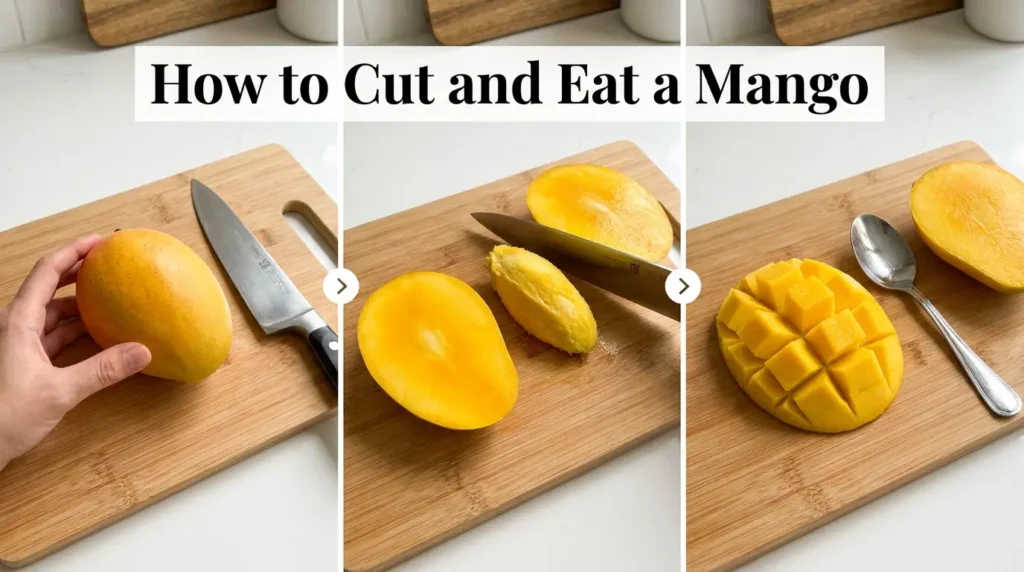
For most people, the easiest method is to cut the mango into two cheeks, score the flesh, and scoop it out.
1. Stand the mango upright
Place the mango on a stable cutting board with the stem end facing upward or downward, depending on which position gives you the best control.
Mangoes have a long, flat seed in the center rather than a small round pit. Your goal is to cut down both sides of this seed to remove as much flesh as possible.
2. Cut off the two mango cheeks
Hold the mango firmly and position your knife slightly to one side of the center line. Cut downward through the flesh, following the flat seed.
Repeat the cut on the opposite side.
You should now have two large pieces of mango flesh, commonly called mango cheeks, plus the narrow center section containing most of the seed. The National Mango Board recommends cutting roughly ¼ inch from the center line to clear the seed.
Don’t try to force the knife directly through the seed. If you feel the knife hitting the hard center, move slightly to one side and continue.
3. Score the mango flesh
Take one mango cheek and hold it with the skin facing downward.
Use the knife to make several parallel cuts through the flesh. Then make another set of cuts across them to create cubes.
Do not cut through the skin.
The cuts should divide the flesh without separating the cubes from the skin. This is the basic preparation for the popular “hedgehog” or inside-out method.
4. Push out the cubes
Hold both ends of the mango cheek and gently push the skin upward from underneath.
The mango flesh should fan outward, making the cubes easier to eat or remove.
You can now:
- Eat the cubes directly from the skin.
- Scoop them into a bowl with a spoon.
- Cut the cubes away from the skin with a knife.
- Add them to yogurt, oatmeal, cereal, or a fruit salad.
For a very ripe mango, use gentle pressure because the flesh can become soft and slippery.
5. Get the remaining flesh from the seed
Don’t throw away the center section immediately. There is usually edible mango flesh around the seed.
You can trim this flesh away with a knife, or simply eat the remaining soft flesh if you’re eating the mango casually at home.
The amount of flesh left around the seed varies by mango variety and shape.
How to Eat a Mango With a Spoon

If your mango is fully ripe and soft, you don’t necessarily need to make cubes.
Cut the mango into two cheeks as described above. Then take a large spoon and slide it between the flesh and the skin, following the curve of the fruit.
Scoop the flesh into a bowl or eat it directly from the skin.
This method works particularly well when the mango is too soft to cut into clean cubes. The National Mango Board specifically recommends a large spoon for fully ripe mangoes.
Best for: very ripe, juicy mangoes when appearance is less important than getting every bite.
How to Peel a Mango Before Eating It

Peeling first is useful when you want clean mango slices or cubes for a plate, fruit salad, or another dish.
Method 1: Use a vegetable peeler
A vegetable peeler works well when the mango is firm or only just ripe. Peel the skin away in strips, then cut the flesh away from the flat seed.
This gives you clean pieces but can be harder with a very soft mango because the fruit may bend or tear. The National Mango Board notes that a peeler is particularly useful for firmer mangoes.
Method 2: Peel with a knife
For a firm or medium-ripe mango, you can carefully remove the skin with a knife.
After peeling, cut the mango flesh away from both sides of the seed. Then slice or cube it.
Take extra care because a peeled mango can become slippery while you’re cutting it.
Method 3: Peel a ripe mango with a spoon
For a fully ripe mango, cut the cheeks away from the seed first. Then slide a large spoon between the skin and flesh and follow the curve of the fruit.
The flesh should separate relatively easily.
This is useful when you want to preserve large pieces rather than cutting the mango into a crosshatch pattern.
The Simplest Way to Eat a Mango Without Making a Mess
If you don’t care about presentation, you can keep things extremely simple.
Wash the mango, cut off the cheeks, and scoop the flesh directly from the skin with a spoon. This avoids the extra work of making perfectly shaped cubes.
For a very soft mango, you can also mash the flesh inside the skin and eat the pulp with a spoon. The National Mango Board describes a traditional approach in which a ripe mango is gently squeezed and rolled to soften the flesh before the pulp is eaten or sucked from the fruit.
This approach is particularly suited to eating mango at home rather than serving it to guests.
Can You Eat Mango Skin?
The practical approach for most people is to peel the mango and eat the flesh.
Mango skin can contain compounds that may cause a reaction in some people, particularly people who are sensitive to poison ivy or related plant compounds. The National Mango Board notes that people who react to mango skin may still be able to eat the mango flesh.
If you have previously reacted to mango skin, avoid eating the peel and take care when handling it. If you develop a significant allergic reaction after eating or handling mango, seek appropriate medical care.
What Does Mango Taste Like?
A ripe mango is generally sweet, juicy, and aromatic, but the exact flavor depends on the variety and ripeness.
Some mangoes have a smooth, rich texture, while others can be more fibrous. A mango that is not fully ripe can taste firmer and more tart, while a ripe mango becomes softer and sweeter.
That difference is one reason the same cutting method may work better for one mango than another.
For a ripe mango that is soft and juicy, spooning or scooping usually makes more sense than trying to produce perfectly straight slices.
7 Easy Ways to Eat Mango

Once you’ve cut the mango, you don’t have to eat it plain. Fresh mango works in both sweet and savory foods.
1. Eat it plain
The simplest option is fresh mango straight from the skin or in a bowl.
This lets you enjoy the fruit without adding anything else.
2. Add mango to yogurt
Cut mango into small cubes and mix it with plain or flavored yogurt.
You can also add the mango on top rather than mixing it in if you want the pieces to remain intact.
3. Make a mango smoothie
Blend ripe mango with yogurt, milk or another suitable liquid, and ice.
Very ripe mangoes work particularly well because they provide both sweetness and a soft texture.
4. Add it to fruit salad
Combine mango cubes with other fruits for a simple fruit salad.
Cut the mango slightly larger than very soft fruits if you want the pieces to maintain their shape.
5. Add mango to breakfast
Diced mango can be added to oatmeal, cereal, pancakes, waffles, or other breakfast foods. The National Mango Board lists mango as a topping and ingredient for several breakfast combinations.
6. Try mango with lime and chili
For a sweet, sour, salty, and spicy combination, serve mango slices with lime juice and chili seasoning.
The National Mango Board highlights this style of serving mango as a snack.
7. Use mango in savory dishes
Mango can also be used in salads, salsas, sauces, and meals.
Diced mango adds sweetness and acidity to dishes that contain savory or spicy ingredients. It can also be used as a topping or mixed into a salad.
What to Do With a Mango That Is Too Firm
Don’t assume a hard mango is spoiled or unusable. It may simply need more time to ripen.
Leave it at room temperature and check it periodically by gently pressing the fruit. Once it develops some give, it is ready to eat.
If you need to use a firm mango immediately, it can still be peeled and cut, but the texture will be firmer and the flavor may be more tart than that of a fully ripe mango.
A peeler can be particularly useful for a firm mango because the skin is easier to remove than it is from a very soft fruit.
What to Do With an Overripe Mango
An overripe mango may be too soft for neat slices, but that doesn’t automatically mean you have to discard it.
If the fruit is still sound and doesn’t show signs of spoilage, scoop out the soft flesh and use it in:
- Smoothies
- Mango puree
- Yogurt
- Desserts
- Sauces
- Frozen treats
However, discard mango that is visibly rotten or spoiled. The FDA advises throwing away produce that looks rotten rather than trying to salvage it.
Mango-Cutting Problems and Easy Fixes
The knife keeps hitting the seed → You are cutting too close to the center
Mango seeds are long and flat, so the center is wider in one direction than the other.
Solution: Cut slightly to either side of the center line rather than trying to cut straight through the middle. Once you have one cheek removed, repeat the cut on the other side.
The mango is sliding around → It is too soft or unstable
A ripe mango can become slippery, especially after peeling.
Solution: Keep the skin on while cutting the cheeks whenever possible. Place the mango on a stable cutting board and use controlled cuts instead of trying to peel the whole fruit while holding it in your hand.
The mango cubes won’t come out cleanly → The fruit is very ripe
Very ripe flesh can stick to the skin or break apart when you try to invert the cheek.
Solution: Skip the hedgehog presentation and use a spoon to scoop the flesh from the skin.
The mango tastes hard and sour → It may not be ripe yet
Firmness and tartness can indicate that the mango needs more time to ripen.
Solution: Leave it at room temperature and check it again when it begins to give slightly to gentle pressure.
Frequently Asked Questions
Do you peel a mango before eating it?
You can peel it, but you don’t have to remove the skin before cutting the fruit. A convenient approach is to cut the mango cheeks away from the seed, score the flesh while leaving the skin intact, and scoop out the pieces.
Can you eat mango straight from the skin?
Yes. After washing and cutting the mango, you can eat the flesh directly from the skin with a spoon or by biting the pieces away from the skin.
How do you know when a mango is ripe?
Gently squeeze it. A ripe mango should give slightly under pressure. Don’t rely on skin color alone because different mango varieties can have different colors when ripe.
What is the easiest way to cut a mango?
Cut down both sides of the flat seed to create two cheeks, score each cheek without cutting through the skin, then scoop out the flesh. This avoids trying to cut through the seed and works well for a ripe mango.
Can you eat an unripe mango?
Yes, but it will usually be firmer and more tart than a ripe mango. How people prefer to eat unripe mango varies by cuisine and personal taste.
Should you wash a mango before peeling it?
Yes. Wash the whole mango under running water before cutting or peeling it. This reduces the chance of transferring contaminants from the skin to the edible flesh during preparation.
What is the best way to eat a very soft mango?
Cut the mango into cheeks and use a spoon to scoop out the flesh. If it is too soft for clean pieces, use the pulp in a smoothie, puree, or dessert instead.
The Easiest Mango Method to Remember
For an everyday mango snack, keep the process simple: wash it, cut around the flat seed, score the two cheeks, and scoop out the flesh. Use a spoon instead of trying to make neat cubes when the mango is very ripe, and judge ripeness by how the fruit feels rather than by its skin color.
