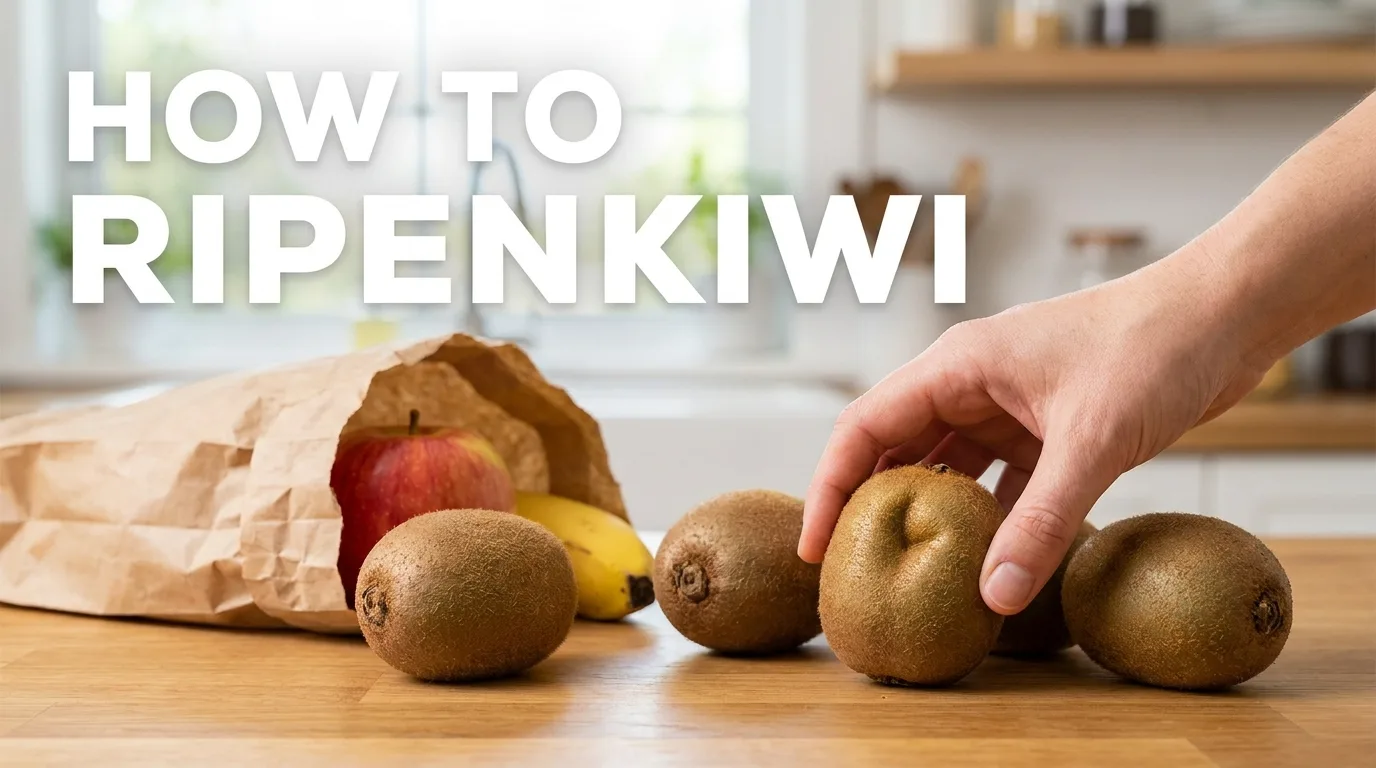
To ripen kiwi, leave firm fruit at room temperature away from direct sunlight. For faster ripening, place the kiwis in a loosely closed paper bag with an apple or banana and check them once a day. Most firm kiwis become ready in about 1–3 days with the fruit-bag method or roughly 3–5 days on the counter, although the timing varies by fruit. A ripe kiwi should give slightly to gentle pressure rather than feel rock-hard.
What You Need
For ordinary ripening:
- Firm, uncut kiwis
- A bowl, plate, or fruit basket
- A room-temperature spot away from direct sunlight
For faster ripening:
- Firm kiwis
- A brown paper bag
- 1 apple or banana
You do not need to heat the kiwi, place it in an oven, or use any special appliance. Kiwifruit responds strongly to ethylene, a natural plant hormone involved in ripening. Apples and bananas release ethylene, so keeping them with kiwi can accelerate softening.
How to Ripen Kiwi Naturally

1. Check the kiwis before you start
Pick out the firm kiwis you want to ripen.
A kiwi that is completely firm is generally not ready to eat. That does not necessarily mean it is poor quality. Kiwis are commonly sold firm so they can withstand handling and storage before they reach eating ripeness.
Avoid fruit with leaking areas, major bruises, cuts, or suspiciously soft spots. A ripe kiwi should soften as a whole rather than having one isolated mushy area.
If a kiwi already has some give when you gently press it, it may only need a short time before eating. There is no need to put a partly ripe kiwi through an accelerated method if you are not in a hurry.
2. Put the kiwi at room temperature
Place the firm kiwis in a bowl or on a plate and leave them at room temperature.
Keep them away from direct sunlight, radiators, hot appliances, and other sources of concentrated heat. The goal is normal room-temperature ripening, not heating the fruit.
Depending on the fruit and its starting condition, this can take around 3–5 days. Some kiwis can take longer, so use texture as the final test rather than treating the calendar as a guarantee.
Check the fruit once a day. Avoid repeatedly squeezing the same spot hard because that can bruise the fruit.
What to look for: the kiwi should begin to yield slightly when gently pressed. A rock-hard kiwi needs more time.
Common mistake: leaving the fruit in strong sunlight because you think extra warmth will make it ripen faster. Excess heat can damage quality rather than give you controlled ripening.
How to Ripen Kiwi Faster in a Paper Bag
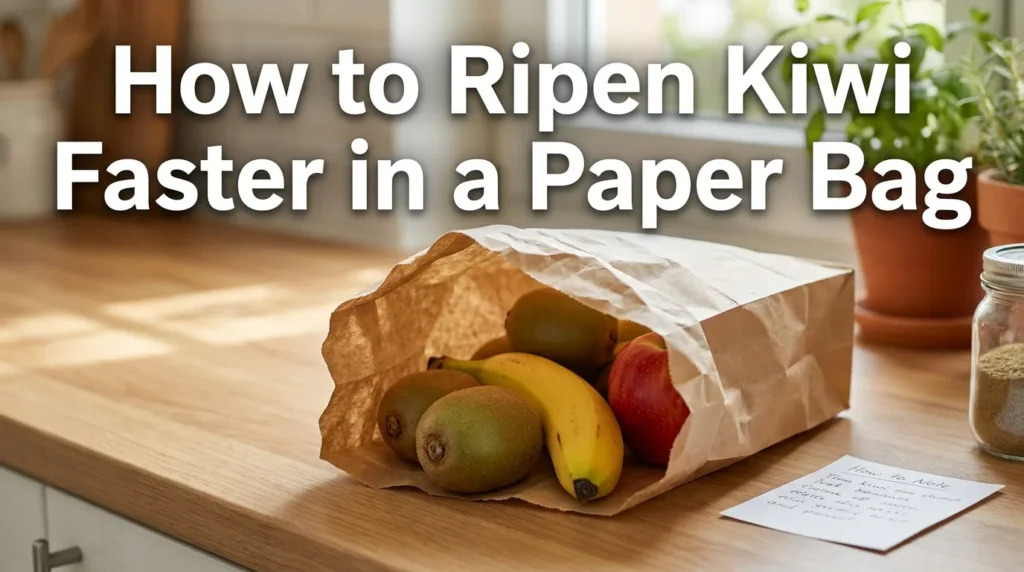
If you need ripe kiwi sooner, the paper-bag method is the simplest practical option.
1. Put the kiwis in a paper bag
Place the firm kiwis inside a clean brown paper bag.
You do not need to tightly seal the bag. Fold the opening over loosely so the fruit is enclosed while still allowing some air exchange.
The purpose is to create a small environment where ethylene around the fruit can build up. Kiwifruit is highly responsive to ethylene, and exposure accelerates softening.
2. Add an apple or banana
For faster ripening, put an apple or banana in the bag with the kiwi.
Apples and bananas produce ethylene, which can stimulate kiwi ripening. University and government food-storage guidance specifically recommends using ethylene-producing fruit to speed the process.
You do not need to fill the bag with fruit. One apple or banana is enough to create a useful ethylene-rich environment.
3. Leave the bag at room temperature
Keep the bag on a counter or another room-temperature location away from direct sunlight.
Start checking the kiwi after about 24 hours, particularly if the fruit was already beginning to soften. Depending on its initial firmness, the process may take around 1–2 days, while some fruit can take longer.
The important point is that the timing is not exact. Variety, maturity at harvest, previous storage, temperature, and the condition of the fruit can all affect how quickly it softens.
4. Remove ripe kiwis from the bag
Once a kiwi gives slightly to gentle pressure, take it out of the bag.
If several kiwis are ripening together, do not assume they will all become ready simultaneously. Check each fruit separately.
Move ripe kiwis to the refrigerator if you are not going to eat them soon. Refrigeration slows further ripening and helps extend their usable life.
What to look for: slight, even softness rather than a hard center with a mushy patch.
Common mistake: forgetting about the bag for several days. The accelerated method can move a kiwi from firm to overripe faster than ordinary countertop storage, so daily checking matters.
How Do You Know When a Kiwi Is Ripe?
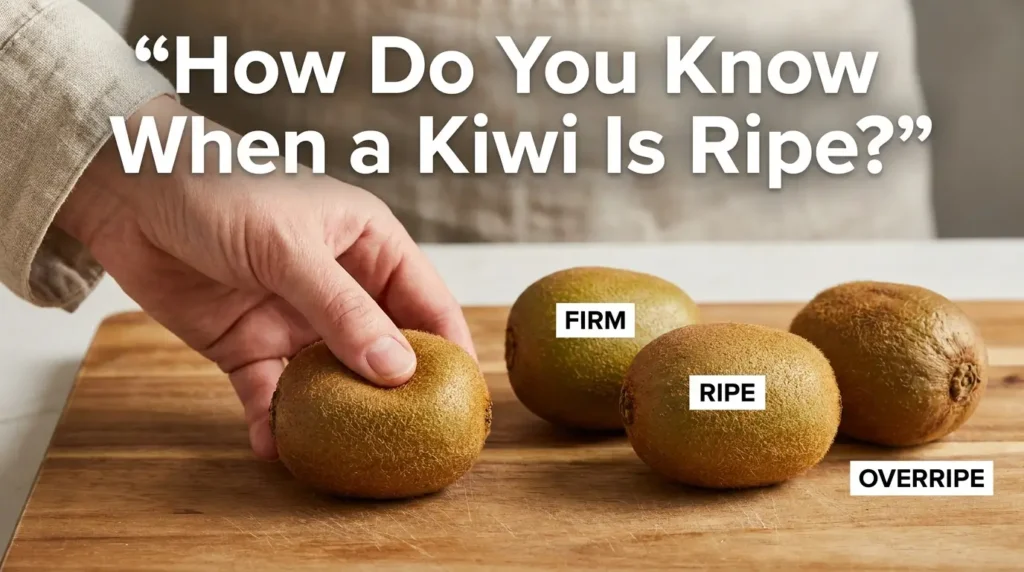
The most useful test is gentle pressure.
Hold the kiwi in your fingers and press it lightly with your thumb. A ripe kiwi should have some give. An unripe kiwi usually feels hard and firm.
You can also use smell and appearance as supporting clues. A ripe kiwi may have a noticeable fresh, fruity aroma, while the fruit should remain intact rather than showing leaking or rotten areas. The University of Minnesota describes ripe kiwifruit as fragrant, plump, and slightly soft to the touch.
Firm vs. ripe vs. overripe kiwi
| Kiwi condition | What it feels like | What to do |
| Unripe | Very firm, little or no give | Continue ripening |
| Nearly ripe | Slightly softer but still fairly firm | Check again soon |
| Ripe | Gives slightly to gentle pressure | Eat or refrigerate |
| Overripe | Very soft, mushy, leaking, or damaged | Inspect carefully and discard if spoiled |
Do not judge ripeness solely by the color of the fuzzy brown skin. Texture is a much more useful indicator for deciding whether a whole kiwi is ready to eat.
How Long Does Kiwi Take to Ripen?
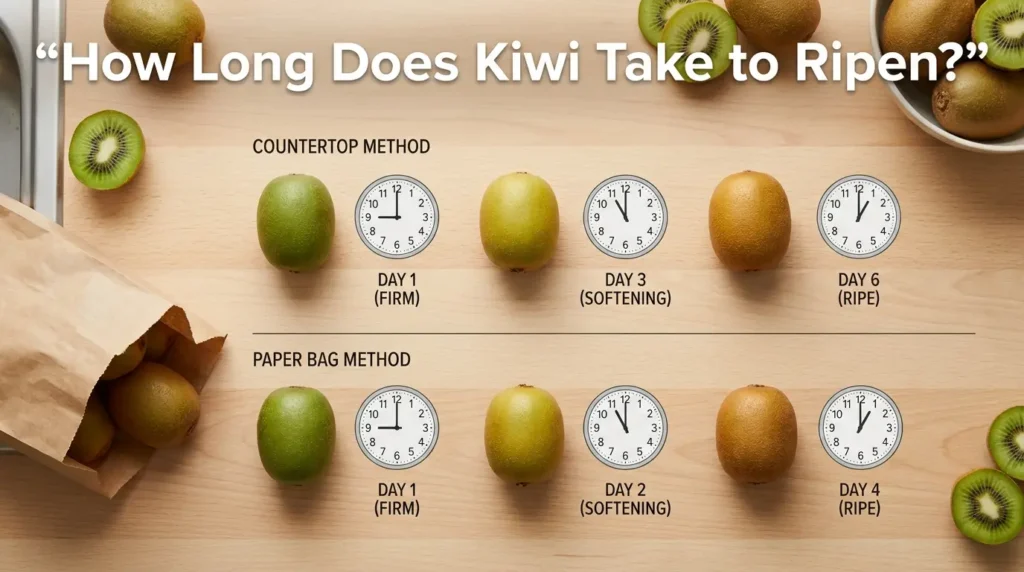
There is no single guaranteed ripening time.
A firm kiwi left at room temperature may take around 3–5 days, while a paper bag with an apple or banana can shorten the process to approximately 1–2 days in many cases. Other sources give somewhat broader windows, which is why texture is more reliable than a fixed timer.
| Method | Approximate time | Best for |
| Counter at room temperature | About 3–5 days | Normal ripening |
| Paper bag alone | Often a few days | Moderate acceleration |
| Paper bag + apple or banana | About 1–2 days in many cases | Faster ripening |
| Refrigerator | Slows ripening | Holding fruit before or after ripening |
These are practical ranges rather than guarantees. A particularly firm kiwi may take longer, while fruit that was already partially ripe can become ready much sooner.
Why Does Kiwi Ripen After You Buy It?
Kiwifruit can continue ripening after harvest. Ethylene plays an important role in the process, and kiwis are particularly sensitive to this plant hormone. UC Davis postharvest information notes that kiwifruit can respond to very low concentrations of ethylene and that higher temperatures increase the rate of ripening.
This explains why two simple changes work at home:
Room temperature speeds the process compared with cold storage.
An apple or banana supplies additional ethylene around the kiwi.
Commercial handling uses controlled temperature, humidity, and ethylene exposure to manage kiwi ripening. At home, you do not need to reproduce those commercial conditions. A counter or paper bag provides a much simpler way to control the process.
Can You Ripen Kiwi in the Refrigerator?
A refrigerator is useful for slowing ripening, not for making a hard kiwi ripen quickly.
If your kiwi is still firm and you want to eat it soon, take it out of the refrigerator and let it ripen at room temperature. Once it reaches the desired texture, refrigerate it if you need to keep it for longer.
Cold storage is widely used for extending the storage life of kiwifruit. USDA storage information lists commercial kiwifruit storage around 32°F (0°C), while consumer guidance recommends refrigeration for ripe fruit.
So, if your kiwi has been sitting in the refrigerator and still feels hard, that is not necessarily a sign that it will never ripen. It may simply be progressing slowly because of the cold.
Can You Ripen Kiwi With a Banana?
Yes. A banana can help accelerate kiwi ripening because bananas release ethylene.
Put the firm kiwi and a banana together in a paper bag and keep them at room temperature. Check the kiwi daily and remove it when it develops slight give.
This is different from simply putting a kiwi beside a banana in an open fruit bowl. The paper bag helps concentrate the ethylene around the fruit, while room temperature allows the ripening process to proceed.
University of Nevada Extension specifically recommends adding apples or bananas to a paper bag when faster kiwi ripening is desired.
Can You Ripen Kiwi With an Apple?
Yes. An apple can also be used as the ethylene-producing fruit in the paper-bag method.
Put the kiwi and apple together in a loosely closed paper bag at room temperature. Check the kiwi daily.
You do not need a special type of apple. The important point is that apples produce ethylene, which can promote ripening in sensitive produce.
If you have both apples and bananas available, there is no practical need to add large quantities of either. One companion fruit is sufficient for a simple home setup.
What If the Kiwi Is Still Hard After Several Days?
If the kiwi remains hard after several days, first check its storage conditions.
Problem → Kiwi is still completely firm
Likely cause: It needs more ripening time, or it was being kept too cold.
Solution: Move it to room temperature. If you want to accelerate the process, use the paper-bag method with an apple or banana and check it daily.
Problem → Kiwi is soft in one spot but hard elsewhere
Likely cause: Localized bruising or damage rather than uniform ripening.
Solution: Inspect the fruit carefully. A healthy ripe kiwi should soften without becoming wet, leaking, or badly damaged. If the soft area looks spoiled rather than naturally ripe, discard the fruit.
Problem → Kiwi became very soft before you checked it
Likely cause: The accelerated ripening environment was left unchecked for too long.
Solution: Refrigerate ripe kiwis promptly when you are not eating them. For future batches, check the fruit at least once a day.
Problem → Kiwi has wrinkles
Likely cause: Moisture loss rather than simply being under-ripe.
Solution: Wrinkled fruit may have lost quality. Check for excessive softness, leaking, mold, or an unpleasant odor. Do not try to rescue fruit that shows obvious spoilage. The California Department of Education recommends selecting kiwis without wrinkles, soft spots, cuts, or bruises.
Should You Put Kiwi in a Plastic Bag?
A paper bag is the more useful choice when your goal is to accelerate ripening.
A paper bag can concentrate ethylene around the fruit while still allowing some air exchange. For ordinary storage after ripening, however, a closed container or suitable produce bag can help reduce moisture loss and extend freshness.
The distinction matters: ripening and storage are two different stages.
When the kiwi is hard, you want controlled ripening at room temperature. When it is ripe, you generally want to slow further changes, which is where refrigeration becomes useful.
Can Heat Make Kiwi Ripen Faster?
Higher temperatures can increase the rate of kiwi ripening, but deliberately heating the fruit is not a good household technique.
There is an important difference between normal room temperature and concentrated heat. Putting kiwi near a heater, in direct sunlight, or in another very hot location does not give you the same controlled conditions used in commercial ripening.
Keep the fruit at ordinary room temperature and use ethylene from an apple or banana if you need to accelerate it. UC Davis notes that higher temperatures increase the ripening rate, while consumer guidance recommends room-temperature conditions and avoiding unusual heat and direct sunlight.
What Is the Difference Between Ripening and Softening?
Softness is the easiest home indicator of eating ripeness, but the two concepts are not exactly identical.
Kiwifruit undergoes several changes during ripening, including changes in firmness and flavor. As the fruit progresses toward eating ripeness, it becomes less firm and more pleasant to eat.
That is why squeezing the kiwi gently works better than relying on a specific number of days. Two fruits purchased on the same day can have different histories and may not reach eating ripeness simultaneously.
If your kiwi has the right amount of give and smells fresh and fruity, it is generally at the stage you are looking for.
How to Store Kiwi After It Ripens
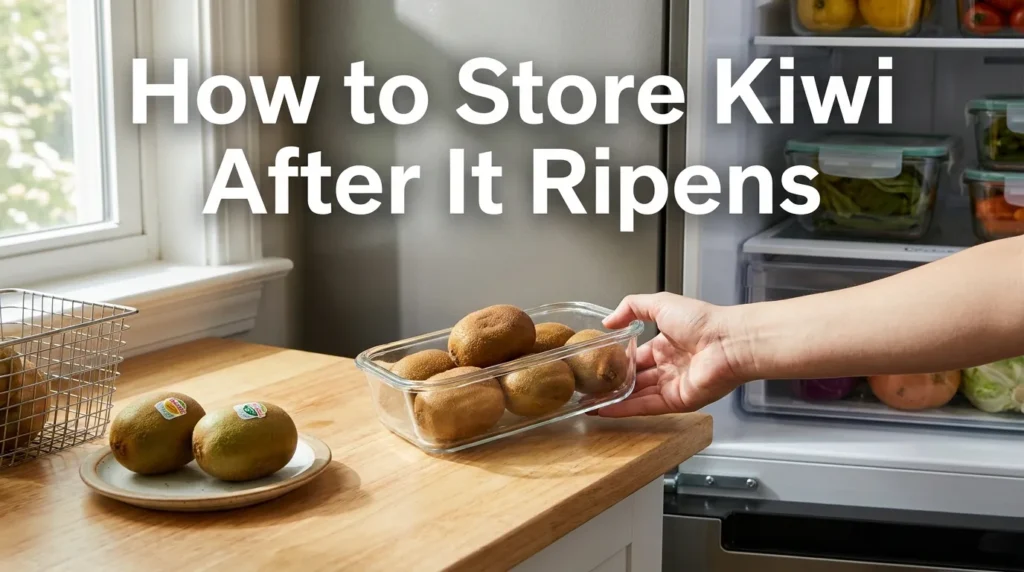
Once the kiwi has reached your preferred softness, refrigerate it if you are not going to eat it shortly.
The California Department of Education advises refrigerating ripe kiwifruit and reports a storage life of several days under refrigeration. Other university guidance gives longer periods depending on storage conditions and packaging.
For practical home use:
- Check the kiwi for your preferred softness.
- Remove ripe fruit from the ripening bag.
- Refrigerate it if you are not eating it soon.
- Keep checking stored fruit for deterioration.
- Eat fruit showing signs of spoilage rather than trying to continue storing it.
Do not put ripe and very firm kiwis together and assume they will all have the same remaining shelf life. Check them individually.
Should You Ripen All Your Kiwis at Once?
Not necessarily.
If you bought a large batch of kiwi, ripening only what you expect to eat soon can make storage easier. Keep the remaining firm fruit in appropriate cool storage and bring individual kiwis to room temperature when you want them to ripen.
This gives you more control over when fruit reaches eating ripeness.
For example, if you have six firm kiwis but only expect to eat two in the next couple of days, you can ripen those two while keeping the others from progressing as quickly. Commercial postharvest guidance emphasizes the strong effect of temperature and ethylene on kiwi ripening, which is the basic principle behind this approach.
Does Kiwi Need to Be Soft All Over?
It should have some give, but it does not need to feel mushy.
A ripe kiwi is not supposed to have the consistency of an overripe peach. If gentle pressure produces a small amount of give and the fruit remains intact, that is a useful eating-ripeness cue.
If the kiwi is extremely soft, leaking, collapsing, or developing an unpleasant smell, that is no longer simply a question of being “more ripe.” Those are potential spoilage signs.
For the best eating texture, stop the ripening process when the fruit has reached the softness you prefer rather than waiting for it to become very soft.
Can You Eat a Kiwi That Is Still Firm?
You can eat a firm kiwi, but it will generally be less soft and sweet than one that has reached eating ripeness.
A very firm kiwi tends to have a harder texture and a sharper flavor. If that is not what you want, give it more time at room temperature.
You can also use a firm kiwi in dishes where a crisp, tart fruit is desirable, but if your goal is a juicy, sweet kiwi, continue ripening it.
Frequently Asked Questions
How do you ripen kiwi quickly?
Put firm kiwis in a loosely closed paper bag with an apple or banana and leave the bag at room temperature. Check the fruit daily and remove each kiwi when it gives slightly to gentle pressure.
How long does it take to ripen kiwi at room temperature?
A useful expectation is around 3–5 days, although the actual time varies. Start checking daily rather than relying on a fixed date.
How long does kiwi take to ripen in a paper bag?
With an apple or banana, kiwi may become ready in around 1–2 days, but some fruit takes longer. The fruit’s firmness is a better indicator than an exact timer.
Does putting kiwi next to bananas make it ripen faster?
Yes. Bananas produce ethylene, which can accelerate ripening in kiwifruit. A paper bag can make this method more effective by concentrating ethylene around the fruit.
Does kiwi ripen in the refrigerator?
It can continue changing in storage, but refrigeration substantially slows the ripening process. Use room temperature when you want a firm kiwi to ripen and refrigeration when you want to slow down ripe fruit.
How can you tell if a kiwi is ripe without cutting it?
Gently press it. A ripe kiwi should yield slightly, while an unripe one is usually firm. A fresh fruity aroma can provide another clue.
Why is my kiwi soft but still sour?
Softness is a practical indicator of eating ripeness, but flavor can vary between fruit. If the kiwi is soft but has an unpleasant or fermented smell, leaking areas, or other spoilage signs, do not treat it as ordinary ripening.
Should you wash kiwi before ripening it?
There is no need to wash kiwi before ripening. If you wash it, dry it thoroughly before storage. Wash produce before eating or preparing it, following normal produce-handling practices.
Can you ripen cut kiwi?
The methods above are intended for whole, intact kiwis. Once kiwi has been cut, treat it as cut produce rather than trying to ripen it like whole fruit. Refrigerate cut fruit promptly and use clean utensils and surfaces.
Safety and Spoilage
Ripening should make the kiwi progressively softer and more pleasant to eat. It should not produce mold, leaking, widespread decay, or a distinctly rotten or fermented odor.
Do not use heat, an oven, or another high-temperature shortcut to force ripening. For a firm kiwi, room temperature plus time is sufficient, while an apple or banana can accelerate the process.
If the fruit has obvious mold or significant spoilage, discard it rather than cutting away a questionable section and assuming the remainder is safe.
Conclusion
For ordinary ripening, leave firm kiwi at room temperature and check it daily. If you need it sooner, put the fruit in a loosely closed paper bag with an apple or banana, then refrigerate the kiwi once it gives slightly to gentle pressure.
