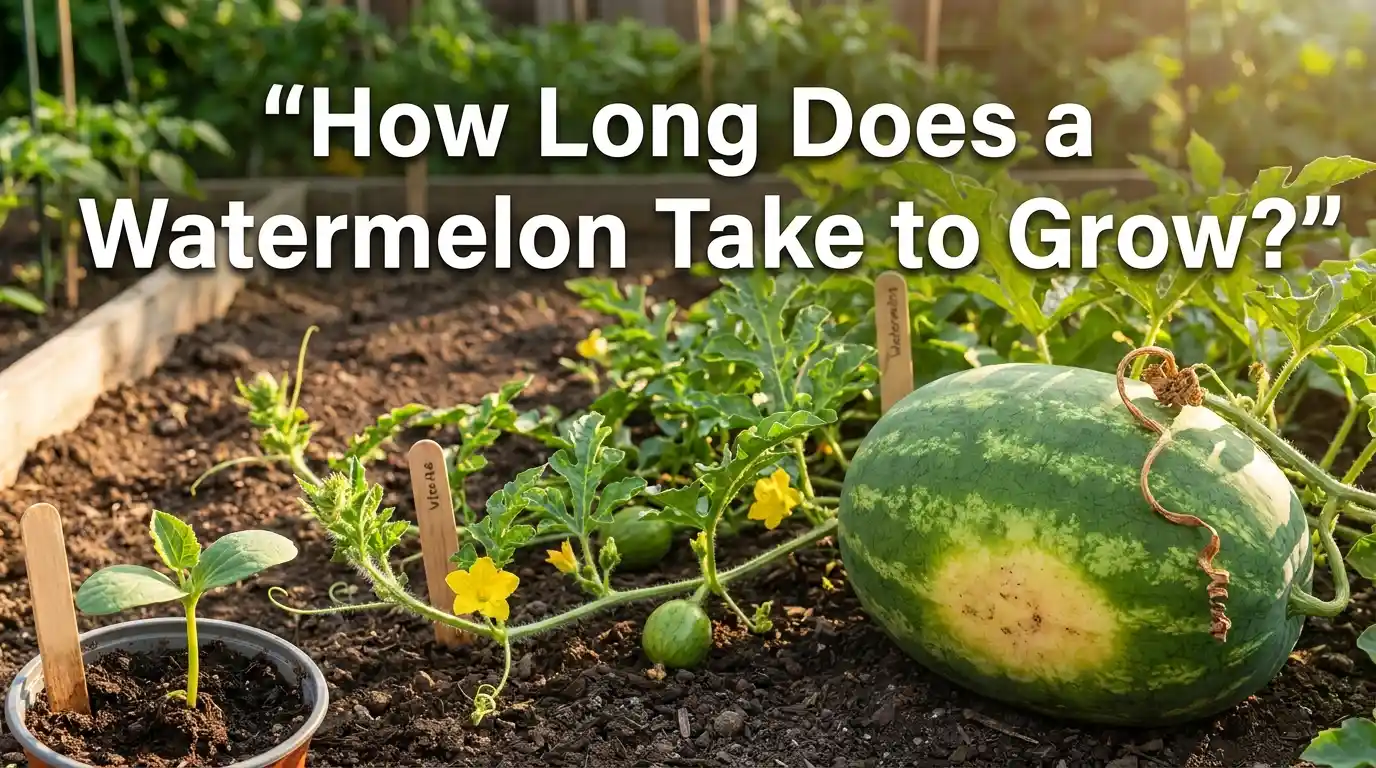
Quick Answer: Watermelons usually take about 70–100 days from planting to harvest, although some varieties can take longer. The exact time depends mainly on the variety, temperature, and growing conditions. After a female flower is successfully pollinated, the fruit generally needs another 35–45 days to mature.
The calendar gives you an estimate, but the ripeness signs on the fruit are more important than counting days alone. A ripe watermelon typically has a creamy-yellow ground spot, a dried brown tendril near the fruit, and a less shiny rind.
How Long Does a Watermelon Take to Grow From Seed?
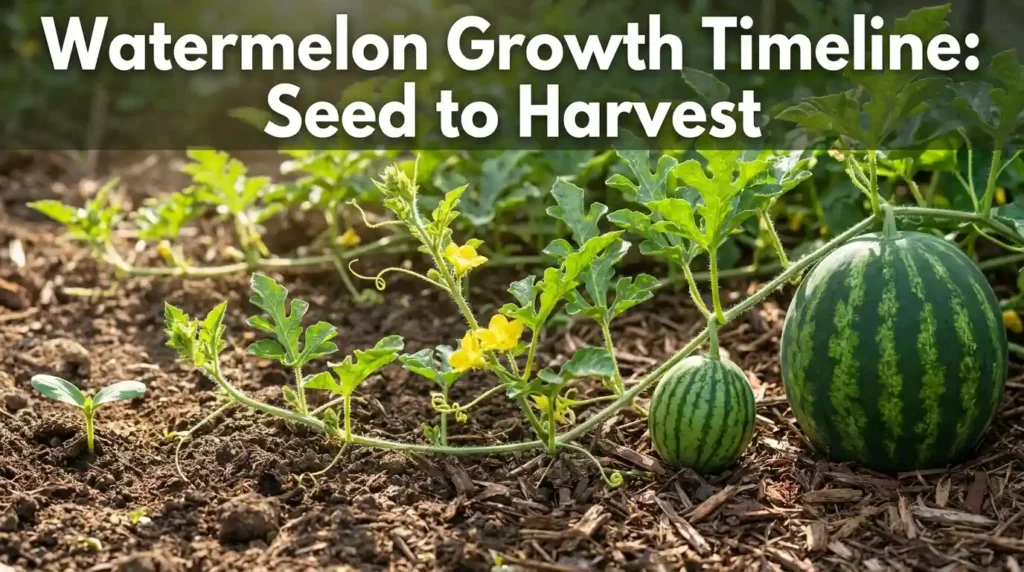
From planting a seed to harvesting a ripe watermelon, expect roughly 10–14 weeks, or around 70–100 days, under good growing conditions. Some varieties mature closer to 70–80 days, while others need 90 days or more. University of Georgia Extension, for example, lists 80–90 days for several watermelon types, while University of Florida Extension gives a general range of 80–100 days.
There is no single number that applies to every watermelon. The variety listed on your seed packet is the best starting point because its stated “days to maturity” reflects its genetics.
A useful way to think about the timeline is:
| Growth stage | Approximate time |
| Seed germination | 4–10 days |
| Seedling establishment | About 2–3 weeks |
| Vine and leaf growth | Several weeks |
| Flowering and pollination | Around 5–8 weeks after planting, depending on conditions |
| Fruit development after pollination | 35–45 days |
| Total seed-to-harvest time | Usually 70–100 days |
Watermelon seeds can emerge particularly quickly in warm soil. Georgia Extension reports emergence in about five days at a soil temperature of 77°F (25°C), while its broader germination guidance gives about 4–5 days under suitable conditions.
The important point is that germination is only the beginning. Most of the waiting happens while the plant builds a large vine, flowers, sets fruit, and then fills and ripens the watermelon.
Watermelon Growth Timeline: Seed to Harvest
1. Germination: About 4–10 Days
The first stage starts when the seed is planted in warm, moist soil.
Watermelon prefers warm conditions. Georgia Extension gives a germination temperature range of approximately 68–95°F (20–35°C) and notes that germination below 70°F is slow. Under favorable conditions, seedlings can emerge within about five days.
At this point, don’t judge your growing progress by the size of the plant. A watermelon seedling initially looks small compared with the large vine it will eventually produce.
You’ll first see the seed leaves emerge, followed by the plant’s true leaves.
What to look for: A healthy green seedling with upright growth and no prolonged waterlogging around the roots.
Common mistake: Planting watermelon in cold soil. Cool conditions can slow germination and early growth considerably.
2. Seedling and Vine Growth: The Next Few Weeks
Once established, the watermelon plant begins producing larger leaves and extending its vines.
This is when the plant starts taking up considerable garden space. Watermelons are vigorous vines, so the plant needs sufficient room, sunlight, water, and nutrients to develop before it can produce a good crop.
Watermelons grow best in sunny locations and fertile, well-drained soil. University of Georgia Extension recommends approximately 8–10 hours of sunlight per day, while Utah State University also emphasizes a sunny location and well-drained soil.
The plant’s early growth is important because the leaves supply the energy needed later for fruit development.
What to look for: Increasing numbers of large true leaves, longer runners, and vigorous vine growth.
Common mistake: Trying to keep the vine too small by repeatedly cutting it back without a specific reason. Watermelon needs substantial leaf growth to support fruit development.
3. Flowering and Pollination
After several weeks of vegetative growth, the plant begins producing flowers.
Watermelon plants produce separate male and female flowers on the same plant. The female flower can be recognized by the small swollen structure behind the flower, which will become the watermelon if pollination succeeds.
Pollination is an important turning point because the small swelling behind a successfully pollinated female flower begins developing into fruit.
Poor pollination can make it appear as though your watermelon plant is “growing but not producing.” A plant can have plenty of flowers without producing mature melons if the female flowers aren’t successfully pollinated.
What to look for: Female flowers with a small watermelon-shaped swelling behind them that continues enlarging after flowering.
Common mistake: Assuming every flower will become a watermelon. Male flowers do not produce fruit, and an unsuccessful female flower can stop developing.
4. Fruit Development: About 35–45 Days After Flowering
Once a female flower is successfully pollinated, the small fruit begins to enlarge.
This is the stage that often causes confusion because the watermelon may become large relatively quickly but still not be ripe.
Utah State University Extension says watermelon fruits generally take 35–45 days to mature from flowering, depending on temperature and variety. Other extension guidance puts the period at approximately five to six weeks after pollination.
During this period, the fruit increases in size and develops its mature flesh and flavor.
Warm weather generally supports faster development, while cooler conditions can delay maturity. This is why two plants of the same variety can sometimes reach harvest at different times.
What to look for: The fruit should continue increasing in size and gradually approach the characteristic shape and rind pattern of its variety.
Common mistake: Picking as soon as the watermelon reaches its expected size. Size does not necessarily mean ripeness.
5. Ripening and Harvest
Near the end of the growing period, the watermelon stops behaving like a rapidly expanding young fruit and begins showing physical signs that it has reached maturity.
This is when you should pay less attention to the calendar and more attention to the melon itself.
Watermelons are non-climacteric fruits, meaning they do not continue ripening normally after harvest. That makes correct harvest timing particularly important.
How Do You Know When a Watermelon Is Ready to Pick?
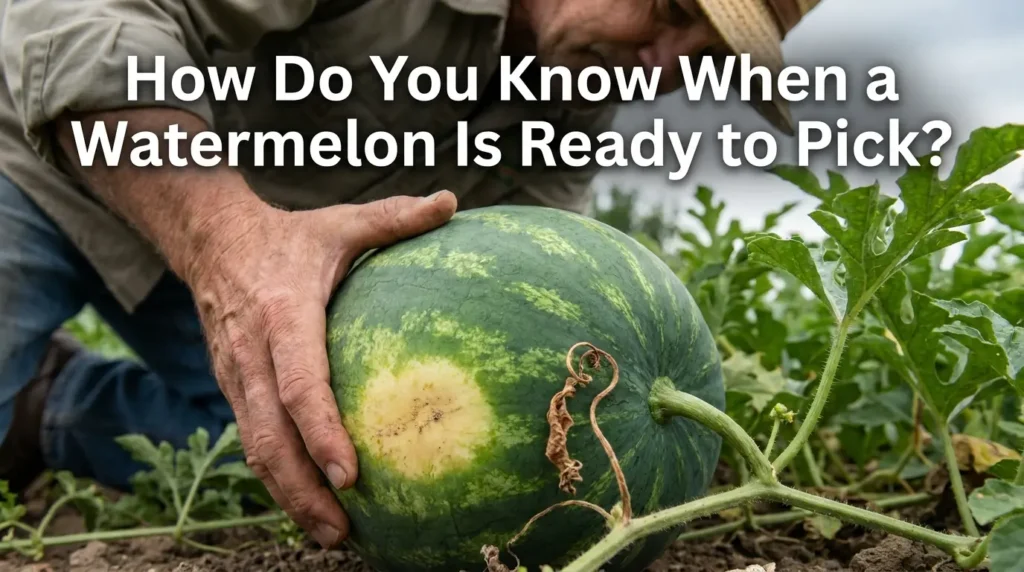
Don’t rely on just one sign. Use several indicators together.
1. Check the Ground Spot
The ground spot is the portion of the watermelon that rests against the soil.
As the fruit matures, this area generally changes from pale green or white to cream or yellow. A clearly creamy-yellow ground spot is one of the more useful visual indicators of maturity.
If the spot is still white or very pale green, the melon may need more time.
This is particularly useful because you can check the fruit without cutting it open.
2. Look at the Tendril Near the Fruit
Find the curly tendril closest to the watermelon where the fruit’s stem connects to the vine.
As the melon approaches maturity, this tendril generally becomes brown, dry, and withered.
However, don’t treat the tendril as an infallible countdown clock. Iowa State Extension notes that in some varieties the tendril can turn brown 7–10 days before the melon is actually ripe. Using it together with the ground-spot color is more reliable than using it by itself.
3. Check the Rind’s Appearance
A developing watermelon often has a relatively shiny appearance.
As it reaches maturity, the rind can become duller or less glossy. This characteristic varies by variety, so use it as supporting evidence rather than your only test.
4. Don’t Depend on the Thump Test Alone
You’ve probably heard that a ripe watermelon should make a hollow sound when tapped.
There is some basis for this traditional test, but it is not particularly reliable for inexperienced growers. Iowa State Extension specifically notes that many people have difficulty distinguishing the sounds accurately, while University of Minnesota and Utah State Extension describe the dull or muffled sound as only one of several maturity indicators.
If the ground spot is still white and the nearby tendril is green, a convincing thump shouldn’t override those other signs.
A better approach: Use the ground spot and tendril first, then consider rind appearance and sound as supporting clues.
Does Watermelon Grow Faster in Hot Weather?
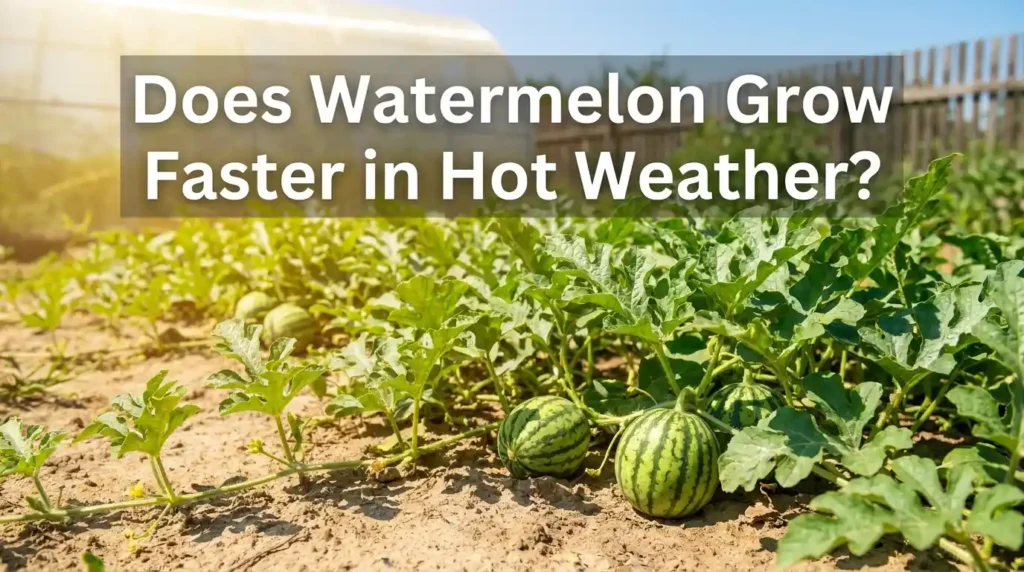
Yes. Watermelon is a warm-season crop, and temperature has a major influence on how quickly it develops.
Cold soil can slow germination, while cool growing conditions can delay plant development and maturity. Georgia Extension recommends warm soil for planting, with 65–70°F (18–21°C) or warmer conditions for setting plants into the garden.
Watermelons also need plenty of sunlight. University of Georgia Extension recommends 8–10 hours of sunlight per day.
That means a watermelon planted at the beginning of a warm, sunny growing season may reach harvest sooner than the same variety grown through a cool or cloudy period.
However, simply making conditions hotter isn’t a shortcut to instant watermelons. Excessive plant stress from poor watering, pests, diseases, or inadequate nutrition can work against healthy growth. University of Florida Extension specifically identifies insect and disease pressure, poor nutrition, and both too much and too little water as factors that can affect watermelon performance.
How Much Water Does a Watermelon Need While Growing?
Watermelon needs consistent moisture, particularly while the plant is establishing and fruit is developing.
Utah State University recommends roughly 1–2 inches of water per week, with deep rather than shallow irrigation. It also recommends reducing watering as the fruit approaches ripeness.
The exact amount your plants need depends on rainfall, soil type, temperature, and drainage, so don’t treat 1–2 inches as a rigid daily target.
A better approach is to maintain adequate soil moisture without leaving the roots sitting in saturated soil.
During fruit development: Keep moisture reasonably consistent.
As ripening approaches: Avoid excessive irrigation, particularly if the soil is already adequately moist.
The goal is not to force the plant to grow faster by constantly adding water. Excessive or inconsistent watering can create growing problems instead.
Does the Watermelon Variety Change the Growing Time?
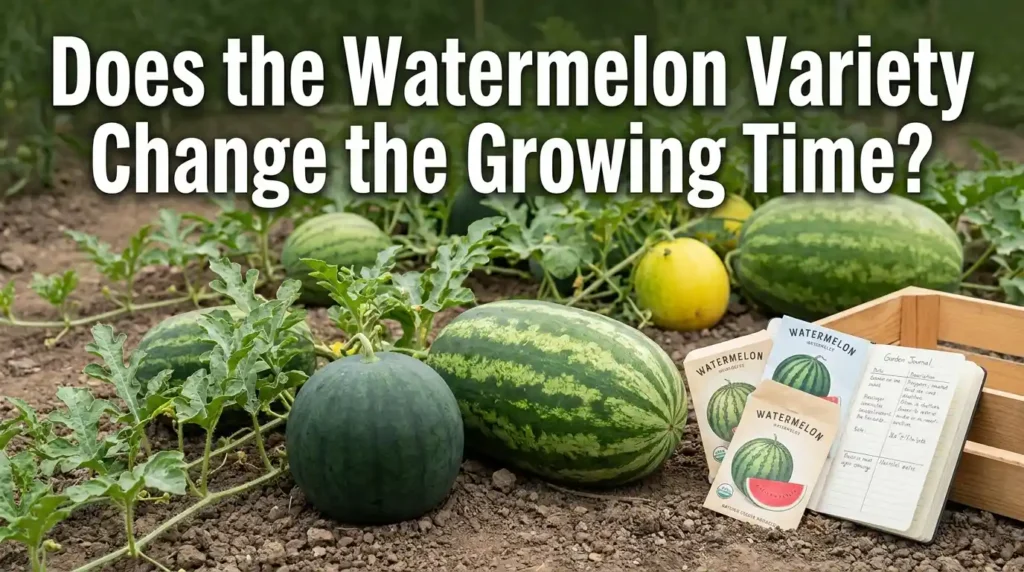
Yes. Variety is one of the biggest reasons there isn’t one universal watermelon growing time.
University of Pennsylvania Extension lists examples ranging from 68 days for Yellow Doll to approximately 85–87 days for several larger varieties, with seedless varieties in its table ranging from roughly 78–80 days for the examples shown.
University of Georgia also lists approximately 80–90 days for several watermelon categories and emphasizes that maturity varies by cultivar, temperature, and general growing conditions.
So, if your seed packet says 75 days, don’t assume every watermelon planted in your garden will be ready exactly 75 days later.
Instead, treat the number as an estimated maturity period and confirm maturity using the fruit’s physical signs.
A simple comparison
| Watermelon type/example | Approximate maturity |
| Early/smaller types | Around 68–80 days |
| Many standard varieties | Around 80–90 days |
| Larger or slower varieties | Around 90–100+ days |
| After successful pollination | About 35–45 days |
These are useful planning ranges, not guarantees. Your specific seed packet should take priority for its variety.
Does Growing From a Transplant Save Time?
It can.
Starting with an established transplant means the seed has already completed its germination and early seedling stages before the plant enters the garden.
Utah State University notes that transplants can mature approximately two weeks earlier than seeded melons and can be useful where the growing season is short.
That doesn’t mean a transplant turns a 90-day watermelon into a 30-day crop. It mainly gives the plant a head start.
There is also a tradeoff: watermelon roots can be sensitive to disturbance, so careless transplanting can slow establishment. Utah State University recommends avoiding root damage when planting because it can slow growth.
For a long, warm growing season, direct seeding can be straightforward. For a short season, a healthy transplant can help you get the crop started earlier.
What Can Make a Watermelon Take Longer to Grow?
Several factors can stretch the expected timeline.
Cool temperatures
Watermelons prefer warm growing conditions. Low temperatures slow development, particularly early in the season.
Insufficient sunlight
Watermelon needs a sunny growing location. Shading can reduce the energy available for vigorous growth and fruit development.
Poor pollination
If female flowers are not successfully pollinated, they won’t develop into mature watermelons.
Water stress
Both inadequate and excessive water can interfere with healthy growth. Consistent moisture is especially important during fruit development.
Variety
An early watermelon and a large, long-season variety can have substantially different maturity dates. Always check the variety’s expected days to maturity.
Pests and disease
Healthy leaves and vines are important because the plant needs them to support fruit development. Pest and disease problems can reduce plant performance and delay or compromise the crop.
Why Is My Watermelon Big but Still Not Ripe?
A watermelon can reach an impressive size before it is ready to harvest.
Don’t use fruit size alone as the deciding factor.
Instead, check the ground spot, nearby tendril, and rind appearance together. A white ground spot combined with a green, flexible tendril suggests that the fruit may still need more time. A creamy-yellow ground spot and a dry brown tendril are stronger signs that it is approaching maturity.
The variety matters too. A naturally large variety may be much bigger than an icebox variety when both are fully mature.
If you have the seed packet, compare the fruit’s development with the listed maturity period before deciding that something is wrong.
Why Did My Watermelon Stop Growing?
If the fruit appears to have stopped getting larger, don’t immediately assume it has failed.
Watermelons don’t grow at a constant rate from pollination to harvest. The fruit eventually reaches its mature size and shifts toward final ripening.
Check:
Problem → Likely cause → Solution
Small fruit that stops developing → Poor or unsuccessful pollination → Watch subsequent female flowers and pollinator activity.
Plant grows vines but produces no watermelons → Flowering without successful female-flower pollination → Encourage normal pollinator activity and avoid disturbing flowers unnecessarily.
Fruit develops slowly → Cool weather or plant stress → Check sunlight, soil moisture, pests, and disease rather than simply adding more fertilizer or water.
Fruit looks full-sized but remains unripe → Harvesting based on size alone → Check the ground spot and tendril and compare them with the variety’s expected maturity period.
Can You Pick a Watermelon Early and Let It Ripen Later?
Not in the same way as a climacteric fruit such as a banana.
Watermelons generally do not continue to increase their sugar content after harvest, which is why they should be left on the vine until they reach proper maturity. University of California’s Postharvest Research and Extension Center states that watermelons are harvested at full maturity because they generally do not develop their internal color or increase sugars after removal from the vine.
This is why harvesting based solely on size or a calendar date can result in a watermelon that looks ready but tastes disappointing.
If you have to choose between “the fruit has reached the expected number of days” and “the fruit has reached the expected number of days and shows maturity signs,” the second situation gives you more useful evidence.
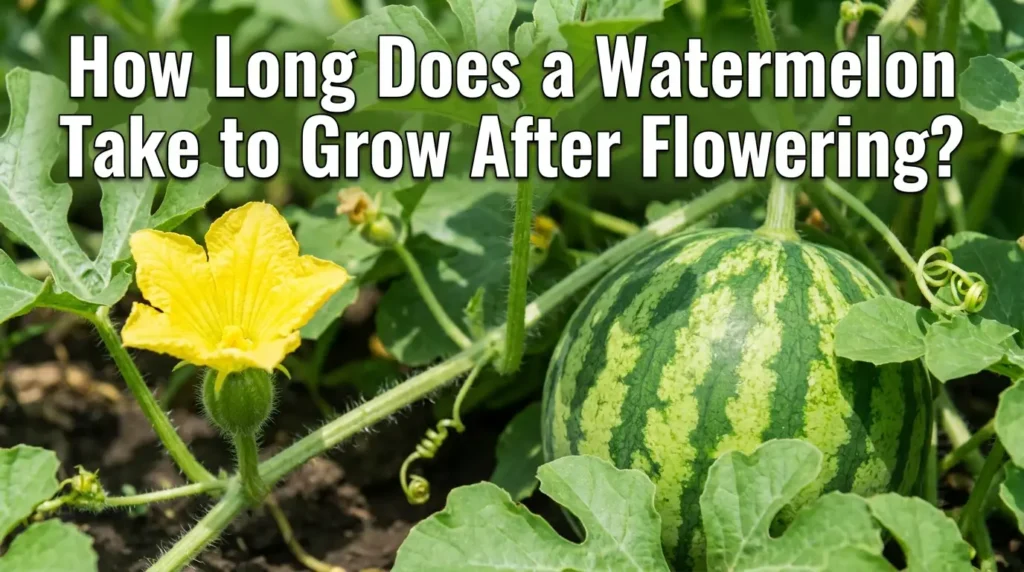
How Long Does a Watermelon Take to Grow After Flowering?
A watermelon usually needs about 35–45 days after flowering, depending on the variety and growing temperature. Commercial extension guidance commonly describes this as roughly five to six weeks after pollination.
This can be more useful than counting from planting when you’re already looking at a particular fruit.
For example, if you know that a female flower was successfully pollinated around June 1, a rough starting point for checking maturity would be around the first or second week of July. You would still confirm the fruit’s physical maturity rather than harvesting solely because 35–45 days have passed.
How Long Does a Mini or Small Watermelon Take to Grow?
Small or “icebox” watermelons can mature sooner than some large varieties, but there is no universal time based solely on fruit size.
For example, Pennsylvania Extension lists Yellow Doll at 68 days, while several larger varieties in the same table fall around 85–87 days.
Your seed packet’s days-to-maturity figure is therefore more useful than assuming a small watermelon must mature within a particular number of days.
FAQ
How many days does it take for watermelon to grow?
Most watermelons take approximately 70–100 days from planting to harvest, depending on variety and growing conditions. Some varieties mature sooner, while others require more than 100 days.
How long does a watermelon take to grow after pollination?
Expect roughly 35–45 days, or about five to six weeks, after successful pollination for many varieties. Temperature and cultivar can shift this period.
What is the fastest way to grow watermelon?
There isn’t a shortcut that guarantees a specific harvest date. Starting with an appropriate early-maturing variety, planting in warm soil, providing full sun, maintaining suitable moisture, and avoiding plant stress can help the crop stay close to its expected maturity period.
How do I know when my watermelon is ripe?
Look for a creamy-yellow ground spot, a brown and dried tendril near the fruit, and a duller rind. Use several signs together rather than relying only on the sound when you tap the melon.
Does watermelon keep getting sweeter after you pick it?
No. Watermelons generally do not increase their sugar content after harvest, so they should be harvested at proper maturity.
Can watermelon grow in a short growing season?
It can, but variety selection and starting method become more important. Early-maturing varieties and transplants can help shorten the time the crop needs to spend developing in the outdoor garden. Utah State University notes that transplants can mature about two weeks earlier than seeded melons.
Final Takeaway
Plan on roughly 70–100 days from planting to a ripe watermelon, but use the calendar as an estimate rather than a harvest command. When the fruit is near maturity, check for a creamy-yellow ground spot, a dry brown tendril, and a duller rind, then harvest when those signs agree.
