
Cooking burgers in the oven at 350°F is one of the easiest ways to get evenly cooked, juicy patties without standing over a grill or skillet. It’s ideal when you’re cooking for a crowd, don’t have outdoor grill access, or just want a hands-off method that frees you up to prep sides. This guide covers exact cook times by patty thickness, the internal temperature that guarantees food safety, and the small technique details like preheating and patty shaping that separate a dry, gray burger from a juicy one.
Featured Snippet
Bake burgers at 350°F for 25–30 minutes for standard ½-inch patties, flipping halfway through, until internal temperature reaches 160°F. Thinner patties need less time; thicker or stuffed patties need up to 35–40 minutes. Always confirm doneness with a meat thermometer rather than time alone.
At a Glance
| Detail | Info |
| Difficulty | Easy |
| Time | 30–45 minutes (including preheat) |
| Cost | Low |
| Skill Level | Beginner |
| Best For | Cooking multiple burgers hands-off, indoor cooking without a grill |
| Prerequisites | Working oven, baking sheet, meat thermometer |
Things You’ll Need
| Item | Purpose |
| Baking sheet | Holds patties and catches drippings |
| Wire rack (optional) | Lifts patties for even air circulation and browning on both sides |
| Meat thermometer | Confirms internal temperature of 160°F for food safety |
| Parchment paper or foil | Easier cleanup |
| Spatula | Flipping and transferring patties |
| Oven mitts | Handling hot pans |
Safety Precautions
Ground beef must reach an internal temperature of 160°F to kill harmful bacteria like E. coli and Salmonella, which can be present throughout ground meat (unlike a whole steak, where bacteria mostly live on the surface). Never judge doneness by color alone; some burgers stay pink inside even at a safe temperature, while others turn brown before reaching 160°F. Wash your hands, cutting board, and any utensils that touched raw meat before they contact other food.
Step-by-Step Guide
- Preheat the oven to 350°F. Starting with a fully preheated oven is what keeps cook times predictable; an oven that’s still heating up will cook patties unevenly and slowly.
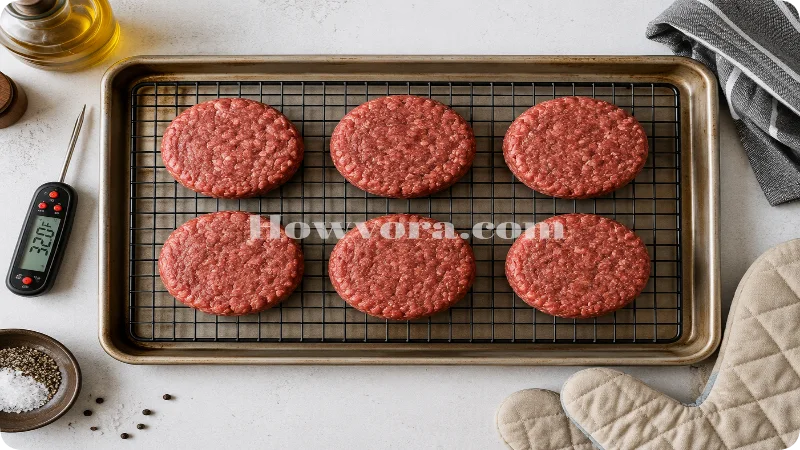
- Shape the patties to an even thickness, about ½ inch for standard burgers. Press a shallow indent into the center of each patty with your thumb. This keeps the patty flat as it cooks instead of puffing into a dome.
- Season both sides with salt, pepper, or your preferred seasoning blend.
- Arrange patties on a wire rack set inside a baking sheet, spaced at least 1 inch apart. The rack lets hot air circulate underneath, so both sides cook evenly without needing to flip as early. If you don’t have a rack, a lined baking sheet works; just plan to flip.
- Bake according to thickness (see table below), flipping once at the halfway point if not using a rack.
| Patty Thickness | Approximate Total Time |
| ¼ inch (thin/smash-style) | 15–18 minutes |
| ½ inch (standard) | 25–30 minutes |
| ¾ inch (thick) | 30–35 minutes |
| 1 inch (stuffed or extra-thick) | 35–40 minutes |
- Check internal temperature with a meat thermometer inserted sideways into the thickest part of the patty. Pull the burgers once they read 160°F.
- Add cheese, if using, for the last 1–2 minutes of baking so it melts without overcooking the patty.
- Rest for 3–5 minutes before serving. This lets juices redistribute instead of running out when you bite in.
How to Know You Did It Correctly
A correctly cooked burger reads exactly 160°F on an instant-read thermometer inserted into the center of the patty, has no raw or translucent pink areas, and releases clear juices (not red or cloudy) when pressed. The exterior should be lightly browned, not gray or steamed-looking, which usually signals the patties were overcrowded on the pan.
Expected Timeline and Results
Including preheating, plan for 35–45 minutes start to finish for standard ½-inch patties. You’ll get a juicy, evenly cooked burger with a light golden crust, less charred than a grilled burger, but more consistent from edge to edge, since there’s no direct flame creating hot spots.
Common Mistakes to Avoid
- Skipping the thermometer. Time estimates vary by oven and patty size; temperature doesn’t.
- Not preheating fully. Starting patties in a cold or half-heated oven throws off every time estimate in this guide.
- Overcrowding the pan. Patties touching each other trap steam and prevent browning.
- Skipping the center indent. Patties without one puff up in the middle and cook unevenly.
- Cutting into the burger right away. Resting for a few minutes keeps the juices in the meat instead of on the cutting board.
Troubleshooting & Common Problems
| Problem | Cause | Solution |
| Burgers turn out dry | Overcooked past 160°F, or beef too lean | Pull at exactly 160°F; use 80/20 ground beef for more fat and moisture |
| Center still pink/undercooked at expected time | Oven not fully preheated, or patty thicker than estimated | Confirm preheat with an oven thermometer; add 5-minute increments and recheck temp |
| Uneven browning or soggy tops | Patties overcrowded or baked directly on a flat sheet without airflow | Space patties at least 1 inch apart; use a wire rack for airflow underneath |
| Burgers puff into a dome | No center indent pressed before cooking | Press a shallow thumbprint into the center of each raw patty |
Expert Tips
- Use a wire rack over a baking sheet rather than baking directly on the sheet; it cooks both sides more evenly and cuts down on flipping.
- If patties vary in thickness across a batch, check the thickest one for internal temperature, not the average.
- For extra browning without extending oven time, broil for the last 1–2 minutes after the internal temperature hits 155°F.
- Freeze raw patties on a tray before stacking them if you’re prepping ahead; this keeps them a uniform, flat shape for even baking later.
What to Do Next
Toast your buns in the same oven during the burger’s last 3–4 minutes of resting time. Set out toppings: lettuce, tomato, onion, pickles, and condiments while the patties rest so everything’s ready to assemble as soon as the burgers come off the pan.
FAQs
Can I cook frozen burger patties at 350°F?
Yes. Skip thawing and add roughly 10–15 extra minutes to the times above, checking internal temperature rather than relying on time alone.
Do I need to flip burgers in the oven?
If you’re using a wire rack, flipping is optional since air circulates on both sides. On a flat baking sheet, flip once halfway through for even browning.
What’s the safe internal temperature for burgers?
160°F, per USDA guidelines for ground beef.
Is 350°F the best oven temperature for burgers?
It’s a good middle ground, hot enough to cook through without drying out the patty, unlike higher temperatures (400°F+) that can brown the outside before the inside reaches a safe temperature.
Can I use foil instead of parchment paper?
Yes, either works for easy cleanup. Foil can also be lightly greased to reduce sticking.
Why does my burger look brown but still test undercooked?
Color isn’t a reliable doneness indicator for ground beef; some burgers brown before they’re fully cooked. Always confirm with a thermometer.
Final Thoughts
Cooking burgers in the oven at 350°F comes down to two numbers: patty thickness (to estimate time) and internal temperature (to confirm doneness). Get those two right, along with a full preheat and a bit of spacing on the pan, and you’ll get consistent, juicy results without needing a grill.
