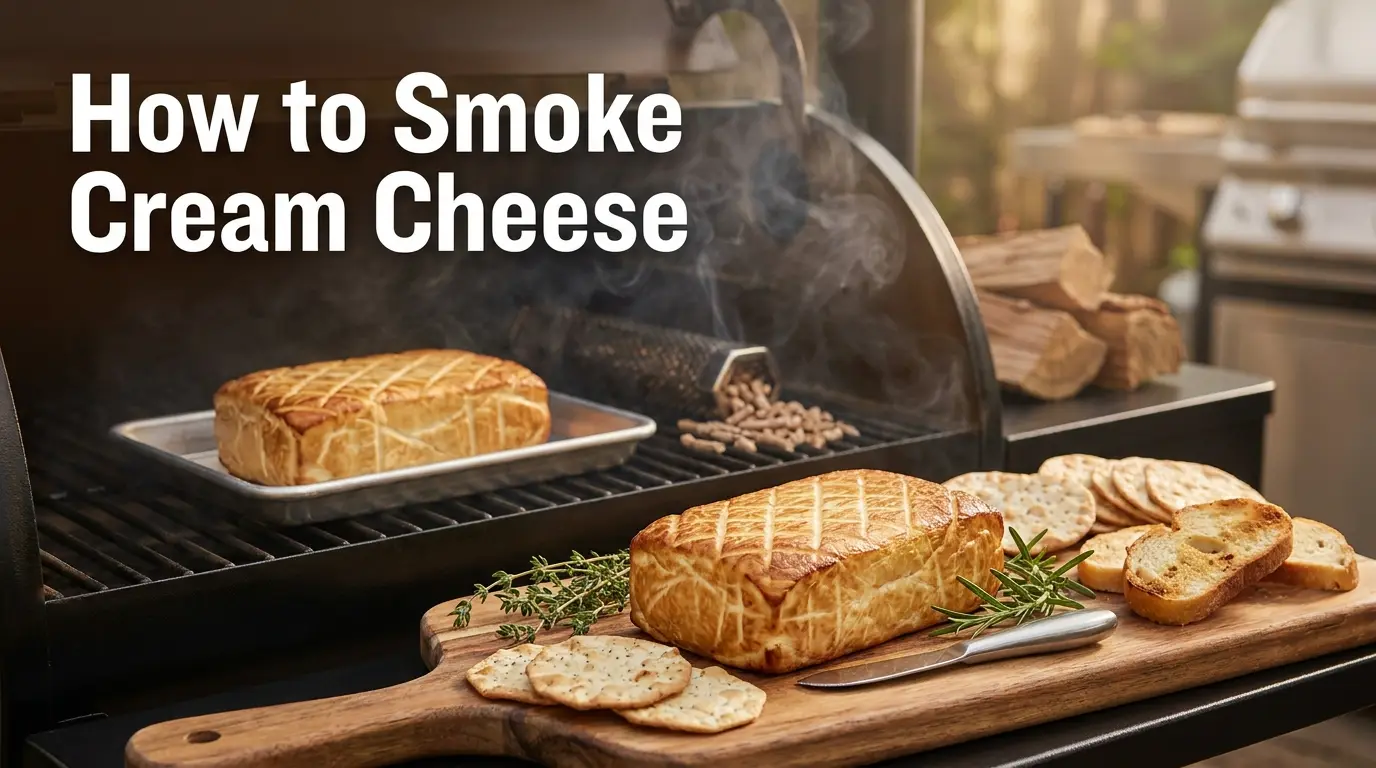
Smoked cream cheese is easiest on a smoker or pellet grill at 225–250°F for about 2 hours. Start with a cold 8-ounce block, coat it with seasoning, and score the top so the smoke and seasoning reach more of the surface. It will become soft, warm, spreadable, and lightly golden rather than turning into a liquid puddle.
What You Need
For one 8-ounce block of smoked cream cheese:
- 1 (8-ounce) block of full-fat cream cheese
- 1–2 tablespoons BBQ rub, everything bagel seasoning, Cajun seasoning, or another dry seasoning
- 1–2 teaspoons olive oil, optional
- Smoker or pellet grill
- Small foil-lined tray, cast-iron skillet, or heavy-duty foil
- Sharp knife
- Crackers, bread, vegetables, or bagels for serving
Keeping the cream cheese cold until you’re ready to prepare it makes the block easier to handle and score.
For wood, mild or moderately flavored choices such as apple, cherry, pecan, or oak work well. Hickory can provide a stronger, bacon-like smoke flavor, but it can be more intense. Food Network’s recipe developer specifically recommends hickory or pecan for a deeper smoke profile and also lists apple, cherry, and oak as suitable choices.
How to Smoke Cream Cheese
1. Preheat the smoker
Set your smoker or pellet grill to 225–250°F.
Both temperatures are used in tested recipes. Philadelphia’s current recipe uses 250°F for 2 hours, while Pit Boss and several other recipes use 225°F for approximately 2 hours. Food Network gives 250°F for about 2–3 hours.
For a straightforward starting point, 225°F for about 2 hours gives you a little more time for the smoke to develop without making the cooking environment unnecessarily hot.
Wait until the smoker has reached a stable temperature and is producing clean smoke before adding the cheese.
2. Keep the cream cheese cold
Remove the cream cheese from its packaging immediately before preparing it.
You don’t need to let it sit on the counter to come to room temperature. In fact, starting with a cold block makes it easier to move, season, and score without breaking it apart.
Place the block on a piece of heavy-duty foil, a small foil-lined tray, or another smoker-safe surface.
3. Coat it with oil and seasoning
Lightly brush the outside of the cream cheese with 1–2 teaspoons of olive oil if you’re using oil.
Then cover the block with your chosen seasoning.
Good options include:
- BBQ rub
- Everything bagel seasoning
- Cajun seasoning
- Garlic and onion seasoning
- Black pepper and paprika
- Lemon-pepper seasoning
- Sweet BBQ rub
- Cinnamon sugar for a sweet version
You don’t need an elaborate seasoning mixture. Cream cheese has a mild flavor, so a strongly flavored rub can work particularly well.
Food Network recommends bold savory or sweet seasoning blends and specifically mentions combinations containing paprika, onion, garlic, and black pepper.
4. Score the top
Use a sharp knife to cut shallow diagonal lines across the top of the block.
Turn the block and repeat the cuts in the opposite direction to create a crosshatch or diamond pattern.
You don’t need to cut deeply into the cheese. Around ¼ inch deep is sufficient for the technique used by several published recipes.
The cuts give the seasoning somewhere to settle and increase the exposed surface area. They also create the characteristic cracked, ridged appearance as the cream cheese softens during smoking. Published recipes from Pit Boss, Z Grills, and other sources use crosshatching or similar scoring before smoking.
Common mistake: Don’t cut the block into separate pieces. You want one intact block that can soften without spreading all over the cooking surface.
5. Put the cream cheese in the smoker
Place the seasoned block on the smoker grate or on a small tray.
Leave some space around it so smoke can circulate.
A tray is particularly convenient because softened cream cheese can become difficult to move once hot. It also catches any seasoning or softened cheese that comes loose.
If you’re using a pellet smoker, the upper rack can work well because it keeps the cream cheese away from the strongest direct heat. Pit Boss, for example, places the cheese on a tray on the upper rack.
6. Smoke for about 2 hours
Smoke the cream cheese at 225–250°F for approximately 2 hours.
This is a range rather than a rigid cooking time. Published recipes cluster around this method: Philadelphia specifies 250°F for 2 hours, Pit Boss uses 225°F for 2 hours, and Food Network gives 250°F for 2–3 hours.
Start checking the cheese toward the end of the cooking period.
You’re looking for:
- A lightly golden or browned exterior
- Opened-up score marks
- A softened, warm center
- A spreadable consistency
- A noticeable smoky aroma
The cheese doesn’t need to become brown all the way through. The goal is a warm, soft, smoky spread rather than a firm baked cheese.
If you prefer a lighter smoke flavor, start checking around the 1½-hour mark. For stronger smoke and a deeper exterior color, it may need closer to 2–3 hours, depending on the smoker and temperature. Food Network’s recipe developer uses the visual and textural cues of being softened, smoky, and golden rather than relying exclusively on the clock.
7. Rest briefly and serve
Remove the cream cheese carefully when it has reached the texture you want.
Let it rest for several minutes before serving. Pit Boss recommends a 10-minute rest, while other recipes serve it after a shorter rest.
Serve it while warm and spreadable with:
- Crackers
- Toasted baguette
- Pita chips
- Bagels
- Pretzels
- Celery
- Carrots
- Bell peppers
- Cucumber slices
For a finishing touch, add honey, hot honey, pepper jelly, fruit preserves, bacon jam, or sliced green onions.
Does Cream Cheese Melt When You Smoke It?
It softens considerably, but it usually doesn’t behave like a hard cheese that completely melts and runs away.
At the low smoking temperatures commonly used for this recipe, the block becomes warm and very soft while generally retaining its shape. Published smoked-cream-cheese recipes describe the finished texture as soft, spreadable, creamy, or gooey rather than completely liquid.
That’s why you can smoke a whole block rather than putting it in a bowl first.
As it heats, the scored lines open and the surface develops a firmer, seasoned exterior while the inside becomes soft enough to scoop with a cracker.
If your cream cheese is spreading excessively, the smoker may be running hotter than intended, the block may be placed too close to direct heat, or the cheese may simply have been left on longer than necessary.
A small tray or cast-iron skillet provides insurance against this problem.
Can You Smoke Cream Cheese Without a Smoker?
Yes. A covered grill can be used to smoke cream cheese.
Philadelphia specifically provides a grill method for its cream cheese recipe and says a smoker isn’t required.
Using a charcoal grill
Set up the grill for indirect heat rather than placing the cream cheese directly over the charcoal.
Add an appropriate amount of smoking wood according to your grill’s normal smoking method, then place the seasoned cream cheese on the cool side of the grill.
Keep the lid closed and maintain approximately 225–250°F inside the grill.
The important thing is controlling the heat. You want the cheese exposed to smoke and gentle indirect heat, not directly exposed to flames.
A foil-lined tray makes the setup easier and protects the cream cheese from falling through the grate if it becomes very soft.
Using a gas grill
A gas grill can also provide indirect cooking, but it doesn’t naturally produce the same smoke as a dedicated smoker.
If your grill is designed for smoking wood chips, follow the manufacturer’s instructions for using them. Keep the cream cheese over indirect heat and maintain approximately 225–250°F.
What about an oven?
An ordinary oven can warm and soften cream cheese, but it cannot genuinely smoke it.
You can make an oven version with smoked seasoning or another smoke-flavored ingredient, but that is a substitute for actual wood smoke rather than the same cooking method.
If you specifically want the smoky flavor, a covered outdoor grill with a controlled smoking setup is a more appropriate alternative.
Don’t try to create a smoking setup indoors by burning wood chips or charcoal in a conventional kitchen oven. Smoke and combustion appliances require proper ventilation and equipment designed for the job.
How Long Does Cream Cheese Take to Smoke?
For a standard 8-ounce block, plan on approximately 2 hours at 225–250°F.
The exact time can vary because smokers don’t all maintain heat and smoke in exactly the same way. Published recipes range from around 1½ hours at 250°F to 2–3 hours at 250°F, with 2 hours being a very common target.
Use the clock as a guide, but use the cheese itself as the final indicator.
| Smoker temperature | Approximate time | What to look for |
| 225°F | About 2 hours | Soft, warm, smoky, spreadable |
| 250°F | About 2 hours | Golden exterior and softened center |
| 250°F | Up to 2–3 hours | Deeper smoke and color |
You don’t need to keep smoking it simply because you haven’t reached a particular internal temperature. This is primarily a smoking and texture process, so appearance, softness, and smoke intensity are more useful than chasing an arbitrary internal temperature.
How Do You Smoke Cheese at Home?
The method depends on the type of cheese.
Cream cheese is unusually convenient for home smoking because recipes commonly use a relatively warm smoker temperature and a short cooking period. Other cheeses, particularly firm cheeses, are often handled differently because excessive heat can cause them to melt.
For smoked cream cheese, the basic home process is:
- Start with a cold block of cream cheese.
- Season the outside.
- Score the top.
- Place it on foil or a small tray.
- Smoke at 225–250°F.
- Cook for roughly 2 hours.
- Remove when softened, warm, lightly colored, and smoky.
- Rest briefly and serve.
For wood choice, apple and cherry give a milder smoke, while pecan and hickory provide a stronger flavor. Food Network specifically recommends hickory or pecan for a deeper profile and lists apple, cherry, and oak as alternatives.
The important distinction is that smoking cream cheese is not the same technique as cold-smoking a hard cheese. Don’t automatically transfer temperatures and times from a cold-smoking guide for cheddar, gouda, or other firm cheeses to this recipe.
Seasoning Ideas for Smoked Cream Cheese
Once you have the basic technique down, the seasoning can change the entire appetizer.
Everything bagel
Coat the block generously with everything bagel seasoning. The sesame, garlic, onion, and other seasoning elements work particularly well with the mild tang of cream cheese.
Serve with crackers, toasted bread, cucumber, or bagel chips.
BBQ
Use a sweet or savory BBQ rub for a classic barbecue-style appetizer.
This works particularly well if you plan to finish the smoked cream cheese with honey or hot honey.
Cajun
Cajun seasoning gives the cream cheese a spicy, savory crust.
Serve it with crackers, toasted bread, celery, or bell peppers.
Sweet and spicy
Use a sweet BBQ rub and finish the warm cream cheese with hot honey or pepper jelly.
The contrast between the creamy, tangy cheese, sweet topping, and smoke is especially useful when serving it as a party appetizer.
Cinnamon sugar
For a dessert-style variation, use cinnamon sugar rather than a savory BBQ rub.
Serve with graham crackers, apple slices, vanilla wafers, or toasted brioche.
Troubleshooting Smoked Cream Cheese
Problem: The cream cheese spreads too much
Likely cause: Excessive heat, direct heat, or a cooking time longer than necessary.
Solution: Keep the smoker around 225–250°F and use indirect heat. Put the block in a small foil tray or cast-iron skillet if your smoker has strong hot spots.
Problem: The smoke flavor is too strong
Likely cause: Strong wood or excessive smoke exposure.
Solution: Try apple or cherry wood instead of a stronger hickory profile, and avoid using more smoke than your smoker normally requires. Food Network notes that wood choices produce different flavor intensities.
Problem: The outside is dark but the center isn’t very soft
Likely cause: The cheese is receiving too much direct heat.
Solution: Move it farther from the heat source or onto an upper rack. Maintain the smoker temperature rather than increasing it to force the center to soften.
Problem: The seasoning doesn’t stay on the block
Likely cause: The surface is too dry for the seasoning to adhere well.
Solution: Lightly brush the block with olive oil before applying the seasoning. You can also gently press the seasoning into the surface rather than simply sprinkling it over the top.
How to Serve Smoked Cream Cheese
Smoked cream cheese works best as a spread or dip while it is still warm and soft.
For an easy appetizer, place the smoked block in the center of a serving plate and surround it with crackers, toasted bread, vegetables, and pretzels.
You can also spoon a topping over the center after smoking. Good choices include:
- Hot honey
- Regular honey
- Pepper jelly
- Fruit preserves
- Cranberry relish
- Bacon jam
- Chopped green onions
- Jalapeños
- Chopped nuts
The toppings don’t need to be cooked with the cream cheese. Adding them after smoking keeps their flavor and texture more distinct.
For a party, you can smoke several blocks at once and use different seasonings on each. Commercial recipe sources commonly use two 8-ounce blocks with different seasonings for this purpose.
How to Store Smoked Cream Cheese
Treat smoked cream cheese as a perishable dairy food.
If you’re not serving it immediately, refrigerate it promptly in a covered container. USDA guidance identifies cream cheese among soft cheeses that should be discarded if held above 40°F for more than 2 hours; if the surrounding temperature is above 90°F, the general limit for perishable food is 1 hour.
Keep your refrigerator at 40°F or below.
For serving at a party, don’t leave the entire batch sitting at room temperature for an extended period. Put out a smaller portion and replenish it as needed.
Frequently Asked Questions
Does cream cheese melt when you smoke it?
It softens dramatically and becomes warm and spreadable, but it generally holds its basic shape during the low-temperature smoking process. At 225–250°F, the finished texture is typically soft and creamy rather than completely liquid.
Can I smoke cream cheese without a smoker?
Yes. A covered grill can be used with indirect heat and a suitable smoking setup. Philadelphia specifically provides a grill alternative for its smoked cream cheese recipe.
How long does cream cheese take to smoke?
About 2 hours is a practical starting point at 225–250°F. Depending on the smoker, temperature, and desired smoke intensity, published recipes range from roughly 1½ hours to 3 hours.
Should I score cream cheese before smoking?
Yes, shallow scoring is useful because it increases the seasoned surface area and creates channels across the top as the cheese softens. Several established recipes use a crosshatch or diamond pattern.
Do I need to use olive oil?
No. Olive oil is optional. It can help seasoning adhere to the surface, but the cream cheese can also be seasoned directly.
What wood is best for smoked cream cheese?
For a milder flavor, try apple or cherry. Pecan provides a richer smoke, while hickory produces a stronger flavor. There isn’t one objectively correct choice because the preferred smoke intensity is subjective. Food Network’s recipe developer recommends hickory or pecan for a deeper profile and lists apple, cherry, and oak as alternatives.
Can I smoke flavored cream cheese?
Yes, provided it is a firm enough block to handle before smoking. Plain block-style cream cheese gives you the most control over seasoning, toppings, and smoke flavor.
Safety
Use refrigerated cream cheese and keep it cold until you’re ready to prepare it. USDA guidance specifically lists cream cheese among soft cheeses that should be discarded if held above 40°F for more than 2 hours, or 1 hour when temperatures exceed 90°F.
For outdoor smoking, use equipment designed for outdoor cooking and follow its manufacturer’s instructions. Never burn charcoal or wood in an enclosed indoor space.
Conclusion
For a reliable smoked cream cheese appetizer, start with a cold 8-ounce block, season and score it, then smoke it at 225–250°F for around 2 hours until the outside is lightly golden and the center is soft and spreadable. If you don’t own a smoker, a covered grill with indirect heat can provide the smoke you need without requiring dedicated smoking equipment.
