Introduction
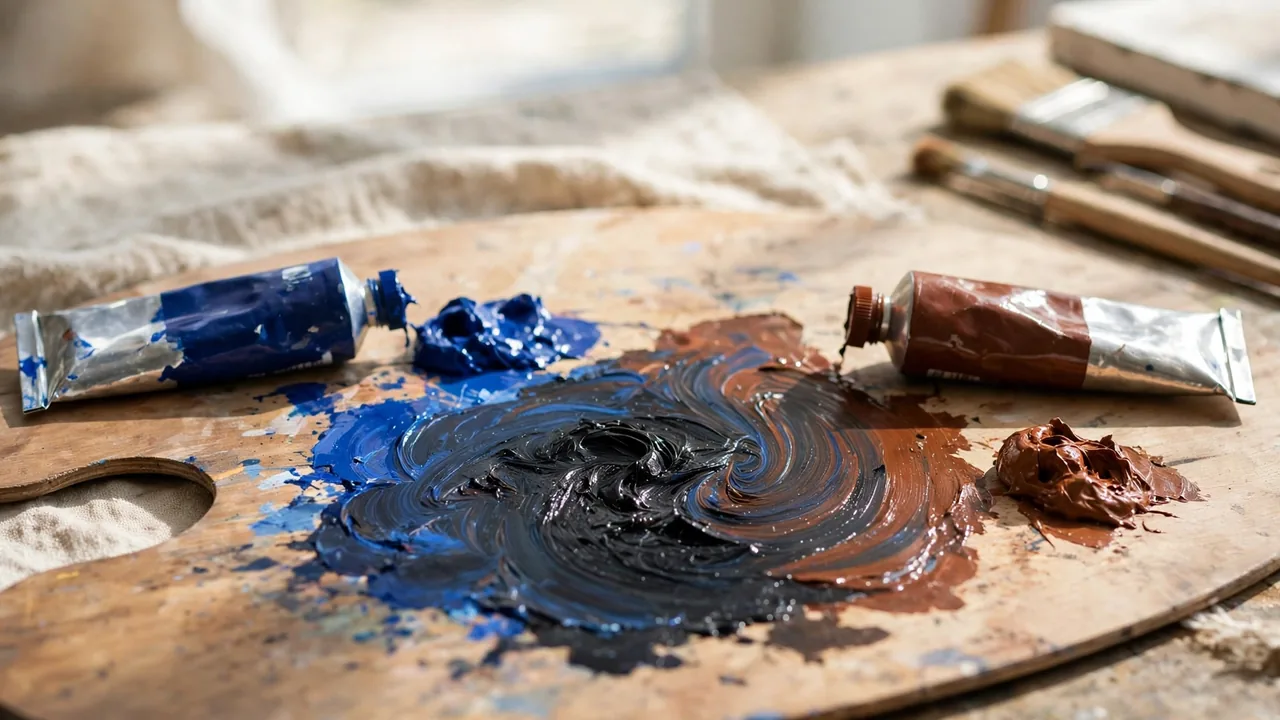
Every paint set includes a tube of black, so why would you make your own? Because tube black is a blunt instrument. Ivory black and mars black are powerful, opaque, and a little dead; mixed into other colors in quantity, they can flatten a mixture and drag it toward mud. The alternative is to mix a black instead. A black built from two dark, transparent paints, classically ultramarine blue and burnt umber, looks deeper, behaves more gently in mixtures, and can be tuned warm or cool to match the painting it lives in.
This guide shows how to make black paint three ways: the classic chromatic black from ultramarine and burnt umber, a deeper version built on phthalo colors for maximum darkness, and an honest comparison with the ready-made tube blacks so you know when mixing wins and when the tube is the right tool. It also covers making black from three primaries, how to test if your mix is truly neutral, and how to store a batch so the black you mixed today matches the black you need next week.
Featured Snippet Answer
To make black paint, mix roughly equal parts ultramarine blue and burnt umber. The blue and the dark orange-brown cancel each other out and produce a rich, near-neutral black. Add a little more blue for a cooler black or more umber for a warmer one, and test the mix in a thin smear and in a tint with white.
Before You Begin

Understand what you are making. A mixed black, often called a chromatic black, is not a single pigment. It is two or three very dark colors whose hues cancel out. Because the ingredients are transparent, the result has depth: light enters the film and reflects back with subtle color still alive in it. That is why mixed blacks look richer in shadows than tube black, a single opaque pigment that simply absorbs. Mixed black shines in shadows, dark mixtures, and glazing. Tube black wins when you need flat, total coverage.
Also know that black is judged in two ways, and you should test both. In a mass tone, the thick paint straight from the pile, almost any dark mix looks black. In a thin smear and in a tint mixed with white, the truth comes out: a mix with too much umber reads brown, too much blue reads navy. Decide now if you want a neutral black, a cool blue-leaning black for night scenes and shadows, or a warm brown-leaning black for earthy work, because the ratio follows from that choice. Finally, if you paint in acrylic, remember that acrylic darkens as it dries, so judge your mix after a test patch has dried.
At a Glance

| Detail | What to know |
|---|---|
| Difficulty | Easy; the skill is in testing and adjusting, not in the mixing |
| Time needed | 5 minutes for a small batch, plus a few minutes of testing |
| Cost | Almost nothing if you own ultramarine and burnt umber; both are staple colors |
| Skill level | Beginner |
| Best for | Artists who want richer shadows, gentler dark mixtures, and blacks tuned to a painting |
Things You’ll Need
| Item | Purpose |
|---|---|
| Ultramarine blue | The dark, slightly violet blue that anchors the classic chromatic black |
| Burnt umber | A very dark transparent brown; its orange undertone cancels the blue |
| Palette knife | Mixes paint thoroughly without loading a brush with pigment |
| Palette or glass sheet | A neutral surface where the mix color reads honestly |
| Small jar with a lid | Stores a mixed batch so it stays consistent across sessions |
| Optional: phthalo blue or phthalo green, alizarin crimson, burnt sienna | For deeper or differently tuned chromatic blacks |
Safety Precautions
- If you ever mix black from dry pigment powder, wear a dust mask and work gently. Fine pigment dust, including carbon black, should not be inhaled. Most painters should simply buy tube paint or pre-dispersed pigment and skip dry pigment entirely.
- Keep solvent rules in place for oil painters. If you thin test mixes with solvent, ventilate the room and store oily rags flat to dry or in a sealed metal container, since they can self-heat.
Step-by-Step Guide
- Step 1: Put out two equal piles. Squeeze out roughly a pea-sized pile of ultramarine blue and the same of burnt umber, side by side. Equal parts is the standard starting point for the classic mix. Ultramarine is a weak tinter and burnt umber is strong, so expect to adjust; the equal start gives you a baseline.
- Step 2: Mix thoroughly with the palette knife. Fold the two paints together, scraping and pressing, until no streaks remain. Under-mixed black is a common false alarm: streaks of umber in a smear will convince you the mix is brown when it is really just unfinished. Give it a full minute of knife work.
- Step 3: Do the smear test. Drag a thin smear of the mix across white paper with the knife edge. Thin paint tells the truth. If the smear shows a brown or rusty cast, the umber is winning; if it shows a clear blue or navy cast, the blue is winning. You are looking for a smear that reads as dark grey-black with no obvious hue.
- Step 4: Do the tint test. Mix a small amount of your black into titanium white to make a mid grey, and paint a patch beside the smear. The tint exposes what the mass tone hides. A neutral black gives a clean neutral grey. A blue-heavy mix gives a blue grey, and an umber-heavy mix gives a warm brownish grey. Decide if that character suits your purpose before adjusting.
- Step 5: Adjust the ratio in small steps. Add the losing color a rice-grain at a time, remix, and repeat both tests. Small steps matter because burnt umber and phthalo colors are strong; a pea-sized addition can overshoot and start an endless back-and-forth. Stop slightly blue for a cool black, slightly warm for a warm one.
- Step 6: Test it inside a real mixture. Mix your black into a mid color you use often, such as yellow ochre, and compare it with the same color darkened by tube black. The chromatic black should darken with more color life and less greying. This test predicts how the black behaves in an actual painting.
- Step 7: For the deepest black, rebuild with phthalo. If the classic mix is not dark enough, mix phthalo blue (or a little phthalo green) with burnt sienna or burnt umber instead. Phthalo pigments are far stronger and darker than ultramarine, and the result is a very deep, slightly cool black. Add the phthalo in tiny amounts; it overwhelms mixtures quickly.
- Step 8: Store the batch and write down the ratio. If you will need this black again, mix a larger amount, put it in a small lidded jar, and note the ratio on the label. An unrecorded ratio means next week’s black will not match this week’s, and large dark areas will show the seam.
How to Know You Did It Correctly
Three checks confirm a good black. The thin smear on white paper reads as black or very dark neutral grey with no obvious brown, blue, or green cast, unless you chose a cast on purpose. The tint with white dries to the grey family you intended: neutral, cool, or warm. And inside a working mixture, the black deepens colors without turning them chalky or muddy grey at small additions. If your black passes the smear and tint tests but murders every mixture it touches, the mix is too strong, which happens with phthalo-based blacks; keep it for accents and use the gentler ultramarine mix for general darkening.
Expected Timeline and Results
The first careful batch takes about ten minutes, most of it testing and adjusting. After that, a practiced mix takes two minutes, because your hands remember the ratio your eyes approved. The result is a black with visible depth: dark passages that still feel connected to the colors around them, and mixtures that darken without dying. What a mixed black will not do is cover like a tube black. Being transparent, it needs two coats to hide a light ground completely, and for flat graphic coverage or a dead-matte background, mars black straight from the tube remains the right choice. Expect to keep both in your kit and reach for each on purpose.
Alternative Methods
Tube blacks are the obvious alternative, and they differ from each other more than most painters realize. Ivory black, traditionally made from charred bone, is warm-leaning, fairly transparent for a black, and the weakest tinter of the three, which makes it the gentlest in mixtures and a good choice for portraits. Mars black is synthetic iron oxide: fully opaque, neutral, and strong, ideal for coverage and graphic work, though it can look flat in shadows. Lamp black is very cool and sooty with high tinting strength. A third route is making black from three primaries: roughly equal parts of a blue, a red, and a yellow produce a dark neutral-ish color, and adding more blue deepens it toward black. This classroom method usually lands at a very dark brown-grey rather than a true black, but it teaches color cancellation better than any other exercise.
Common Mistakes to Avoid
- Judging the mix by the pile alone. A thick pile of almost anything dark looks black. Always test a thin smear and a tint with white before you commit.
- Adding too much at once while adjusting. Strong pigments overshoot fast. Adjust in rice-grain steps or you will spend ten minutes swinging between blue-black and brown-black.
- Under-mixing. Streaky paint gives false test results and uneven color on the canvas. Knife-mix until the color is completely uniform.
- Using a chromatic black where you need opacity. Transparent mixed blacks over a light ground can look washed out in one coat. For full coverage, use mars black or plan on two coats.
- Assuming acrylic black looks the same wet and dry. Acrylic dries darker. A mix that looks perfect wet may dry a shade deeper and cooler, so let your test patch dry before final judgment.
Troubleshooting & Common Problems
| Problem | Cause | Solution |
|---|---|---|
| The mix looks brown, not black | Too much burnt umber, or the mix is not dark enough overall | Add ultramarine in small steps and retest the smear. If it stays brown, the umber itself is too light; switch the partner to burnt sienna plus phthalo blue |
| The mix looks navy blue | Too much ultramarine for the amount of umber | Add burnt umber a little at a time until the smear neutralizes |
| Tints with white turn green | Phthalo green in the mix is showing its hue at low concentrations | Warm the mix with a touch of alizarin crimson or burnt sienna, or reserve that black for deep accents rather than greys |
| The black kills every color it touches | The mix is too strong or too opaque, typical of phthalo builds and mars black | Use the gentler ultramarine and umber mix for darkening colors, and add black in smaller amounts than you expect |
| Coverage is weak and streaky over white | Chromatic blacks are transparent by nature | Apply a second coat, or switch to mars black for that passage |
Expert Tips
- Match the black to the painting, not to a formula. A landscape full of warm earth wants a warm-leaning black; a night scene wants a cool one. The formula is a starting point, and the tint test is how you aim it.
- Keep a dedicated darkening mix instead of pure black for shadows. Many painters keep ultramarine plus burnt umber pre-mixed and then push it toward the local color of each shadow, which keeps shadows related to the objects casting them.
- Save the strongest black for the smallest areas. The deepest accents in a painting work by contrast. If everything dark is maximum black, nothing is; keep the phthalo build for the few accents that should truly drop away.
What to Do Next
Put your new black to work in a controlled test before trusting it in a major piece: paint a small value study using only your mixed black, white, and one color, and watch how the greys behave. Then mix a full jar of your preferred ratio and label it with the recipe and the date.
FAQs
What two colors make black paint?
Ultramarine blue and burnt umber are the classic pair. They sit opposite each other in effect: the blue is dark and cool, the umber is dark with an orange-brown undertone, and together they cancel into a near-neutral black. Roughly equal parts is the starting point.
Why do artists mix black instead of using it from the tube?
A mixed black is transparent and tunable, so it feels alive in shadows and darkens mixtures without flattening them. Tube black is a single opaque pigment; it covers superbly but can look dead and can grey mixtures quickly. Many painters use both: mixed black for shadows and color work, tube black for coverage.
What is the difference between ivory black and mars black?
Ivory black is warm-leaning, comparatively gentle, and semi-transparent, so it mixes softly and suits portraits and subtle work. Mars black is a synthetic iron oxide: neutral, fully opaque, and strong, so it covers in one coat and suits backgrounds and bold work.
Can you make true black from red, blue, and yellow?
You can get very close to black, and the attempt is a great learning exercise. Equal parts of the three primaries cancel toward a dark neutral, and extra blue deepens it. In practice the result is usually a very dark brown-grey rather than a perfect black, because real pigments are not perfectly balanced. It works for crafts and studies; the two-color chromatic mix is darker and cheaper for serious work.
Why does my mixed black look green in light tints?
That happens when the mix contains phthalo green or a green-leaning blue; at full strength the color is too dark to read, but diluted in white the green shows. Balance it with a small amount of a red such as alizarin crimson or a warm earth like burnt sienna, or use that batch only where a green-leaning dark is welcome.
What is the strongest, darkest black paint?
Among common choices, a mix built on phthalo blue or phthalo green with a dark earth gives the deepest dark in a paint film, deeper than the classic ultramarine mix. Among tube paints, mars black gives the most complete opaque coverage. Specialty carbon-based paints sold for maximum light absorption exist, but they are fragile, matte specialty coatings rather than general studio paints.
Final Thoughts
Making black paint is a five-minute skill with an outsized payoff: mix ultramarine and burnt umber, test the smear and the tint, tune the temperature, and record the ratio. The black you get back is deeper, livelier, and kinder to your mixtures than anything from a tube, and now you also know when the tube is the smarter tool. Keep both, and choose on purpose.