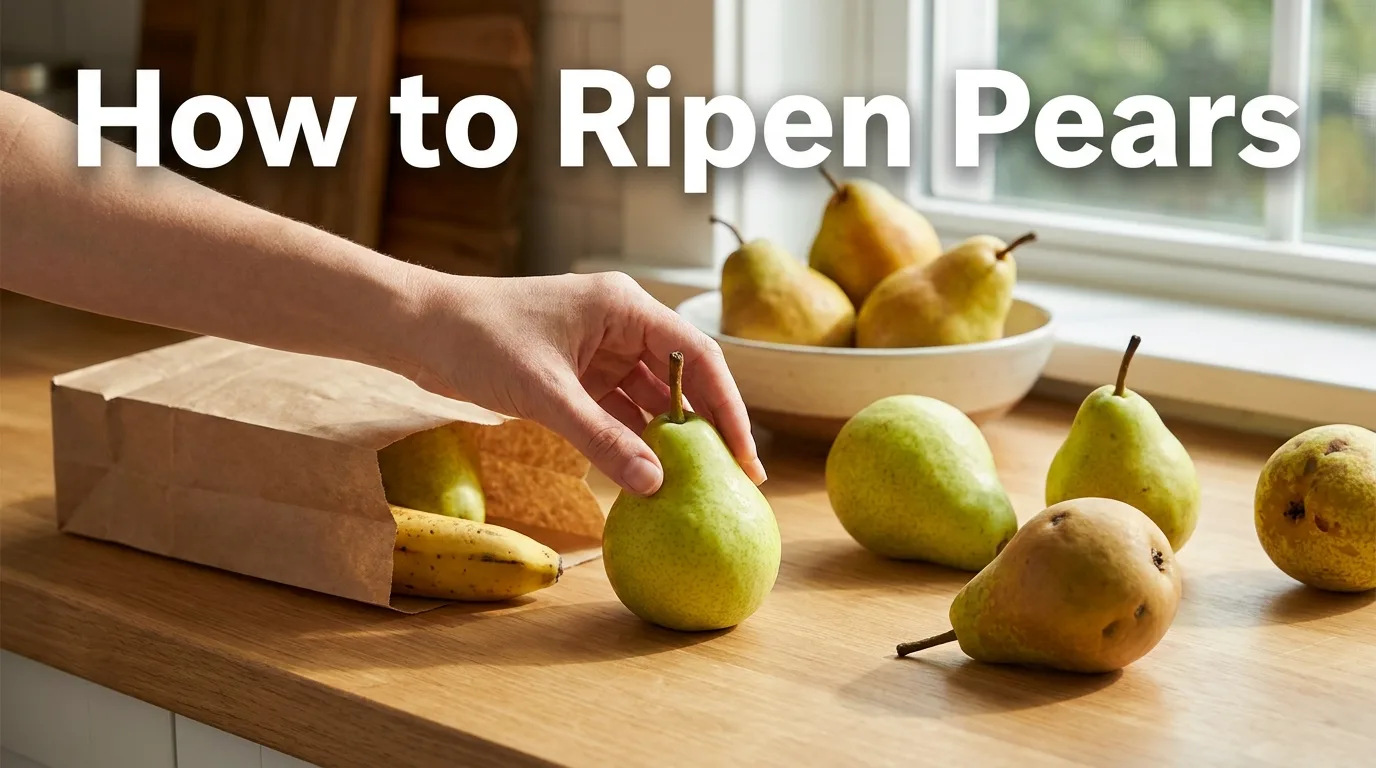
Quick Answer: To ripen most supermarket pears, leave them at room temperature, ideally around 65–75°F (18–24°C), and check them daily. Depending on the variety and how mature they were when purchased, pears may take anywhere from a few days to around 10 days. For faster ripening, put the pears in a brown paper bag, optionally with a ripe banana or apple. A pear is generally ready when the flesh at the neck just below the stem gives slightly when gently pressed.
How Pear Ripening Works
Pears are unusual because most European pears are harvested while they are mature but still firm. They then finish ripening after harvest.
During ripening, the fruit undergoes changes in texture, aroma, flavor, and sweetness. The flesh becomes softer and juicier, while the characteristic pear aroma becomes more noticeable.
Ethylene plays an important role in this process. It is a naturally occurring plant hormone that promotes ripening. Keeping pears together or placing them in a paper bag can increase the concentration of ethylene around the fruit and speed the process.
This is why the simplest approach is usually not to add heat or use a complicated appliance. Give the pears the right temperature and enough time.
How to Ripen Pears at Room Temperature
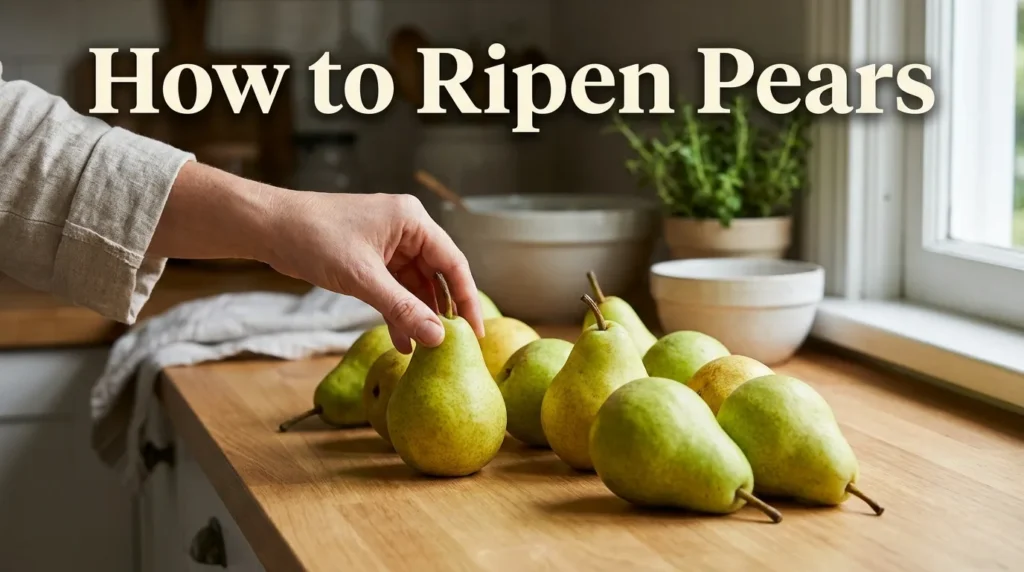
For most store-bought pears, room-temperature ripening is the easiest method.
1. Remove the pears from cold storage
If your pears are refrigerated and still firm, take out the number you expect to eat soon.
Cold temperatures slow ripening, so keeping unripe pears in the refrigerator can delay the process.
You don’t need to wash the pears before ripening them. If you do wash them, dry them thoroughly before storing them.
2. Put them in a suitable place
Arrange the pears in a single layer on a clean countertop, fruit bowl, or other location away from excessive heat and direct sunlight.
A normal indoor room temperature is generally suitable. Around 65–75°F (18–24°C) is a useful working range.
Avoid putting them directly beside a hot stove, radiator, or other heat source. Higher heat isn’t a reliable shortcut to better ripening and can contribute to quality loss.
3. Check them every day
Start checking after a day or two.
Hold a pear gently and press the flesh at the neck, immediately below the stem, with your thumb.
- Very hard: It needs more time.
- Slightly yielding: It is ready or very close.
- Soft around the entire fruit: It may be overripe.
Don’t repeatedly squeeze the body of the pear. Pressure can bruise the flesh and create soft spots that don’t accurately indicate ripeness.
4. Eat ripe pears or refrigerate them
Once the pear reaches the texture you want, eat it or move it to the refrigerator if you need to keep it longer.
Refrigeration slows additional ripening, so it is useful after the pear has reached the desired stage.
How to Ripen Pears Faster in a Paper Bag
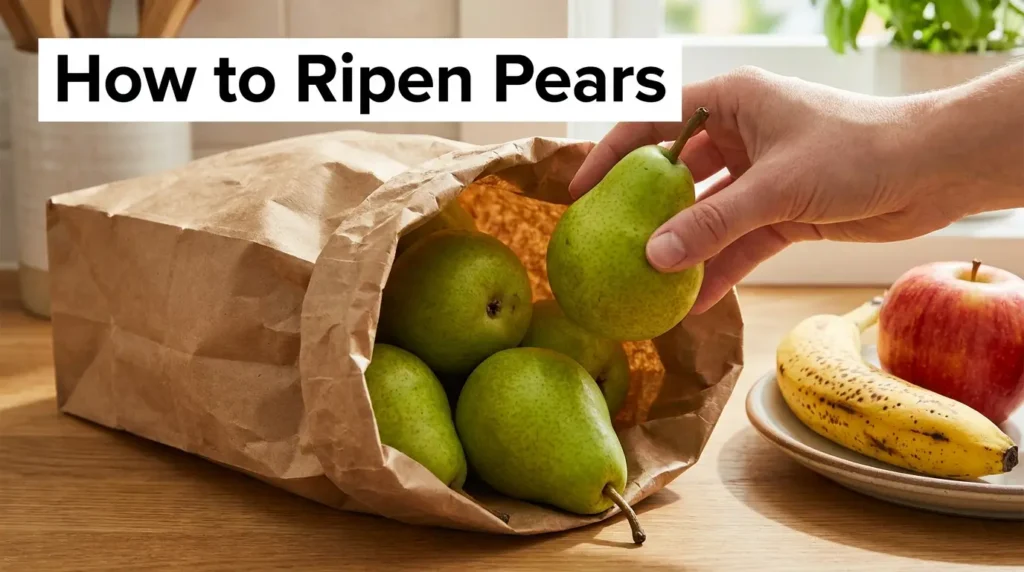
If your pears are very firm and you don’t want to wait as long, a brown paper bag can accelerate ripening.
What you need
- Firm pears
- 1 brown paper bag
- Optional: 1 ripe banana or apple
Method
- Put the pears inside the paper bag.
- Loosely fold the top of the bag closed.
- Keep the bag at room temperature.
- Check the pears every day.
- Remove each pear as soon as its neck begins to yield.
The paper bag helps retain some of the ethylene naturally released by the fruit.
Should you add a banana?
You can.
A ripe banana releases ethylene, as do apples and pears. Putting one in the bag with your pears can increase the amount of ethylene surrounding the fruit and may accelerate ripening.
You don’t need several pieces of fruit. One ripe banana or apple is enough to try this method.
Don’t seal the pears in an airtight container
A paper bag is different from a tightly sealed plastic bag.
The goal is to create a favorable ripening environment, not to trap the fruit in a completely airtight space. Excess moisture can encourage deterioration.
How Long Do Pears Take to Ripen?
The exact time depends on the pear variety, how mature the fruit was when harvested, its previous storage conditions, and room temperature.
A useful expectation for store-bought pears is several days rather than several hours.
Some varieties can take only a few days, while others may need close to a week or longer.
For example, Penn State Extension gives approximate ripening periods after appropriate conditions of around 5 days for Bartlett, 7 days for Bosc, and 9 days for D’Anjou. These should be treated as general guides rather than exact deadlines.
The neck test is more useful than saying, “This pear has been sitting out for exactly five days.”
Why can two pears ripen at different speeds?
Even pears from the same bag can behave differently.
Differences in:
- Variety
- Harvest maturity
- Previous refrigeration
- Room temperature
- Fruit size
- Storage conditions
can all affect the rate at which an individual pear becomes ready to eat.
That’s why you should check individual pears rather than assuming the entire batch will ripen simultaneously.
How to Tell When a Pear Is Ripe
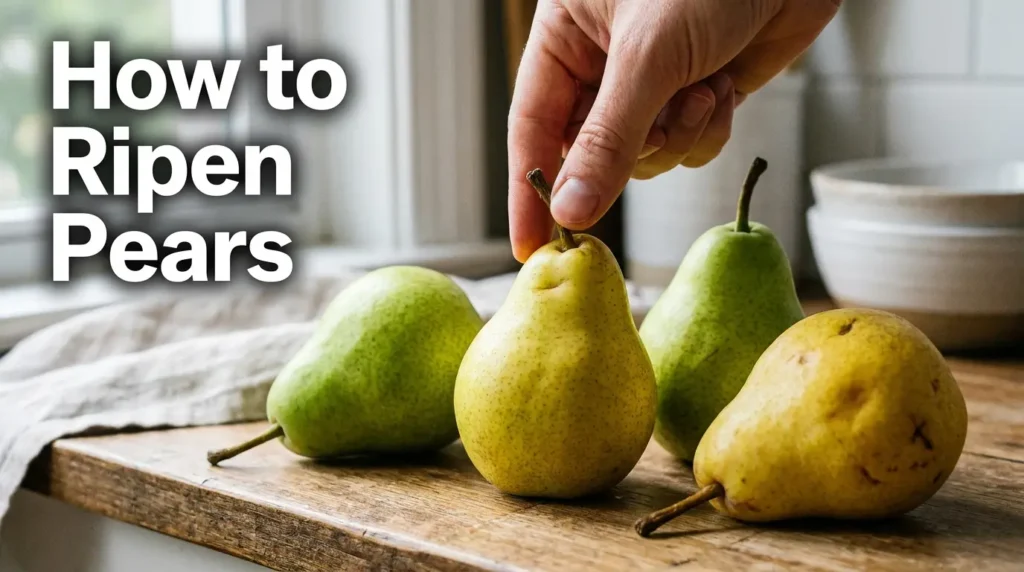
The neck test is one of the most useful ways to judge a European pear.
Gently press the area immediately below the stem.
Firm neck
If the neck feels completely hard, the pear probably needs more time.
Put it back on the counter and check it again later.
Slightly soft neck
If the neck gives slightly under gentle pressure, the pear is generally ready to eat.
This doesn’t mean the fruit should feel mushy. You are looking for a small amount of yielding rather than significant softness.
Very soft neck
If the neck and much of the fruit feel very soft, the pear may be past its ideal eating stage.
Cut it open and inspect the flesh. If it has an unpleasant smell, extensive browning, mold, or other signs of spoilage, discard it.
Don’t Judge Every Pear by Its Color
Color can help with some varieties, but it isn’t a universal ripeness test.
Bartlett pears
Bartlett pears undergo a noticeable color change as they ripen. Green Bartletts become more yellow.
Anjou pears
Anjou pears can remain green even when ripe. A color change isn’t a dependable way to decide whether they’re ready.
Bosc pears
Bosc pears also retain much of their characteristic brownish skin, so softness at the neck is more useful than waiting for a dramatic color change.
This is one reason people sometimes leave perfectly ripe pears sitting on the counter because they expect the skin to change significantly.
How to Ripen Different Types of Pears
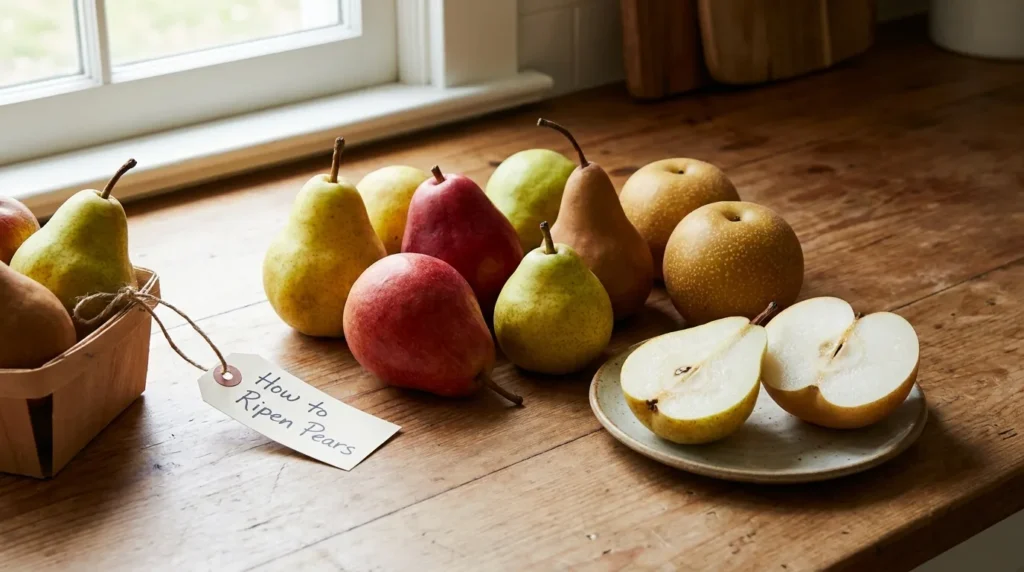
Not all pears behave exactly the same way.
| Variety/type | What to look for |
| Bartlett | Neck gives slightly; skin may become more yellow |
| Anjou | Slight neck softness; color may remain green |
| Bosc | Slight neck softness; don’t wait for a major color change |
| Comice | Gentle neck yielding and characteristic aroma |
| Asian pear | Usually eaten crisp; doesn’t follow the same soft-ripening pattern |
If you don’t know your pear variety, use the neck test rather than relying heavily on skin color.
What If Your Pears Were Picked From a Tree?
Homegrown pears require a little more attention.
European pears are generally harvested when mature but before they become fully ripe. Many varieties need a period of cold storage after harvest before they will ripen properly.
This is particularly important with winter pear varieties.
Penn State Extension explains that different European pear varieties have different chilling requirements before they can ripen successfully. Bartlett has a relatively short requirement, while varieties such as Bosc, D’Anjou and Comice require longer chilling periods.
So if you picked hard pears directly from a backyard tree and they refuse to ripen normally on the counter, the problem may not be that you’re using the wrong countertop method. They may need the appropriate postharvest chilling period for their variety.
What About Asian Pears?
Asian pears are different from European pears.
They are generally ripened on the tree and are meant to be eaten while they remain crisp and juicy rather than becoming soft and buttery.
If you have an Asian pear, don’t wait for the fruit to become soft like a Bartlett.
The appropriate harvest and eating characteristics depend on the particular cultivar, but the basic distinction is important:
European pear: often harvested firm and ripened after harvest.
Asian pear: generally reaches eating maturity on the tree and stays crisp.
Can You Ripen Pears in the Refrigerator?
Not if your goal is to make firm pears ripen quickly.
Refrigeration slows the ripening process. If your pears are still firm, leave them at room temperature first.
Once they have reached the ripeness you want, refrigeration becomes useful because it slows further changes and can extend their usable period.
This gives you a simple two-stage system:
Unripe → room temperature
Ripe → refrigerator if needed
Can You Ripen Pears in the Microwave?
A microwave can heat and soften fruit, but softening isn’t the same thing as ripening.
Natural ripening involves changes in texture, aroma, flavor, and other components of the fruit. Simply heating a hard pear does not reproduce those changes.
If you need a pear for a recipe, cooking it may be an option, but don’t use a microwave as a substitute for naturally ripening a pear you want to eat fresh.
Can You Ripen Pears in the Oven?
The same principle applies to an oven.
Heat can soften the fruit, but it doesn’t provide the same natural ripening process. There is little reason to use an oven when room-temperature ripening or a paper bag can accomplish the actual goal.
If you’re making baked pears, that’s a cooking method rather than a ripening method.
How to Ripen Pears Overnight
If you need a ripe pear by tomorrow, a paper bag with a ripe banana or apple is the practical method to try.
However, don’t expect a completely immature pear to become perfectly ripe overnight every time.
Ripening is a biological process, and the starting condition matters. A pear that is already close to ripe may become ready quickly, while an extremely firm pear can require considerably longer.
Check it the next morning rather than assuming the same timing will work for every pear.
Why Won’t My Pears Ripen?
There are several possible reasons.
The pears remain completely hard
Likely cause: They may need more time, or they may have been stored under conditions that delayed ripening.
Solution: Keep them at room temperature and check the neck daily. A paper bag can accelerate the process.
The pear is soft but doesn’t taste ripe
Likely cause: Softness and ideal eating quality don’t always develop in exactly the way you expect, particularly if the fruit has been stored poorly.
Solution: Check another pear from the batch. If several have unpleasant flavor, excessive internal browning, or deterioration, the problem may be fruit quality rather than insufficient time.
The skin isn’t changing color
Likely cause: Variety.
Solution: Don’t use color as your primary test. Anjou and Bosc pears, for example, may not show the dramatic color change people associate with Bartlett pears.
One pear is ripe while the others are still hard
Likely cause: Natural variation in fruit maturity and storage history.
Solution: Remove the ripe pear and continue checking the others individually.
What Happens If You Let a Pear Get Too Ripe?
A ripe pear can move quickly from pleasantly soft to excessively soft.
Signs that a pear may have gone past its ideal eating stage include:
- Very soft flesh
- Bruised or collapsed areas
- Excessive internal browning
- Fermented or unpleasant odor
- Mold
A little surface blemishing isn’t automatically spoilage, but mold or a clearly deteriorated interior is a reason to discard the fruit.
If several pears are approaching overripe at the same time, use them promptly in smoothies, sauces, baked dishes, or other cooked preparations where their softer texture isn’t a problem.
How to Store Pears After They Ripen
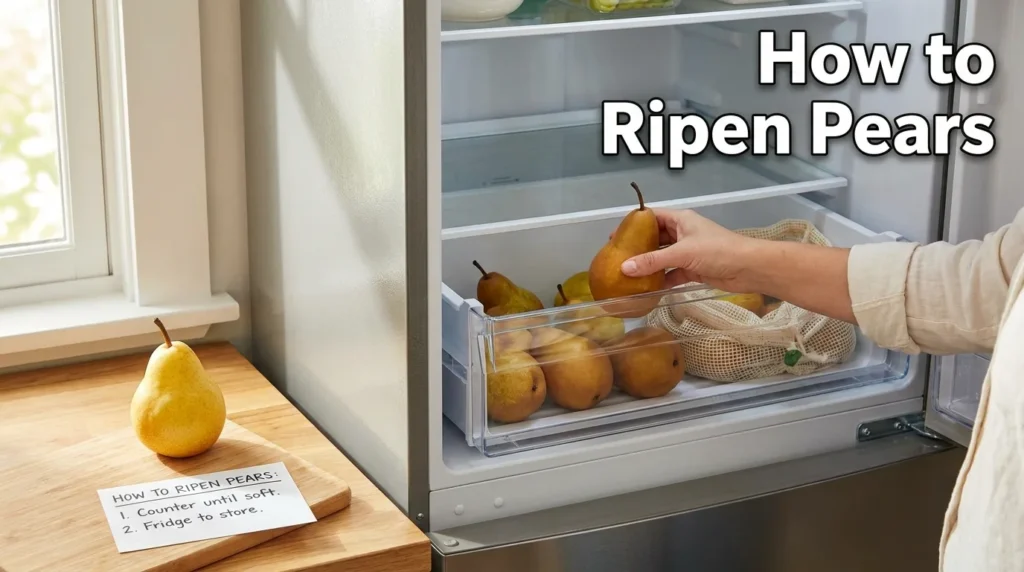
Once pears reach the ripeness you want, refrigeration is the easiest way to slow further ripening.
Keep ripe pears refrigerated and use them while they remain in good condition. USA Pears recommends using refrigerated ripe pears within roughly 3–5 days for best quality.
Don’t wash the entire batch long before you intend to eat it. Washing and excess surface moisture can make storage more difficult. Wash the pear when you’re ready to eat or use it, and dry it if necessary.
How to Ripen Pears Without a Paper Bag
You don’t actually need a special ripening setup.
The simplest approach is:
- Leave firm pears at room temperature.
- Keep them away from excessive heat and direct sunlight.
- Check the neck every day.
- Eat them when the neck gives slightly.
- Refrigerate ripe pears that you aren’t ready to eat.
The paper-bag method is simply an acceleration option.
Can You Put All Your Pears in One Bag?
You can, but there’s a practical reason to check them individually.
If one pear ripens before the others, leaving it in the bag can make the group harder to manage. Check the fruit daily and remove pears as they become ready.
Also inspect the fruit for damage or deterioration. One spoiled piece of fruit shouldn’t be left sitting with the rest of the batch.
Common Pear-Ripening Mistakes
Waiting for the whole pear to become soft
The neck should generally soften first. A completely soft pear may already be past its ideal eating stage.
Waiting for every variety to turn yellow
This works better for Bartlett than for varieties such as Anjou or Bosc.
Putting unripe pears straight into the refrigerator
Cold storage slows ripening, so this works against your immediate goal.
Using heat as a shortcut
An oven or microwave can heat or soften fruit but doesn’t replicate natural ripening.
Squeezing the pear repeatedly
Frequent pressure can bruise the fruit. Use one gentle neck check rather than repeatedly squeezing the same spot.
Leaving ripe pears on the counter for too long
Once they reach the texture you want, refrigerate them if you’re not going to eat them soon.
Frequently Asked Questions
How do you ripen pears quickly?
Put firm pears in a brown paper bag at room temperature. Adding one ripe banana or apple can increase the ethylene around them and may speed ripening further.
How many days does it take to ripen a pear?
It varies by variety and starting condition. Many supermarket pears take several days, while some may take around a week or longer. Use the neck test rather than relying on an exact day count.
Should pears be hard or soft when ripe?
For most European pears, the neck should have a slight give when ripe. The entire pear should not be mushy.
Do pears ripen faster next to bananas?
They can. Both bananas and pears release ethylene, so placing a ripe banana with firm pears in a paper bag can increase exposure to the ripening hormone.
Can you ripen a pear after cutting it?
Cutting the pear doesn’t provide the same controlled ripening process as leaving the whole fruit intact. If you have already cut an unripe pear, it is generally better to use it in a cooked preparation or another recipe rather than expecting it to develop the same texture as a naturally ripened whole pear.
Why are my pears hard but brown inside?
Internal browning can result from storage-related physiological problems and doesn’t necessarily mean the pear simply needs more time to ripen. Cut the pear open and inspect its flesh. If the interior is extensively brown, watery, unpleasant-smelling, or otherwise deteriorated, don’t treat additional counter time as a solution.
Can you eat an unripe pear?
Yes. A firm pear can be eaten, especially if you prefer a crisp texture, although a European pear that has not finished ripening may not have its characteristic soft, juicy texture and full flavor.
What is the fastest natural way to ripen pears?
A paper bag at room temperature, optionally with a ripe banana or apple, is a practical way to accelerate natural ripening. There is no reliable method that instantly turns a very immature pear into a fully ripe one.
Conclusion
For most store-bought European pears, room temperature plus patience is the foundation, while a brown paper bag can accelerate the process when needed. Check the neck just below the stem rather than waiting for the whole pear to become soft or relying entirely on skin color.
Once the neck gives slightly, move the pear to the refrigerator if you’re not ready to eat it and check the remaining pears individually as they continue to ripen.
