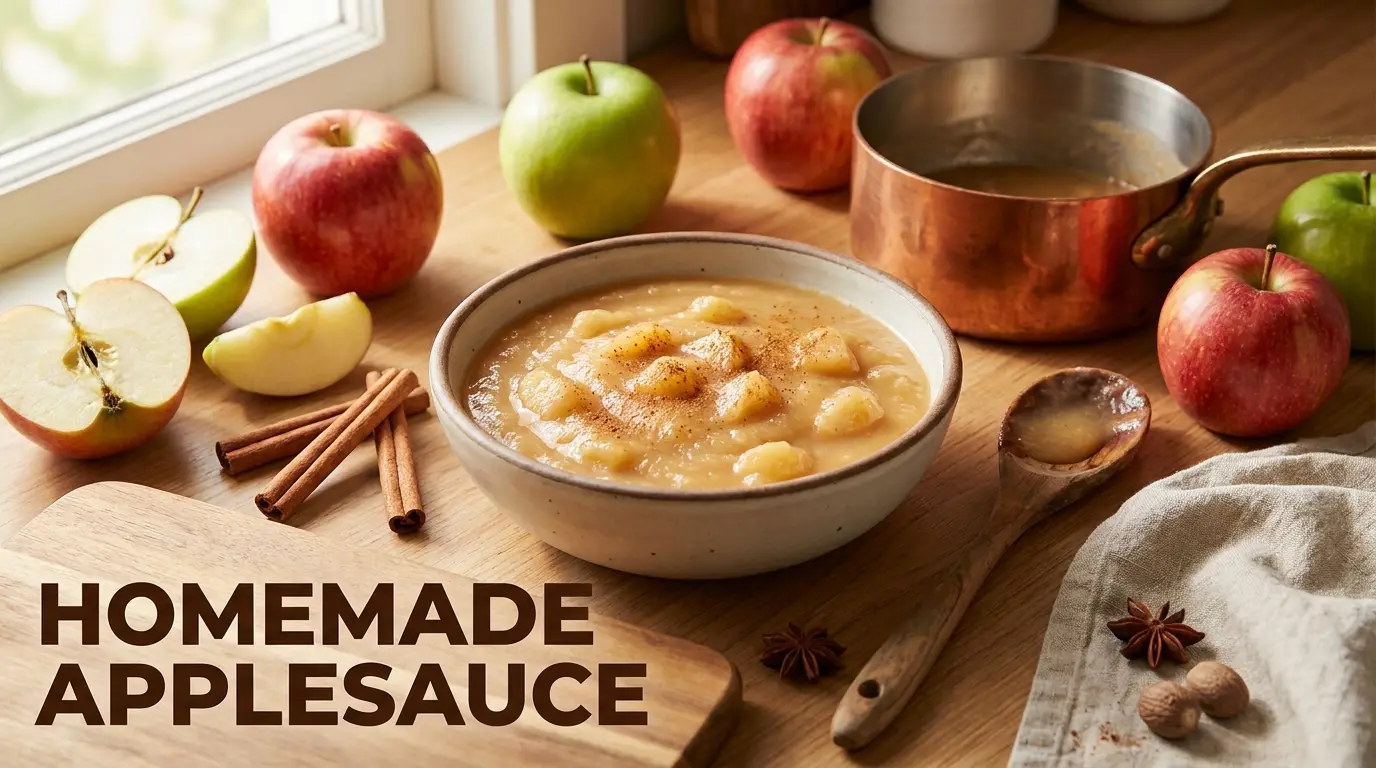
Homemade applesauce is simple: cook peeled, cored apples with a small amount of water until very soft, then mash or blend them to your preferred texture. A mixture of sweet and tart apples gives balanced flavor, and sugar is optional. On the stovetop, the apples generally become sauce-ready in about 15–30 minutes, depending on the variety and size of the pieces.
What You’ll Need
Makes: about 4 cups
Prep time: 10–15 minutes
Cook time: about 15–30 minutes
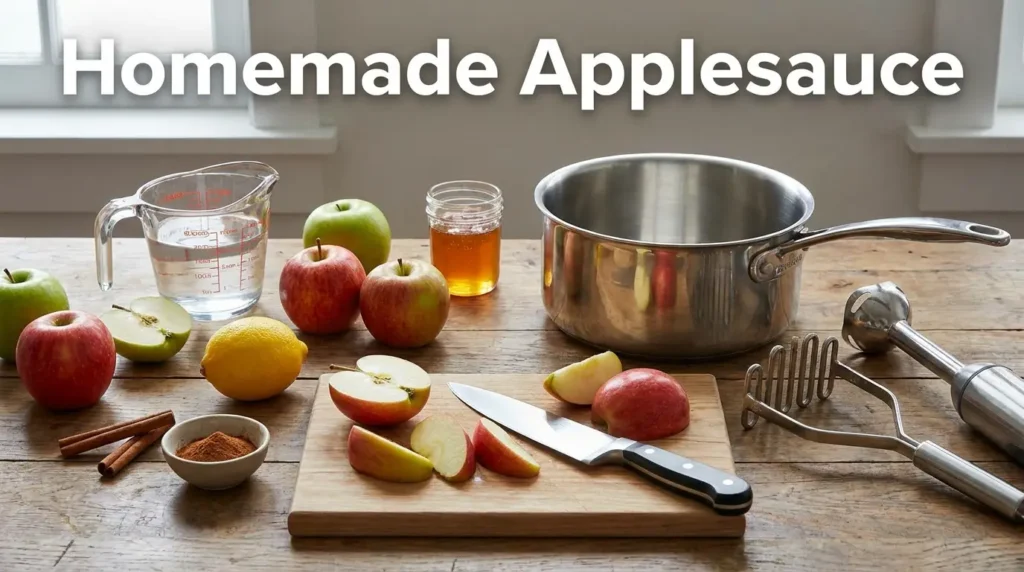
Equipment: large saucepan or Dutch oven, knife, cutting board, potato masher or immersion blender
Ingredients
- 3 pounds apples, preferably a mixture of sweet and tart varieties
- ½ cup water, plus a little more if needed
- 1 tablespoon lemon juice, optional
- Cinnamon, optional, to taste
- Sugar, maple syrup, or honey, optional, to taste
You do not need sugar to make applesauce. The amount needed depends heavily on the apples you use. Penn State Extension recommends combining sweet apples with tart apples for a balanced sauce, while the National Center for Home Food Preservation notes that applesauce can be made without added sugar.
Which Apples Are Best for Applesauce?
You can make applesauce from many varieties, but the flavor and texture will change.
Good choices include:
- Golden Delicious: naturally sweet and cooks well
- Gala: sweet and juicy
- Fuji: very sweet
- McIntosh: sweet-tart and breaks down readily during cooking
- Granny Smith: distinctly tart and useful for balancing sweeter apples
- Honeycrisp: sweet and juicy
- Braeburn: sweet-tart and suitable for cooking
- Jonathan: good for cooking and sauce
A blend is often more useful than relying on one variety. Penn State Extension suggests using 1–2 pounds of tart apples for every 3 pounds of sweeter apples when you want a noticeably tart flavor.
1. Wash, Peel, Core, and Cut the Apples
Wash the apples, then peel and remove the cores. Cut them into roughly 1-inch pieces so they cook at a similar rate.
You can leave the apples unpeeled if you plan to process the cooked fruit through a food mill, but peeling them first makes the process simpler when using a masher or immersion blender.
If you’re cutting the apples ahead of time, they can begin to brown. This is mostly a quality issue rather than a sign that the apples have spoiled. If needed, keep the cut pieces briefly in water with a little lemon juice or ascorbic acid, then drain them before cooking. Extension guidance specifically recommends ascorbic acid solutions for preventing discoloration when preparing apples for preservation.
Avoid: leaving cut apples soaking for a long time. You want to prevent browning without unnecessarily waterlogging the fruit.
2. Start the Apples With a Little Water
Put the prepared apples into a large, heavy saucepan and add ½ cup water for about 3 pounds of apples.
The water is not meant to cover the apples. Its main purpose is to provide enough moisture to prevent the fruit from sticking or scorching while the apples begin releasing their own juices. The National Center for Home Food Preservation and Penn State both use about ½ cup water as a starting point for larger quantities of apples.
Cover the pan and bring the mixture to a simmer over medium to medium-high heat.
Once it begins simmering, reduce the heat to maintain a gentle simmer.
Stir occasionally, especially during the beginning of cooking, and scrape the bottom if necessary.
How much water should you use?
Use less rather than more.
Juicy apples can release plenty of liquid as they cook. If you add too much water at the beginning, you may end up with thin applesauce that needs additional cooking.
If the pan looks dry before the apples soften, add another small splash of water.
3. Cook Until the Apples Are Completely Soft
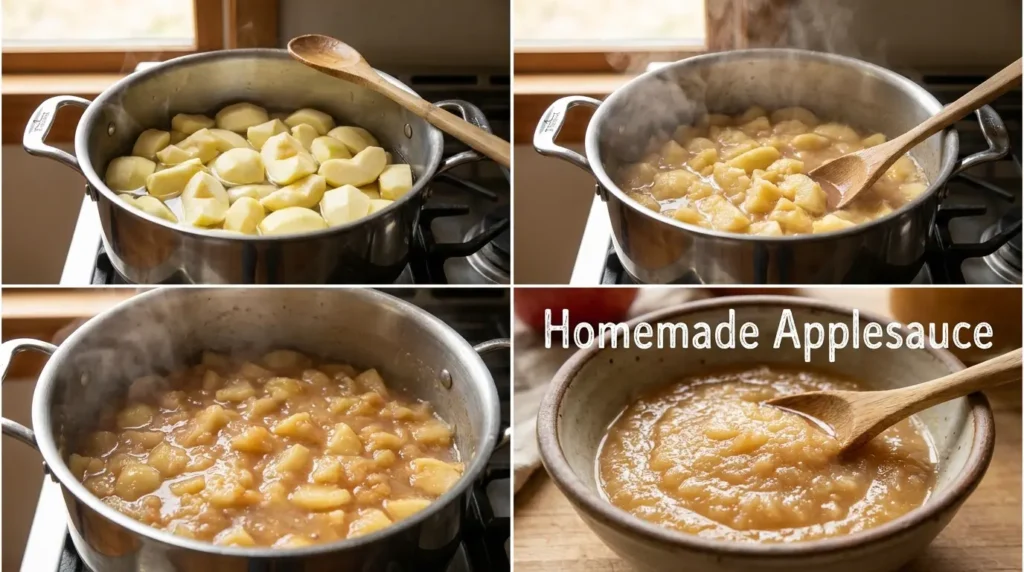
Cook the apples, covered, until they are soft enough to mash easily.
This usually takes around 15–30 minutes, although the exact time varies with the apple variety, maturity, and size of the pieces. Extension guidance gives cooking ranges from about 5–20 minutes for some apples, while recipe sources commonly use around 15–30 minutes.
Don’t use the clock as your only test.
The real doneness test
Take a piece of apple and press it with a fork.
It should:
- collapse easily
- have no firm or crunchy center
- mash with very little resistance
- look soft and cooked through
If the apples still resist the fork, keep simmering them and check again after a few minutes.
The goal is not merely to make the apples warm. They need to become soft enough to turn into sauce without leaving hard pieces behind.
4. Choose Chunky or Smooth Applesauce
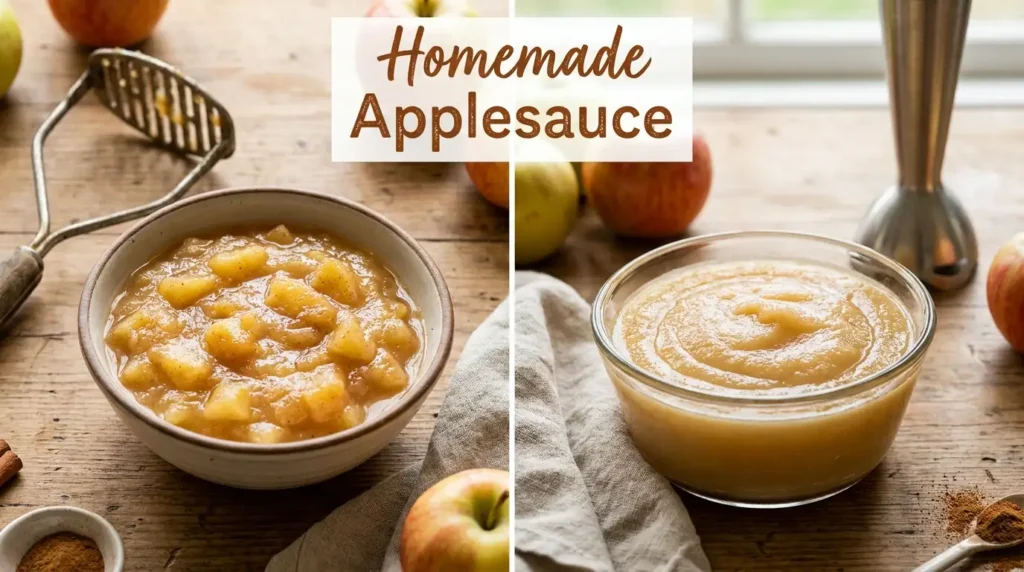
Once the apples are tender, remove the pan from the heat and decide what texture you want.
For chunky applesauce
Use a potato masher or fork and mash the apples directly in the pan.
Stop when you still have some small pieces of apple remaining.
This is the easiest method and gives you control over the final texture.
For smooth applesauce
Use an immersion blender directly in the saucepan and blend until the sauce reaches the consistency you like.
You can also use a food mill or sieve.
A food mill is particularly useful if you cooked the apples with their skins and want to separate the skins and seeds from the sauce. For ordinary stovetop applesauce made with peeled, cored apples, an immersion blender is usually more convenient.
Texture tip: don’t automatically blend until completely smooth. Stop as soon as the sauce reaches the consistency you want. You can always blend more, but you cannot easily turn completely pureed applesauce back into chunky sauce.
5. Adjust the Flavor While It’s Warm
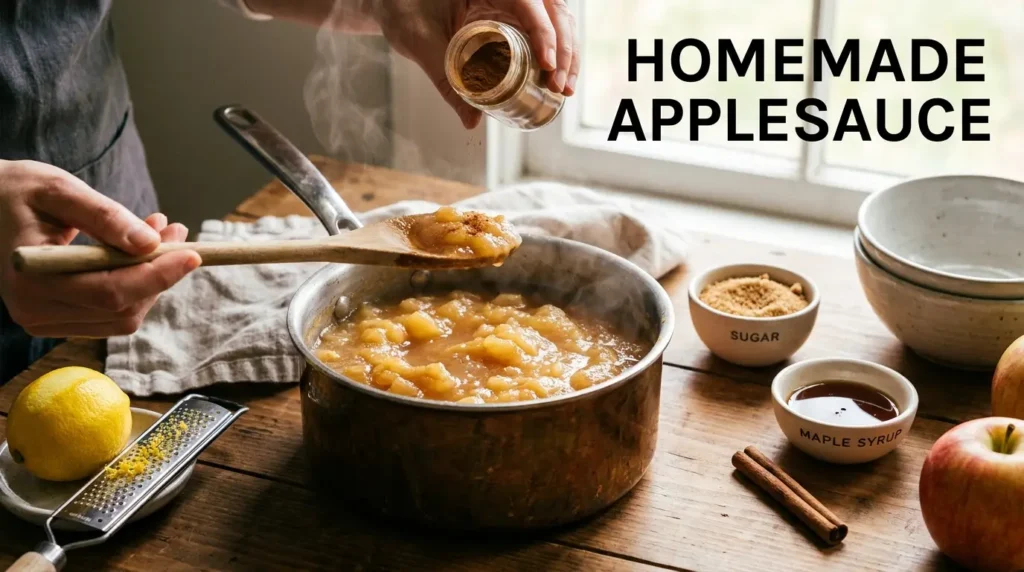
Taste the applesauce before adding anything.
This is important because apples differ dramatically in sweetness and acidity.
If it tastes too tart
Add a small amount of sugar, maple syrup, or honey and stir well.
Start with a little, taste again, and continue only if necessary.
If it tastes too sweet
A small amount of lemon juice can provide acidity and make the flavor taste brighter.
If the apple flavor needs more brightness
Add lemon juice gradually.
If you want cinnamon applesauce
Stir in ground cinnamon to taste.
You can also add a small amount of nutmeg, but keep the spices restrained if you want the apple flavor to remain dominant.
There is no requirement to sweeten or heavily season homemade applesauce. Sugar is primarily for flavor rather than for making the sauce itself.
6. Let It Cool and Serve
Homemade applesauce can be served warm, chilled, or at room temperature.
For warm applesauce, spoon it directly into bowls once it reaches a comfortable serving temperature.
For chilled applesauce, transfer it to a container and refrigerate it.
The sauce will generally feel thicker once chilled, so don’t judge the final consistency entirely while it is piping hot.
Homemade applesauce also works beyond a simple side dish. Serve it with:
- oatmeal
- pancakes
- waffles
- yogurt
- pork
- roasted meats
- toast
- baked goods
- granola
Its mild sweetness also makes it useful as an ingredient in baking.
How to Make Applesauce Without Sugar
You can make applesauce with no added sugar at all.
Start with naturally sweet apples such as Gala, Fuji, Golden Delicious, or another sweet variety. Add a tart apple such as Granny Smith if you want more acidity and complexity.
Cook the apples with water until completely soft, then mash or puree them.
Taste before deciding whether anything else is needed.
If the finished sauce tastes good without sweetener, leave it that way. The apples provide the sweetness naturally, and authoritative home-preservation guidance confirms that applesauce can be packed without added sugar.
How to Make Chunky Homemade Applesauce
For chunky applesauce, the cooking method matters less than what you do afterward.
Cut the apples into moderately sized pieces rather than tiny dice. Cook them until tender but not completely disintegrated, then mash them gently with a potato masher.
Leave some visible pieces.
You can also mix apple varieties with different cooking characteristics. Some apples break down quickly while others hold more texture, which can give the finished sauce a more varied consistency. McIntosh, for example, breaks down readily when cooked and is especially suited to sauce.
If you want a sauce with obvious apple pieces, avoid aggressive blending.
How to Make Smooth Applesauce
For very smooth applesauce, cook the apples until they are completely soft rather than stopping as soon as they are merely fork-tender.
Then puree them with an immersion blender.
If you want an especially refined texture, push the cooked apples through a food mill or fine sieve.
For a regular homemade batch, however, an immersion blender is usually enough.
If the sauce is too thick
Stir in a tablespoon or two of water or apple juice at a time until you reach the desired consistency.
If the sauce is too thin
Return it to the saucepan and simmer uncovered, stirring frequently, until some of the excess liquid evaporates.
Don’t add large amounts of water at the beginning simply because the pan looks dry. Apples release their own juice as they soften.
Can You Make Applesauce With the Apple Peel On?
Yes, but the method changes.
You can cook apples with their skins on and then pass the softened fruit through a food mill or sieve to separate the skins and seeds.
This is a practical approach when you’re preparing a large quantity.
For a small everyday batch, peeling and coring the apples first is easier if you intend to use a potato masher or immersion blender.
For home preservation, Penn State Extension specifically describes using a food mill or sieve for smooth sauce and notes that avoiding high-air-incorporation equipment is useful when preparing applesauce for canning.
Can You Make Applesauce in a Blender?
You can use a blender to puree cooked apples, but be careful with hot food.
Never fill a blender container completely with hot applesauce. Hot contents can generate steam and force the lid upward.
Let the mixture cool somewhat, use a small batch, and follow the blender manufacturer’s instructions for hot foods.
An immersion blender avoids transferring hot applesauce between containers and makes small batches particularly convenient. Food Network’s tested recipe also gives precautions for blending hot apples, including allowing them to cool briefly and filling the blender no more than halfway.
For everyday homemade applesauce, there is usually no need to make the process more complicated than necessary.
Alternative Method: Oven Applesauce
The stovetop is the simplest option for most batches, but the oven can be useful when you want a more hands-off method.
Ina Garten’s applesauce, for example, combines apples and flavorings in a covered Dutch oven and cooks them at 350°F (175°C) for about 1½ hours, until the apples are completely soft.
The practical difference is control.
Stovetop: faster and easier to monitor liquid and texture.
Oven: longer cooking but less need to stand over the pan.
For a quick homemade batch, there is little reason to choose the longer oven method unless you specifically prefer its style of cooking.
Troubleshooting Homemade Applesauce
Applesauce is too watery → Too much liquid
Apples naturally release water during cooking, and different varieties contain different amounts of juice.
Solution: simmer the sauce uncovered over low to medium-low heat, stirring frequently, until enough liquid evaporates to give you the consistency you want.
Don’t add thickeners such as flour or cornstarch. Applesauce should thicken naturally as excess water cooks away.
Applesauce is too thick → Not enough liquid
If the cooked apples are difficult to mash or the sauce is unusually dense, add a small amount of water or apple juice.
Add it gradually rather than pouring in a large amount.
Solution: stir in one or two tablespoons at a time until the texture is right.
Applesauce tastes bland → Apples lacked contrast
A sauce made entirely from mild sweet apples can taste one-dimensional.
Solution: add a little lemon juice for acidity, or combine sweet apples with tart varieties the next time you make it. A blend of apple varieties is specifically recommended by extension sources for good flavor.
Applesauce turned brown → Oxidation
Cut apples naturally darken when exposed to air.
Solution: cook the apples promptly after cutting, or briefly hold them in water containing lemon juice or ascorbic acid if you need to delay cooking. Browning can also be reduced through proper cooking and minimizing unnecessary exposure to air.
Brown color by itself does not necessarily mean the applesauce has spoiled.
How to Store Homemade Applesauce
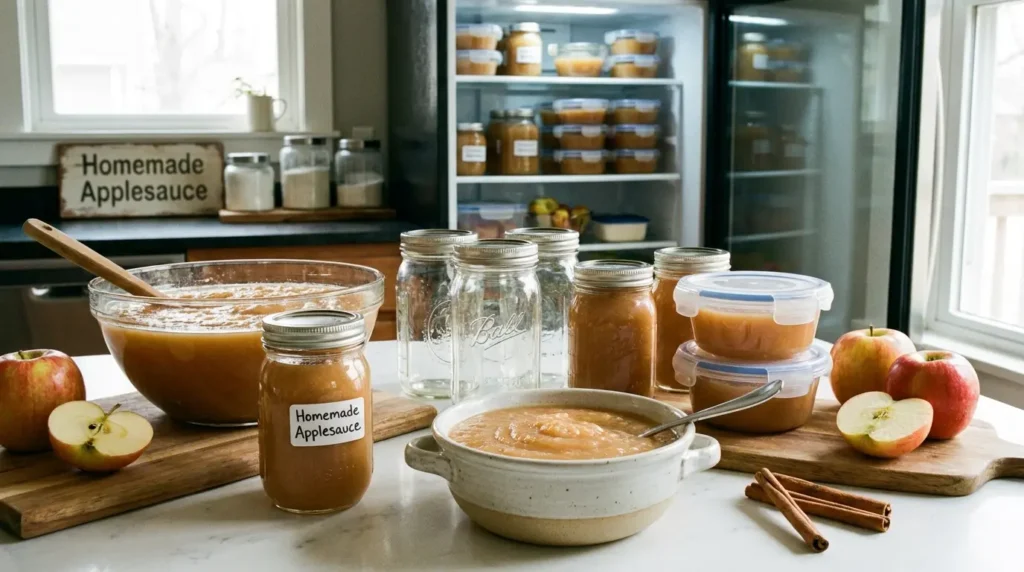
Transfer leftover applesauce to a clean, covered container and refrigerate it promptly.
For food safety, refrigerate cooked food within 2 hours, or within 1 hour when the surrounding temperature is above 90°F (32°C). FoodSafety.gov recommends keeping refrigerators at 40°F (4°C) or below and using refrigerated leftovers within about 3–4 days.
For the best practical approach:
- Let the sauce stop steaming heavily.
- Divide a large batch into smaller, shallow containers if necessary.
- Cover and refrigerate promptly.
- Use refrigerated leftovers within 3–4 days.
If you know you won’t eat the sauce within that period, freeze it instead.
Can You Freeze Homemade Applesauce?
Yes. Applesauce freezes well when packed properly.
Penn State Extension recommends cooling the sauce quickly, transferring it to suitable freezer containers, allowing room for expansion, and thawing it in the refrigerator.
For convenient portions, freeze applesauce in:
- small freezer containers
- freezer-safe jars with appropriate headspace
- silicone portions or freezer trays, then transfer the frozen portions to a freezer bag
Leave expansion space rather than filling a container completely.
Penn State’s preservation guidance suggests ½ inch of headspace for pints and 1 inch for quarts when freezing applesauce.
For best quality, Penn State lists about 8–10 months as a suggested storage period for frozen applesauce.
Thaw it in the refrigerator before serving.
How to Can Homemade Applesauce
If you want shelf-stable applesauce, use a tested home-canning procedure rather than simply putting hot sauce into jars and sealing them.
The National Center for Home Food Preservation recommends preparing the applesauce, reheating it to boiling, filling hot jars while leaving the specified headspace, and processing the jars in a boiling-water canner or appropriate pressure-canning setup according to the tested times for the jar size and elevation.
For a boiling-water canner, the NCHFP procedure specifies:
| Jar | 0–1,000 ft | 1,001–3,000 ft | 3,001–6,000 ft | Above 6,000 ft |
| Pints | 15 min | 20 min | 20 min | 25 min |
| Quarts | 20 min | 25 min | 30 min | 35 min |
These processing times are for the tested applesauce canning procedure and vary by elevation.
Do not use an improvised open-kettle hot-fill method for shelf-stable applesauce. Penn State Extension specifically states that open-kettle canning is no longer recommended and recommends processing applesauce in a boiling-water or atmospheric steam canner.
If you are only making a small batch for the refrigerator or freezer, skip canning entirely.
Frequently Asked Questions
Do I have to peel apples for applesauce?
No. You can cook apples with their skins and then use a food mill or sieve to separate the skins and seeds. For a small batch, peeling first is usually easier if you plan to mash or blend the sauce.
How many apples do I need for applesauce?
As a practical starting point, use about 3 pounds of apples for roughly 4 cups of finished sauce, although the yield varies with the apple variety, cooking time, and desired thickness. For canning quantities, NCHFP estimates about 3 pounds of apples per quart of sauce.
Why is my homemade applesauce not sweet?
The apple varieties may simply be tart or less naturally sweet. Taste the finished sauce and add sugar, maple syrup, or another sweetener gradually if desired. Next time, use more naturally sweet apples or combine sweet and tart varieties.
Can I make applesauce without lemon juice?
Yes. Lemon juice is optional for an everyday refrigerated or frozen batch. It can brighten the flavor and help with color, but you do not need it simply to turn cooked apples into applesauce.
For canning, follow the tested preservation recipe rather than adding or removing acidic ingredients based on an improvised recipe.
Why is my applesauce too watery?
Usually, there is simply too much liquid relative to the apples. Simmer the sauce uncovered until some of the water evaporates. The exact amount of liquid needed varies because different apples have different levels of juiciness.
Can I leave applesauce chunky?
Absolutely. Mash the cooked apples lightly with a potato masher instead of blending them. Chunky and smooth applesauce are both normal preparations.
How long does homemade applesauce last in the refrigerator?
For food-safety purposes, treat homemade applesauce as a cooked leftover and use it within 3–4 days when refrigerated at 40°F (4°C) or below.
Can I freeze applesauce?
Yes. Cool it promptly, place it in freezer-safe containers with room for expansion, and thaw it in the refrigerator.
Conclusion
The easiest homemade applesauce starts with flavorful apples, a small amount of water, and gentle cooking until every piece is soft enough to mash. For the most balanced flavor, combine sweet and tart apples, then adjust the lemon juice, cinnamon, and sweetener only after tasting the finished sauce. Refrigerate what you’ll eat within a few days and freeze the rest for longer storage.
