Quick Answer
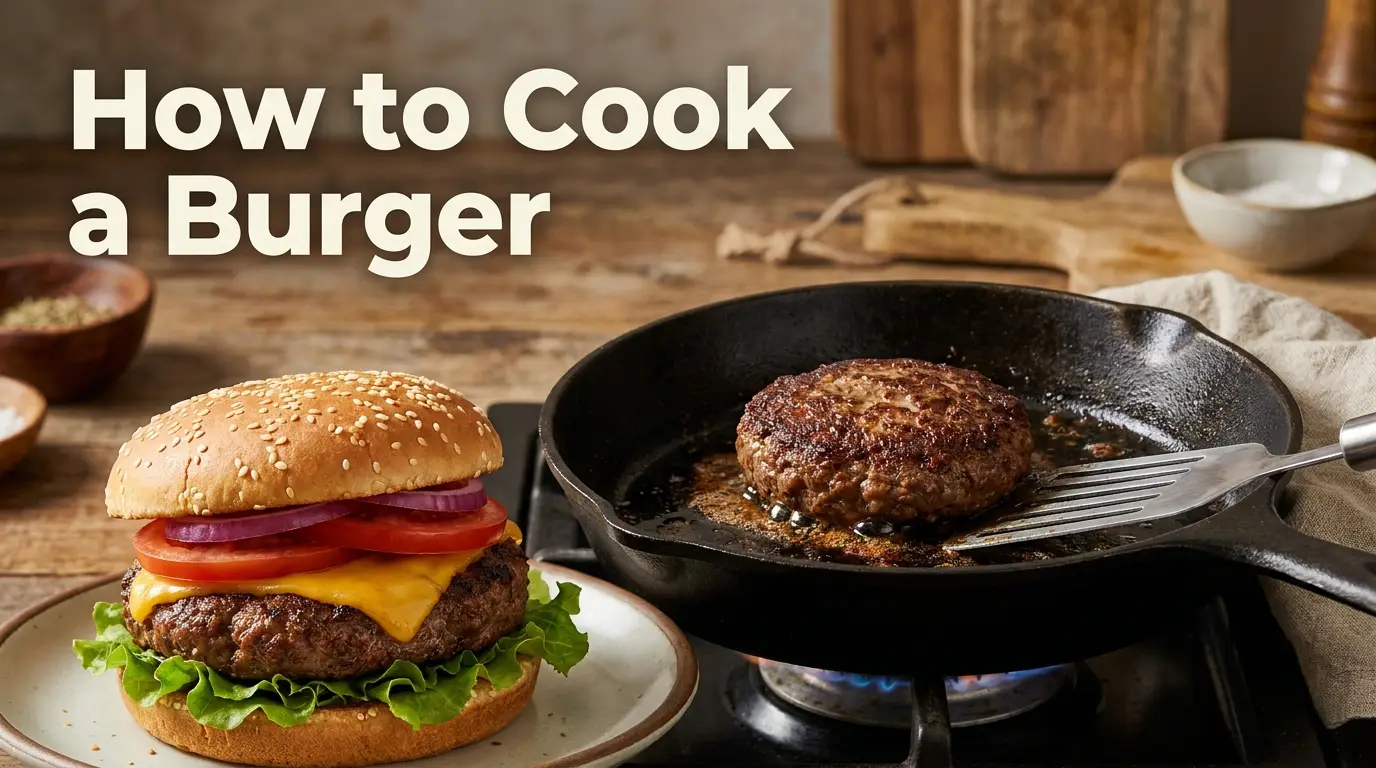
For an easy homemade beef burger, shape ground beef into loose patties about ¾ inch thick, season the outside, and cook them in a hot skillet over medium-high heat. A burger of this size commonly takes roughly 6–10 minutes total, but cooking time changes with thickness and heat, so use time only as a guide. For food safety, cook ground beef burgers to 160°F (71°C) internally, checking the center with an instant-read thermometer rather than relying on color.
What You Need to Cook a Burger
This basic method makes 4 burgers.
Ingredients
- 1½ pounds ground beef, preferably around 80% lean and 20% fat
- 1–1½ teaspoons kosher salt
- ½ teaspoon freshly ground black pepper
- 1 teaspoon neutral cooking oil, only if your skillet needs it
- 4 hamburger buns
- 4 slices cheese, optional
- Lettuce, tomato, onion, pickles, or other toppings
- Ketchup, mustard, mayonnaise, or your preferred sauce
The 80/20 ratio is a practical cooking preference rather than a safety requirement. A little more fat generally makes the finished burger richer and more forgiving if it cooks slightly longer than planned.
Equipment
You need:
- A heavy skillet or griddle
- A thin, sturdy spatula
- An instant-read food thermometer
- A plate for cooked burgers
- A toaster, skillet, or grill for warming the buns
A heavy skillet, particularly cast iron or another thick-bottomed pan, is useful because it retains heat well and provides a broad surface for browning.
1. Shape the Burger Patties
Divide the beef into four equal portions. For substantial burgers, aim for roughly 6 ounces each and form them into patties around ¾ inch thick.
Handle the meat gently. Press it together just enough for the patty to hold its shape, then flatten it evenly with your fingertips. Make the patties slightly wider than the buns because ground beef contracts during cooking. USDA notes that shrinkage varies with the meat’s fat and moisture content, cooking temperature, and cooking time.
For grilled burgers, a shallow indentation in the center can help counter the tendency of the patty to dome as it cooks. Don’t make a deep hole; a light depression is enough.
Avoid kneading the ground beef repeatedly. Overworking it can produce a dense texture rather than the loose, tender bite associated with a good burger.
Season the patties on both sides shortly before cooking. Salt draws attention to the beef’s flavor, while pepper adds a simple savory bite. More elaborate seasoning mixes are optional because they can change the character of the burger.
What to look for: The patties should be evenly thick, compact enough to stay together, but not tightly compressed.
Common mistake: Making a perfectly round, tightly packed meatball and then flattening it aggressively. This can leave the burger dense and heavy.
2. Heat the Cooking Surface Properly
Place a heavy skillet over medium-high heat and let it heat thoroughly before adding the patties.
You want a hot surface that immediately begins browning the beef rather than slowly warming it. Bon Appétit’s current stovetop burger guidance emphasizes a hot pan and leaving the burger undisturbed long enough to form a deep brown crust.
Add a small amount of neutral oil if the pan requires it. A well-seasoned cast-iron skillet and a reasonably fatty ground beef mixture may need little or no additional oil.
Don’t overcrowd the pan. Give each patty enough room to contact the hot surface without touching another burger. Too much food in the pan can reduce browning and encourage steaming; using a large, heavy skillet also helps maintain heat.
Before cooking, prepare everything else within reach: the spatula, thermometer, cheese, toasted buns, plate, and toppings. Burgers cook quickly once the crust develops.
What to look for: When a drop of moisture hits the pan, it should sizzle rather than sit quietly. The surface should be thoroughly hot before the meat goes in.
Common mistake: Starting in a barely warm pan. The burger can release moisture before a good crust forms.
3. Cook the First Side Without Moving the Burger
Place the patties in the hot skillet, leaving space between them. Let them cook without repeatedly sliding, lifting, or pressing them.
For a burger around ¾ inch thick, begin checking the first side after about 3–5 minutes. Larger or thicker patties may require longer. Published cooking times vary because burger weight, thickness, pan material, burner strength, and starting temperature all affect how quickly the center cooks. Bon Appétit, for example, gives approximately 5 minutes for the first side of a 5-ounce patty over medium-high heat, with the second side taking additional time depending on the desired doneness.
You are looking for a strongly browned surface. The burger should also release relatively easily when you slide a thin spatula underneath it.
Do not press the patty down with the spatula. Pressing is often tempting because it produces a dramatic sizzle, but it can force rendered fat and juices out onto the pan rather than keeping them in the burger. Food Network’s current grilling guidance similarly recommends resisting the urge to press the patties.
What to look for: A deeply browned crust and a patty that can be lifted without the surface tearing apart.
Common mistake: Flipping repeatedly before the crust has formed. Give the first side enough uninterrupted contact with the pan.
4. Flip and Finish Cooking
Slide the spatula underneath the burger and turn it over in one controlled movement.
Cook the second side for another few minutes, adjusting the time according to the patty’s thickness and how quickly your cooking surface is working. Instead of treating a timer as the final authority, begin checking the internal temperature once the burger looks well browned on both sides.
For ground beef, the USDA recommends a minimum internal temperature of 160°F (71.1°C). Insert the thermometer into the center of the burger. With thin patties, inserting the probe from the side can make it easier to reach the center accurately. Color is not a reliable safety test because ground beef can brown before reaching a safe temperature.
This is important when cooking burgers because their appearance can be misleading. A brown center does not by itself prove that the burger has reached a safe temperature.
Once the center reaches 160°F, transfer the burger from the heat.
What to look for: A browned crust on both sides and an internal temperature of at least 160°F in the center.
Common mistake: Cutting the burger open to check whether it looks done. This loses more juices and still does not provide the same reliable safety check as a thermometer.
5. Add Cheese and Finish the Burger
For a cheeseburger, place the cheese on the patty during the final minute or two of cooking. Covering the skillet briefly can help it melt quickly.
American, cheddar, Swiss, provolone, pepper Jack, and similar cheeses all work. The choice is primarily a matter of taste.
While the cheese melts, toast the buns. Place them cut-side down in a clean skillet, toaster, or on the grill until the interiors are lightly browned.
Toasted buns do more than add flavor. Their firmer surface helps them stand up to hot beef, sauces, and juicy toppings without immediately becoming soggy.
Once the burger reaches the safe temperature, move it to the prepared bun and add toppings immediately.
A simple order is sauce on the bun, lettuce or another relatively dry layer, the burger, cheese, tomato or onion, pickles, and another small amount of sauce. You don’t need to follow a fixed arrangement; the goal is to balance moisture, crunch, acidity, and richness.
What to look for: The cheese should be softened or fully melted, and the cut sides of the buns should have light browning.
Common mistake: Leaving the cooked burger sitting in the hot pan while preparing toppings. This can continue cooking it and make the texture drier.
How Long Does It Take to Cook a Burger?
There is no single cooking time that works for every burger. Thickness, weight, cooking method, pan material, heat level, and the temperature of the meat all change the result.
As a practical guide for a roughly ¾- to 1-inch beef patty:
| Method | Approximate cooking time | Temperature check |
|---|---|---|
| Skillet | About 6–10 minutes total | 160°F |
| Grill | About 8–12 minutes total | 160°F |
| Oven | About 15–20 minutes | 160°F |
These are starting ranges, not guarantees. For example, current stovetop guidance from Bon Appétit puts many 5-ounce burgers in the roughly 5–10 minute total range, while oven recipes commonly take around 15–17 minutes depending on the oven and patty.
For burgers, the most reliable combination is a time range plus an internal temperature check. Don’t extend or shorten cooking simply to match a number on a recipe if your burger has not reached the safe temperature.
How to Cook a Burger on the Grill
Grilling is useful when you want more direct-heat flavor and don’t want grease splattering around the kitchen.
Heat a gas or charcoal grill to a medium-high cooking temperature. Clean the grates and lightly oil them if appropriate for your grill. Place the seasoned patties over direct heat and let them cook without pressing.
Depending on their size and your grill, burgers may need around 4–6 minutes on the first side before they are ready to turn. Food Network recommends flipping when the burger releases from the grate more easily and has developed browning.
Flip once, continue cooking, and check the center with a thermometer. Ground beef burgers should reach 160°F. USDA specifically warns against relying on exterior browning when grilling because meat can brown rapidly before reaching a safe internal temperature.
For cheese, add it during the final minute or so and close the grill briefly to help it melt.
Grill Tip for Better Results
Don’t keep lifting the lid or turning the burgers unnecessarily. Every unnecessary opening changes the cooking environment, while excessive handling can interfere with the crust.
Never partially cook burgers and refrigerate them with the intention of finishing them later. USDA advises against partially cooking ground beef for later completion because harmful bacteria can survive the partial cooking process.
How to Cook a Burger in the Oven
The oven is convenient when you need to cook several burgers with less direct attention.
Heat the oven to about 400°F and arrange the patties on a suitable baking sheet or rack. An elevated rack can allow hot air to circulate around the patties, while a lined sheet makes cleanup easier.
Bake until the burgers reach 160°F internally. Depending on patty thickness, oven performance, and the cooking surface, this can take roughly 15–20 minutes. A current oven-burger recipe from The Kitchn lists approximately 15–17 minutes for its method, but the thermometer should determine when your burgers are finished rather than the clock alone.
The oven generally produces less aggressive surface browning than a very hot skillet. You can compensate by using a hot cooking surface or briefly finishing the burgers under a broiler, provided you watch them closely.
Troubleshooting Burger Problems
Burger is dry → Likely cause: Overcooking
Cooking beyond what the burger needs can drive out more fat and juices. USDA notes that overcooking ground beef results in greater loss of fat and juices and can produce a drier, less tasty result.
Solution: Use the thermometer rather than adding several extra minutes “just to be safe.” Once the center reaches 160°F, remove the burger from the heat.
Burger is falling apart → Likely cause: Patties are too loose
If the beef is barely holding together, the patty may crack when you turn it.
Solution: Compress the meat just enough to form a cohesive patty, but avoid aggressively kneading it. Make the thickness reasonably even so the burger cooks consistently.
Burger has little crust → Likely cause: Cooking surface isn’t hot enough
A cool pan gives the beef time to release moisture before it develops strong browning.
Solution: Preheat the skillet thoroughly and avoid overcrowding. A heavy pan can help maintain heat when the cold patties are added.
Burger is domed in the middle → Likely cause: The patty is contracting as it cooks
This can make the center noticeably thicker than the edges and create an uneven burger shape.
Solution: Form the patty evenly and, particularly when grilling thicker burgers, press a shallow depression into the center before cooking.
How to Keep a Burger Juicy
Juiciness comes from several small decisions rather than one special ingredient.
Start with ground beef that isn’t excessively lean, handle it gently, and avoid making the patty unnecessarily thin unless you’re intentionally making a diner-style burger. Preheat the cooking surface so the exterior browns efficiently instead of slowly steaming. Don’t press the patty while it cooks, and most importantly, don’t continue cooking far beyond the temperature you actually need.
Season the outside shortly before cooking. Toast the buns while the burgers finish so everything reaches the table together.
A good burger doesn’t need a complicated mixture of breadcrumbs, eggs, sauces, and spices. Those ingredients can make excellent specialty burgers, but a straightforward beef patty gives you a useful baseline for learning how cooking time, thickness, heat, and seasoning affect the result.
Burger Safety You Shouldn’t Skip
Keep raw ground beef refrigerated at 40°F (4.4°C) or below and use or freeze it within 1–2 days if it is refrigerated.
Wash your hands, utensils, counters, and cutting boards after they contact raw meat, and keep raw beef separate from ready-to-eat ingredients. USDA recommends these steps to reduce cross-contamination.
The key cooking rule is simple: ground beef burgers should reach 160°F (71.1°C) as measured with a food thermometer. Don’t use a brown center, clear juices, or a particular cooking time as a substitute for that measurement.
If you have cooked burgers left over, refrigerate them promptly and use them within about 3–4 days. USDA recommends reheating cooked leftovers to 165°F.
Frequently Asked Questions
What is the best way to cook a burger?
The practical choice depends on what you have available and the result you want. A skillet is convenient indoors and gives excellent surface browning, while a grill adds direct-heat character and an oven is useful for hands-off cooking. The objective safety standard remains the same for ground beef: reach 160°F internally.
Should I cook burgers on high or medium heat?
Medium-high heat is a useful starting point for skillet or grill burgers because it provides enough heat for browning without requiring the cooking surface to stay at maximum heat continuously. Adjust the burner or grill as necessary if the exterior is darkening much faster than the center.
Do I need oil to cook a burger?
Not always. A fatty ground beef blend can release enough fat during cooking that additional oil isn’t necessary, particularly in a well-seasoned skillet. If your pan is prone to sticking or you’re using a leaner mixture, a small amount of neutral oil can help.
Should I flip a burger only once?
One deliberate flip is a simple technique that makes it easier to develop a good crust, but the exact number of flips is not a food-safety rule. What matters most is maintaining appropriate heat and cooking the center to the required temperature.
Can I cook a burger from frozen?
Frozen burgers can be cooked, but they generally require more time and make judging the center by appearance even less reliable. Use a thermometer and make sure the center reaches 160°F before serving.
The Main Takeaway
For a dependable homemade burger, focus on three things: form the patty gently, cook it on a properly heated surface without pressing it, and verify 160°F in the center with a thermometer. Start with the skillet method, then adjust thickness, seasoning, cheese, and toppings to create the style of burger you prefer.
